Showing posts with label EU. Show all posts

Thursday, April 14, 2016

Quo Vadis, Poland?

Source: Wikipedia
The Polish Parliament
Poland, the biggest EU state in Central and Eastern Europe, is going through a strong nationalist revival in the last two years, rising many questions and worries about the future of the country within the Union. Poland is the second, after Hungary, to join the new wave of nation-centered politics from the former communist block, but by far the most important from the point of view of the decision making processes within the Union. 
The dramatic changes took place after May 2015 presidential elections, when  Lech Kaczynski won the elections and the Party for Right and Justice (PiS) gained control over the both chambers of the Parliament. Lech's twin brother, Jaroslaw, former prime minister, died in a controversial airplane accident in 2010, together with more than half of the Polish politicaleadership at the time. 
PiS is the first party to govern the country alone since the end of communism, a situation which gives considerable leverage in the internadecision making process. This rule of the unique party comes after the disappointment brought by many of the post-communist coalitions. 

Policy of thought

With 4 out of 10 people living in the countryside and over 90% of the population of Catholic faith, Polish politicians started an aggressive campaign, both on the home and foreign front aimed to reinstate a different leadership. Many observers assume that such a return to identity politics is the consequence of a total and non-critical adhesion to the Western values after the fall of communism.
Kaczynski - and not only - are often building their discourses by blaming the German influence into their media and politics. Cultural happenings that do not comply with the overall directions confirmed through the religious channels are welcomed with protests and threats of outlaw. The public TV and broadcast were purged by bringing people close to the establishment. The Polish leaders categorically refused to accept any refugees. This February, Patrik Jaki, deputy minister for Justice proposed baning the sentence 'Polish death camps' under the threat of a 3-year sentence. And the examples can continue...

Where to?

Poland joined the EU in 2004, and since then the country's economic situation improved permanently. The unemployment was reduced, the highway network extended from 76.5 to 3000 km. The current government made more economic promises too, one of them being to increase the child subsidy to around 129$, an encouragement for extended families too. From the same family register, the authorities seek to completely outlaw abortions and birth control, a decision that rose protests in the country.
The Venice Commission, a legal body in charge with overviewing the constitutional changes within the EU, warned the country that many of the previsioned constitutional changes are contrary to human rights.
As the EU's sixth largest country, Poland is important from a strategical point of view too, for its border with Russia and for its voted and influence on the climate change policy of the Union, as the biggest coal producer in the EU.  
This July, NATO is supposed to have its regular summit in Poland and the current situation worries both sides of the Atlantic.
Within the EU, Poland can be subject to the rule of law mechanism adopted in 2014, leading to the suspension of the voting rights, following successive breaches of the EU Treaty. Kaczynski is trying to play hard the Hungarian card, whose far-right leader Orban he met recently. 
He wants to keep Poland in the EU, but without the euro, dreaming to be, maybe, the UK of the East. Meanwhile, it risks to be more isolated within the democratic partners. On the other side of the border, the man from Kremlin may be just a little bit happier.  

Wednesday, March 30, 2016

EU-Peru Visa Waiver

High representatives of Peru and the EU signed the 14 March in Brussels an agreement for short-stay visa waiver. The agreement, that is applied from March 15 on a provisional basis until voted by the EU Parliament, provides visa free travel for EU citizens when travelling to the territory of Peru and for the citizens of Peru when travelling to the EU territory for a period of 90 days.
The provisions apply for valid ordinary, diplomatic or special passports, for all category of persons on any purpose - tourism, cultural visits, family, business - except for carrying a paid activity. Through this agremeents, both part hope to improve cultural connections, as well as political and economic improvement of the bilateral relations. 
EU is Peru's third trade partner after the US and China, and the largest foreign investor, with a 50% share of the total foreign investments. Between the two parts there are several cooperation programmes ongoing. During the 2007-2013 programe of 135 million Euro, Peru was supported to reduce the children malnutrition in remote and poor areas, to fight against illegal drugs and to create alternative development solutions and encourage ecological trade. During the various elections taking place in Peru, EU deployed Electoral Observation Mission.

Saturday, December 29, 2012

"...we would miss the typical British sense of humour"

There were a couple of information and declarations lately regarding the possibility of an EU withdrawal from the Union. Almost 40 years after the UK was received in the EU, the president of the European Council tries to explain why the British monarchy should continue being part of the Union.

Most probably, we will not see soon an EU without the UK, but on the other hand, the EU as such should be changed and this may be one of the biggest challenges of 2013 for Europe.

Tuesday, August 28, 2012

Poland's challenges

Poland in between worlds, continents and geological challenges. A Stratfor analysis worth to read.

Wednesday, August 8, 2012

EU and Syria

I continue to keep my strong opinion that in the case of Syria, EU was completely out of sight. It could be because EU doesn't matter too much in the area, but also because it did not find any convincing and reliable way to support its opinions. When you do not have any influence and credibility in time of peace, do not expect to find one out of the box during the war. And, as many from the EU are well aware, Syria is in war for more than 12 months.

When it comes to the coercition measures, EU restricted the freedom of movement of top Syrian officials and forbade the exportation of luxury goods to Syria. Also, top EU ladies aired a video appeal to Assad's elegant wife to convince his husband to give up the slaughtering of his own people. 

Today, the European Council decided to impose the right to local authorities the right to inspect vessels and aircrafts bound for Syria, in search of weapons. The Brussels authorities expressed their concern regarding the situation of Syrian refugees, some of them recently returned back from Lebanon. 

Maybe once the war will be over, EU should reconsider its role and strategy regarding not only Syria, but the Middle East in general, and end up by focusing obsessively only on one issue managed disastrously partly for leftist bias, partly for complete lack of sensibility for the subject

Monday, November 1, 2010

Under the threats of terror

The week-end started with the failed terrorist attempt in the US and ended with a suicide attack in Istanbul's populated area of Taksim, wounding 32 persons. The main suspect, the separatist PKK Kurdish party denied any involvement.

In the Yemen case, several investigations are currently under deployment, framing the need of an extensive intelligence share between countries aiming to oppose terrorism, the attack being attributed to Al Qaeda operatives. Al Qaeda suicide bombers carried out a series of attacks in Istanbul in November 2003 that killed 62 people and wounded hundreds. Several Islamist militants were arrested last month. But officials have played down the likelihood of Islamist role.

Turkey is a couple of days ahead the 2010 EU Progress Report and is still trying to find a solution regarding the conflict with Cyprus. The geopolitical ambitions and the temptation to become leader in the Muslim world antagonized the country's foreign relations with former partners in the region. Ankara is showing its full disponibility to enter the EU, pledging Turkey's future role in increasing the potential of the organization.

Friday, March 5, 2010

India, China and the global ambitions

India and China represent for both US and Europe the big challenges. Markets with huge potential and unpredictable but enormous influence, Brussels and Washington are doing their best to win the charms of these two giants.
The latest initiative, supported by UK and Sweden is pledging for an increased diplomatic presence of the EU, as a first step to get a better understanding of the particular contexts of these two countries.
But, if in the case of India, the exposure to the Western institutional system is offering the possibility of a common lecture, in the case of China, the basic understandings of the concepts of power and the military and diplomatic doctrines are still unknown and do not offer an easy key of understanding.
A cross lecture of some considerations of Chinese authors writing about the Chinese-Indian relations, published at the end of the last year by the European Council on Foreign Relations are offering a puzzling image of the bilateral relations between the two countries and the intricate and spontaneous directions these relationships could follow in the near future.
The practical alliances - as it was the case during the WTO negotiations or the joint memorandum on climate change - are surpassed by historical conflicts and different orientations generated during the Cold War. Even at the level of both countries it is felt the need of a relaunch of the trade relations, the strategical interests of the two countries are rather competitive than complementary. The imbalance is reflected as well in the structure of the alliances enforced by both countries - India, for a strategic partnership with US, or China, with a close dialogue with Pakistan. These partnerships are derived by practical reasons as well, both parts being able to have a strict observance of the main agenda.

The end of the two-blocks competitive politics was replaced by a very pragmatical reshaping of the international global strategies. In the case of the countries with such a huge economic and strategic potential, as it is the case of India and China, the question is rather how to understand the necessity of the pragmatic alliances and to be able to predict the outcome and the next steps. The home politics considerations are permanently important and do not help as too much in being accurate in our predictions. And, for our limited Western understanding, China is the big riddle. To be solved - hopefully - in a century or two time.

Monday, February 22, 2010

What to do in the case of Greece? Some lessons learned as well

Since a couple of months already, Greece is facing a debt deficit problem. Greece is an EU member and its problems are directly or indirectly affecting the whole European members of the Union. In the same time, the situation, including from the point of view of the history of the relations between Bruxelles and Athens, is offering lots of warnings regarding the future expansions of the European Union.
Trust?
These relations are concerning the trust between the Hellenic national institutions and the European bodies. The politics of expansions are decided on the basis of various factors: from strong lobby - political, individual, economic - from the part of the candidate countries, from political interests - as it was the case after the end of the Cold War, with so many countries once part of the other side of the Iron Curtain reclaiming their right to be "Europeans", or economic interests. The weights of these interests are varying and are not always very clear.
The final decision for entering the EU is took in accordance with the level of fulfillement of the so-called "Copenhagen Criteria", laid down at the June 1993 European Council in Copenhagen. Shortly, these criteria are requiring to the candidates countries: functional democratic governance, respect of the rule of law, respect for human rights and the protection of minorities, fulfilling the criteria for a functional market economy, legislative alignement with the communitarian legislation. More or less, these criteria are imposing various subjective definitions and, probably, should request careful rephrasing on the basis of recent lessons learned. But, by now, there were the main standards followed in deciding the fate of a candidate.
The annual progress of the candidate countries are evaluated in detailed reports, benchmarks for the local political decision makers. The reports are made in accordance with the information provided by local institutions - in the area of judiciary, or economy - as well as non-governmental association and individuals directly involved in the political processes. The key-word for gaining respect is reliability of the sources. Without reliable and transparent information you cannot build policies and, the degree of openness of various public institutions is an important denominator for the free societies, in comparison with the attitudes encountered in totalitarian states.
As for the member states, the need to respect rules and criteria continue, mainly regarding the economic standards. One of the most important set in this respect are those set by the art. 121 (1) of thee European Community Treaty, the so-called Maastricht criteria of convergence. These regulations are available for the EU member states to enter the third stage of the European Economic and Monetary Union (EMU) and to adopt the euro as their currency. Greece wanted among the first to join the EU, hoping to tranfer the responsibility for some internal problems to the European Central Bank. The candidacy was kept in check for two years, but soon after Greece joined the euro, in 2001, it emerged that the Greek government lied about its deficit.
The EU opened its first investigation into Greece’s deficit in 2004 after a revision of data revealed that, contrary to previous indications, the deficit had exceeded the EU ceiling every year since the country adopted the euro. But, at stake it was a more serious matter, one of national pride: the gap reached a euro-area record 7.5 percent that year was swollen by costs for hosting the Olympic Games in Athens.
To-do-lists
- The inflation rate should be no more than 1.5 percentage points above the rate for the three EU countries with the lowest inflation over the previous year; Budget deficit: This must generally be below 3% of gross domestic product (GDP)
- The national debt should not exceed 60% of GDP, but a country with a higher level of debt can still adopt the euro provided its debt level are falling steadily
- The long-term rate should be no more than two percentage points above the rate in the three EU countries with the lowest inflation over the previous year
- The national currency's exchange rate should have stayed within certain pre-set margins of fluctuation for two years.
But, as the case of Greece already showed, some serious loopholes could be open by the possibility to alternate the responsibility in terms of separation of monetary and fiscal politicies. Greece enjoyed monetary stability - enforced by the strength of the other EU member countries - but lacked completely a coherent fiscal policy. And, again, the matter of trust intervened: Athens authorites lied again about the budget deficit. Added to a national debt of 113 percent of the GDP, a huge lie of a deficit of 4 percent, instead of the real one, of 12.7 percent of the GDP, in 2009. The limit set is of 3 percent.
What to do?
The question is not so difficult: what EU should do in this respect? Plus: what is to be done in the next future, giving the fact that Greece is not the one and only country facing this kind of problems. In fact, with the exception of the big industrial countries, all of new members - from the Baltic to the last two Eastern European countries members Romania and Bulgaria, plus Spain and Portugal - could be exposed to serious economic risks.
As in the case of Greece it is more about serious system problem, but about accountability, helping Athens in this situation will risk to let unsanctioned a behavior creating serious problem to the economy of the European Union.
On the other side, what consequences to follow at the level of the Union if Greece will not benefit of the required help?
The EU informal summit from February 11, set a couple of lines concerning the "Greek file". According to the French President Nicolas Sarkozy, the European Union will monitor Greece's fiscal actions on a monthly basis, as the country bids to cut its massive public deficit. The objective set for 2010, according to Sarkozy, is to reduce the deficit by four percentage points of GDP.
A potential aid package might be delivered as well, with a German contribution of almost 20%. In this situation, apparently, a situation was already found. Greece will be saved and, maybe, due to the strict monitoring system announced, it will be able to correct the not-telling-the-truth-attitude in respect with the EU institutions. In the same time, strict and clever mecanisms of control and reporting, mainly in the area of economic parameters, are more than necessary. New countries from the Western Balkans are making small but strong steps to get closer to Bruxelles. Some of them are inheriting serious system disfunctionalities dued to the lack of institutional cultures. Greece could be a start for redefining and reanalysing the general and particular policies. Including regarding building trustworthy relationships among member countries.

Thursday, November 12, 2009

Saturday, October 31, 2009

Broken promises from EU members on crisis missions risk more fragile states collapsing into failed states


October 15

Broken promises and treating Afghanistan, DR Congo and Iraq like Bosnia has left the EU without the capacity to prevent fragile states from becoming failing states. This is the main finding of the latest report from the European Council on Foreign Relations, published today.

According to the report, Can the EU rebuild failing states? A review of Europe's civilian capacities, by ECFR's security experts Daniel Korski and Richard Gowan:

  • EU member states break promises and significantly under-staff key international missions.
    No member state has deployed even half of what they promised in the 2004 Civilian Headline Goal process, and the EU has a shortage of 1,500 personnel across its 12 ongoing EU state building missions. All eyes are on Afghanistan: but the EU's police mission there is at half its authorised strength.
  • Crisis missions still rely on the 'Bosnia-template', ignoring reality on the ground.
    The 2005-2006 mission to DR Congo, for instance, was rendered largely irrelevant because EU planning failed to take into account corruption and the country's size compared to Bosnia.
  • Turf wars between the European Commission and the European Council weaken missions.
    In practice, spheres of influence overlap, leading to squabbles over who is responsible for what. In 2004 this led to a case at the European Court of Justice over who should get involved in a project tackling weapons trafficking in West Africa.

Daniel Korski says:

"If Yemen descends into full blown civil-war or al Qaeda gains new bases in Africa, the EU will be ill-equipped to offer the strategic and development assistance likely to be needed. Getting EU crisis missions right is essential in a world where stability in faraway places is key to security on the streets of Hamburg, Marseille and Manchester."

Broken promises and weakened missions

The EU prides itself on its involvement in civilian missions to fragile states, with successes in countries like Bosnia and Aceh. But this reputation is being undermined by the broken promises of some member states.

The worst offender in breaking promises is Spain, which deploys less than 3% of its pledged civilian experts. Britain does little better, fulfilling only 7% of its promises. France is more than twice as likely to stand by its undertaking, but Korski and Gowan rank France below Britain because France's civilian missions have serious flaws elsewhere - for instance, debriefing procedures in France are very inconsistent.

Korski and Gowan's report is the first-ever audit of the EU's civilian crisis management capabilities based on extensive research in all 27 member states, interviews with more than 50 EU officials and reviews of completed and ongoing European missions, including former EU Special Representatives, heads of missions and senior generals.

For the full text of the report: http://ecfr.eu/page/-/documents/civilian-crisis-report.pdf

Key recommendations to policy makers include:

  1. The EU needs to scrap the 'Bosnia template' and rethink its entire approach to foreign interventions, with a focus on speed, security and self-sufficiency. EU member states need to recruit the right specialists, officials and administrative staff. Then the EU must be able to deploy these civilian experts rapidly to dangerous places and to let them operate closely with local populations. Civilian personnel must become better at taking the initiative, and Brussels must be prepared to cut the apron-strings.
  2. The EU should appoint senior envoys in each of the twenty countries the EU considers to be at greatest risk of instability. These twenty countries should be based on the European Commission and Council Secretariat's watch lists of countries in danger of slipping into violence. This would allow the EU to have a more seamless approach to foreign interventions, taking steps to prevent crisis before they erupt and offering immediate assistance on the ground when they do.
  3. Set up a "European Institute for Peace" which should be the standard setter of member states' civilian missions training.
  4. Ensure each member state devises a National Action Plan, to make certain all recruitment, training, funding, debriefing and planning targets are met. This should be peer-reviewed by another member state every four years.

NOTES TO EDITORS

1. Daniel Korski is a senior policy fellow at the European Council on Foreign Relations and is based in London. He is a former British official who has worked in Bosnia, Iraq, Yemen and Afghanistan. He can be contacted at daniel.korski@ecfr.eu, or on +44 7876 616302.

2. Richard Gowan is a policy fellow at the European Council on Foreign Relations and is based in New York City. He can be contacted at Richard.gowan@ecfr.eu, or on +1 917 975 6629.

3. Results of the audit: The analysis of the 27 member states conducted in this audit allowed the authors to divide them into four groups on the basis of their civilian crisis management capabilities.

a) The professionals: Denmark, Finland, Germany, the Netherlands, Sweden and the United Kingdom. The EU's top performers take the role of civilians in crisis situations seriously. They recruit carefully and comprehensively, offer extensive training for civilians, have developed cross-governmental planning processes, and seek to debrief all deployed personnel to learn lessons.

b) The strivers: Austria, Belgium, France, Ireland, Italy and Romania. These countries show signs of wanting to build their civilian capacities but have yet to put in the necessary hard work. While France, Italy and Romania are all major contributors to missions in terms of numbers deployed, they fall down elsewhere. None of these countries appears to take have put much thought into recruitment, and debriefing procedures in France and Italy are extremely patchy.

c) The agnostics: the Czech Republic, Hungary, Poland, Portugal, Slovakia, Slovenia and Spain. These countries seem unconvinced about the value of civilian deployments. Planning is a problem; all countries report poor governmental co-operation; and debriefing is mostly patchy and informal.

d) The indifferents: Other than Lithuania, which seems to be attempting to improve its performance, no country in this category seems to take the task of developing civilian capacities seriously. Only Greece and Malta have compulsory training for police; Lithuania, Estonia and Latvia only train personnel deploying to Afghanistan. Planning and debrief procedures in these countries are also very weak. Others, such as Bulgaria, Luxemburg and Cyprus, need more coordination between the ministries responsible for their involvement.

4. This report, like all ECFR publications, represents the views of its authors, not the collective position of ECFR or its Council Members.

5. For all media enquiries please email press@ecfr.eu or telephone +44 20 7031 1623.

6. The European Council on Foreign Relations (ECFR) is the first pan-European think-tank. Launched in October 2007, its objective is to conduct research and promote informed debate across Europe on the development of coherent and effective European values based foreign policy. http://www.ecfr.eu/

Sunday, October 4, 2009

New PM in Moldova

is Vlad Filat, the new - not fully, but more Western oriented than his precedessors, for sure.
What it is necessary, rapidly, is to offer to Moldova an incentive package, encouraging them to go closer to the EU. And some signs have been already sent.

Monday, September 14, 2009

EU and the UN, the battle for influence

The EU's ongoing loss of influence at the UN is putting lives at risk, a new paper from the European Council on Foreign Relations argues.
As world leaders gather in New York for the opening of the UN General Assembly on Tuesday, the paper - The EU and human rights at the UN: 2009 annual review - by ECFR's UN experts Richard Gowan and Franziska Brantner MEP warns that the EU is losing its ability to push the UN to respond to humanitarian crises.
Earlier this year, the EU was repeatedly thwarted in its efforts to use the UN to pressure the Sri Lankan government to allow humanitarian aid in during its assault on Tamil areas, which led to tens of thousands of civilian casualties. China and Russia blocked EU attempts to force Colombo's hand in the Security Council, and the EU found itself outmanoeuvred and outvoted in the Human Rights Council.
The paper - the authors' follow-up to their report last year on the EU's performance in human rights debates at the UN - also reveals that the number of states most fiercely opposed to the EU's human rights positions at the UN has swollen to 40 this year from 19 last year. Since the late 1990s when the EU enjoyed the support of over 70% of the UN General Assembly in human rights votes, support of the EU's human rights position has haemorrhaged: the EU has lost the backing of 13 former allies on human rights votes in the last year - 117 of the UN's 192 members now typically vote against the EU.
Gowan and Brantner argue that while the Obama administration's decision to re-engage with the UN following the obstructionism of the previous administration has generated a new spirit of optimism, European governments have failed to capitalise on this new mood and are increasingly allowing their opponents to set the agenda and dominate human rights debates and effectively endorse human rights abuses.
Richard Gowan says:
Obama's enthusiastic engagement with the UN gives Europeans a new sense of hope after Bush. But the EU must avoid the temptation to hang back and hope the US will fix everything - American diplomats want to see that the EU can deliver.
Tragically, EU and US efforts to contain the Sri Lanka crisis through the UN failed due to opposition from China, India and Russia. Up to 10,000 civilians died. The basic value of saving lives is falling victim to power politics in the Security Council.
The paper is the first of a series of annual updates mapping the EU's performance in human rights debates at the UN, based on the authors' groundbreaking Audit of European Power at the UN, which revealed a massive decline in European power at the UN over 10 years.
POLICY RECOMMENDATIONS:
The EU needs to use "tough diplomacy" to deal with the power politics played by China and Russia - and advocate a new Security Council agreement on protecting humanitarian access during major crises.
The EU and the US should set up a working group to co-ordinate human rights positions at the UN - and expand it to include other liberal states.
To regain the initiative at the UN, the EU should use next year's Millennium Development Goals conference to address unfinished UN reforms by tabling agenda proposals now.
The European Commission should raise economic rights issues at the UN instead of waiting for G8 and G20 meetings to improve relations with the developing world during the recession.
NOTES TO EDITORS
Richard Gowan is a policy fellow at the European Council on Foreign Relations and is based in New York City. He can be contacted at Richard.gowan@ecfr.eu, or on +1 917 975 6629.
Franziska Brantner is an MEP (Green Group), where she sits on the Foreign Affairs committee. She can be contacted on matters relating to this report at franziska.brantner@gmx.de.
This memo, like all ECFR publications, represents the views of its authors, not the collective position of ECFR or its Council Members. It does not reflect the official view of the Green Group in the European Parliament, or other parties and institutions with which the authors are involved.
For all media enquiries please email press@ecfr.eu or telephone +44 20 7031 1623.

The European Council on Foreign Relations (ECFR) is the first pan-European think-tank. Launched in October 2007, its objective is to conduct research and promote informed debate across Europe on the development of coherent and effective European values based foreign policy. http://ecfr.eu/page/m2/3560dda0/5135bcdf/32ef4984/34af2b9c/3259004495/VEsA/

Tuesday, August 18, 2009

Out of CIS

end of a relationship. Georgia looks forward to NATO and EU.

Friday, August 7, 2009

First step for South Stream

FT - No friends, only partners in Realpolitik
Bloomberg - Turkey's offer to Gazprom
Turkey's decision could be a tough answer to the EU following the difficult European negotiations.

Factbox about Nabucco

Hungarian support for Nabucco
In the same time, I will doubt at least 10% the ways in which public opinion understand the technical and economic feasability arguments for a pipeline or another, otherwise than by political and national sympathies.

Friday, June 5, 2009

The European elections - The Europeans are making choices

When, what, and why?
Information for the media and for the voters

The nationalist movements are getting more votes and support, the expected success of the anti-immigration Dutch party being an example in this respect:

WSJ

Times on-line

Le Figaro

Anxious moments, waiting for the results in the Czech Republic and Ireland.

Media reports about candidates and general apathy.

Also, for the first time ODIHR is deploying a monitoring mission to 15 of the 27 EU countries.

In terms of e-politics, Europe is still at the beginning of a long way to catch up with the US.

Thursday, June 4, 2009

An European perspective on Guantanamo

ECFR Press Release


The Justice and Home Affairs Council is meeting today and Friday to discuss Europe's action on resettling Guantanamo Bay detainees.

Anthony Dworkin, Senior Policy Fellow at the European Council on Foreign Relations and author of ECFR's recent policy brief, Beyond the "War on Terror": Towards a new transatlantic framework for counterterrorism, says:

"President Obama has promised to close Guantanamo, and Europe applauds him. But so far the EU has been slow to offer support. Europe has a huge interest in rebuilding a counterterrorism partnership with the US based on the rule of law, but it cannot expect to have influence in Washington if it is not prepared to help resettle Guantanamo Bay detainees.

It now seems likely that the European Union will agree a framework this week that makes a very positive start - it is the initial, necessary step towards Europe working with the US in closing Guantanamo.

The EU ought to endorse this framework. Member states must then urgently agree with the US how many and which detainees they are willing to take. As part of the deal, the US should be willing to admit some detainees itself."

Dworkin calls for:


1. The EU must endorse a joint framework for resettling detainees that includes a supporting statement that member states consider accepting some former prisoners, as well as providing an information sharing protocol - which will help allay concerns over freedom of movement in the Schengen area. Giving the stance Obama is taking and the hurdles he is facing in closing Guantanamo, such a statement will contribute to improved US-EU relations.
There are 50 detainees whom the United States is willing to release if a country can be found to take them. Since Obama became president, the UK has accepted a former resident and France has taken a non-citizen with family members in France. Several other EU countries-including Portugal, Spain, Ireland, Italy, Lithuania and Belgium-have said they will consider doing so.

2. Member states must move quickly to reach agreement with the US on a specific number of prisoners they are willing to take as Obama works to follow through on his promise to accept some detainees in the US.

For press interviews and comment, Anthony Dworkin can be reached at: anthony.dworkin@ecfr.eu or on +44 7879 636701.
For all other press enquiries, please email press@ecfr.eu or call +44 (0)207 031 1623.

For more information, please click here for ECFR's latest policy brief on counterterrorism.

Tuesday, April 28, 2009

EU Foreign Ministers Discuss Growing Eastern Instability


Ahto Lobjakas
Radio Free Europe/Radio Liberty
April 27


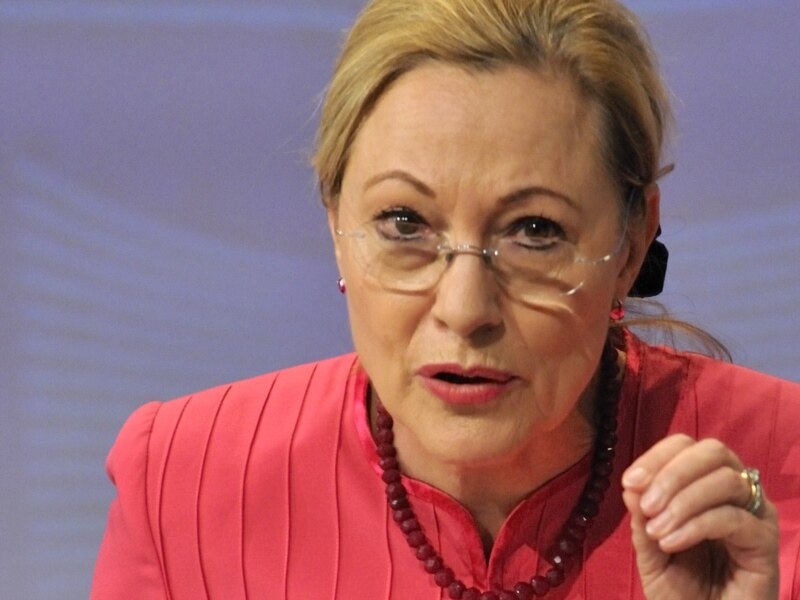
Benita Ferrero-Waldner is expected to tell EU foreign ministers that the bloc has no choice but to seek closer ties with its neighbors.


Keeping its eastern neighbors on the path to stability and prosperity has become a formidable test for EU foreign policy in recent months.

As she unveiled an annual review of the bloc's European Neighborhood Policy, EU External Relations Commissioner Benita Ferrero Waldner told the 27 EU foreign ministers it has been a "difficult year" -- particularly in the east.

But Czech Foreign Minister Karel Schwarzenberg, who chaired the meeting, said the EU is resolved to push on with its Eastern Partnership initiative, which is designed to forge closer ties between the bloc and six eastern neighbors.

"We believe that sending a strong message to the six partnership countries -- Ukraine, Belarus, Moldova, Georgia, Armenia, and Azerbaijan -- is very important in the light of the recent developments in the region, and that we need to engage with our neighbors more closely in order to promote good governance, the rule of law, and transparency," he said.

Brutal Crackdown

One need look no further than this month's unrest in Moldova to know that this will not be easy.

That country is still recovering from a brutal crackdown on mass public protests in the capital, Chisinau, following a landslide win for the ruling Communists in parliamentary elections. In the wake of the violence, the country's increasingly Russian-leaning president, Vladimir Voronin, pointedly accused neighboring Romania -- an EU member -- of fomenting the unrest.

Moldova then expelled the ambassador to Romania and imposed a summary visa regime on Romanian visitors. And sources in Brussels say Voronin told Kalman Miszei, the EU special envoy, that Moldova has "friends elsewhere."

Now, at Romania's request, EU foreign ministers meeting in Luxembourg discussed Moldova during talks over lunch -- a setting usually reserved for issues of particular concern.

The EU adopted a declaration saying it has "serious concerns" about developments in the country, and Czech Foreign Minister Schwarzenberg said Moldova "poses a challenge" for the EU.

"The current tensions in the country pose a challenge for the European Union. Our task is now to find a proper way to strengthen our policy of bringing Moldova closer to our standard," he said. "We expect Moldova to behave in a European way, not only vis-a-vis the European Union and its members, but first of all, of course, internally."

But, Schwarzenberg stressed, the Eastern Partnership initiative remains "no doubt the right tool" to bolster reforms in Moldova.

Cutting Some Slack

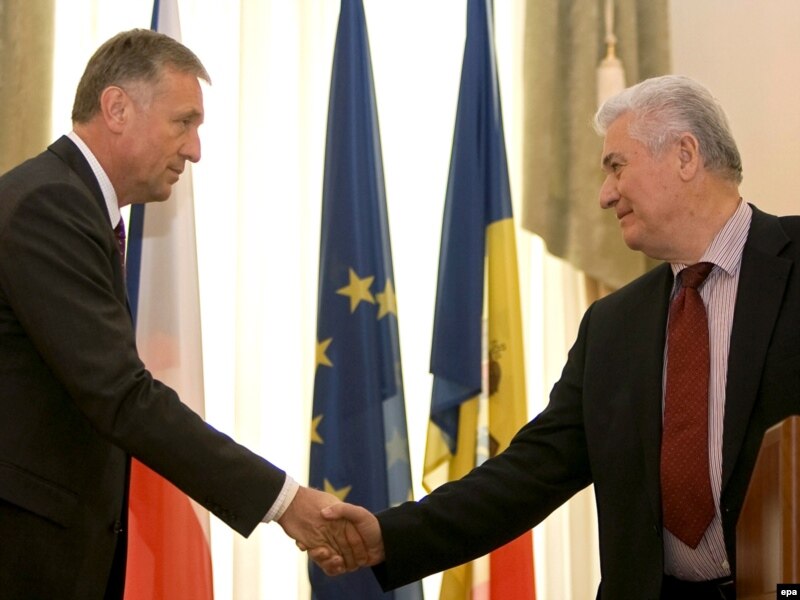
Czech Prime Minister Miroslav Topolanek, who was in Chisinau last week representing the EU Presidency, reported that neither the government nor the opposition appears to have the political will to meet the other side for talks -- a key EU wish.

Moldovan President Vladimir Voronin (right) meets with Czech Prime Minister Mirek Topolanek in Chisinau on April 22.

The Netherlands is the lone advocate of a tougher EU stance on Moldova (and another problematic partnership member, Belarus). But Germany and Poland head the EU's mainstream in arguing that Moldova must not be isolated and needs greater EU support.


The country's economy is seen by many in the EU to be on the brink of collapse.

Moldova's decision to slap visas on Romanians is, however, likely to have repercussions. The European Commission has called the measure unacceptable in light of EU-Moldova visa facilitation talks and is likely to raise it at an EU-Moldova meeting in a few days.

Moldova's partner on the EU lunch agenda was neighboring Ukraine, where there has been no public unrest but where mounting political and economic paralysis increasingly threatens the country's viability.

Again, Germany and Poland appear to be closely coordinating policy, with the two countries' foreign ministers reported to have addressed a joint letter to the EU's Czech presidency last week expressing concern at the economic and political situation in Ukraine.

The two ministers are said to have floated the idea of an EU assistance mission to Ukraine to facilitate dialogue among all political leaders. However, it is generally feared that a resolution to the political crisis in Ukraine is improbable before the 2010 presidential elections.

The EU's foreign-policy chief, Javier Solana, said after the meeting that the EU would now study ways of stabilizing the country. "After the discussion today we will see how we can help prior to the elections and after the elections, the presidential elections, to see how we can arrange the economic situation and the political situation," he said.

Is Lukashenka Coming?

The EU foreign ministers on April 27 will also discuss the agendas and guest lists of two important upcoming summits.

On May 7, representatives of Belarus, Ukraine, Moldova, Georgia, Armenia, and Azerbaijan have been invited to attend a summit in Prague on its Eastern Partnership, which is meant to extend special benefits to the EU's eastern neighbors.

Much speculation is circulating over whether Belarus's authoritarian president, Alyaksandr Lukashenka, will attend. The invitations to the summit are not personal, giving every country's leader the choice of whether to turn up in Prague in person. Many EU nations expect Lukashenka to send a stand-in.


A joint declaration signed by the 27 EU member states and the six partner countries is planned for the summit. The text of the document is still being discussed with the partners and is expected to be finalized a week in advance of the summit.

On May 8, the EU will hold another summit in Prague, dedicated to what has become known as the Southern Corridor of energy provision.

This meeting will be conducted under the auspices of the EU "troika" of Topolanek, Solana, and European Commission President Jose Manuel Barroso. The three will face officials representing Azerbaijan, Georgia, Turkey, Kazakhstan, and Turkmenistan.

Six 'Observers'

Together, the five countries represent the EU's main hope of securing significant amounts of natural gas deliveries without resorting to Russian supplies or mediation.

Six "observers" have also been invited -- Iraq, Egypt, and Uzbekistan as potential supplier countries; and Russia, Ukraine, and the United States as other major interested parties.

The presence of the last three has been the subject of some controversy within the EU. Germany led a long-established group of countries -- including France, Italy, and Spain, among others -- which overcame resistance from others and secured an invitation for Russia.

The Southern Corridor is explicitly defined by the EU as a direct link to energy resources in the Caspian Sea region bypassing Russia.

A draft summit declaration, seen by RFE/RL, breaks new ground for the EU by saying the bloc intends to "give strong political support" to the construction of the Southern Corridor -- including the "trans-Caspian link."

This is a planned gas pipeline running from Turkmenistan to Azerbaijan which would link Central Asia directly with the Nabucco pipeline projected to run from Baku to Europe, circumventing Russia.

Thursday, April 23, 2009

Belarusian President Hails Eastern Patnership As 'Timely Idea'


RFE/RL
April 23


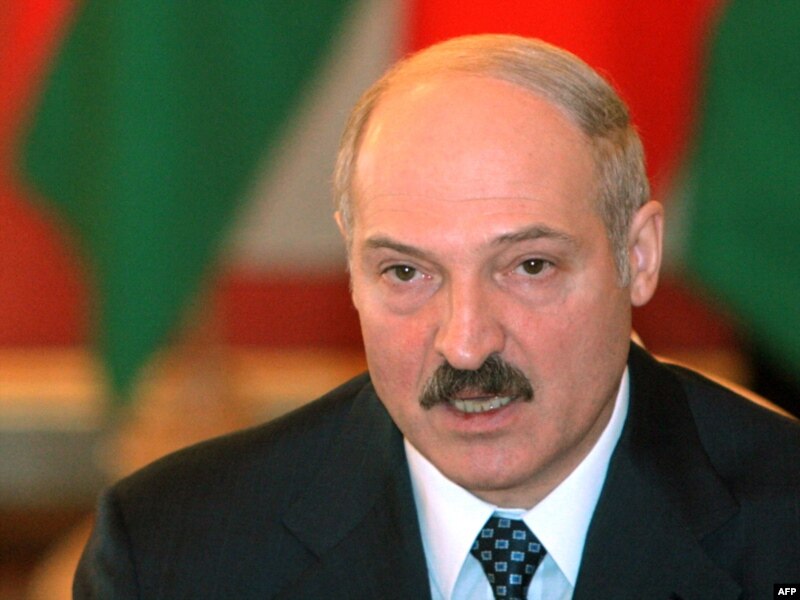
President Alyaksandr Lukashenka


MINSK -- Belarusian President Alyaksandr Lukashenka stressed in his annual address to the National Assembly that Belarus wants to normalize "difficult" relations with the European Union, RFE/RL's Belarusian Service reports.

Lukashenka said the "idea of [the EU's] Eastern Partnership is timely. We have yet to work out the format of cooperation with Brussels."

He added that "we are going to where we are expected [to go]."

Lukashenka added that half of Belarus's trade turnover is with EU member countries.

Speaking about the opposition activists who appealed to the EU not to invite him to the EU summit on Eastern Partnership in Prague on May 7, Lukashenka called them "enemies of the people."

He singled out Alyaksandr Milinkevich, his rival in the 2006 presidential election, as the only one who did not join in the appeal.

Milinkevich told RFE/RL that he "is not working to receive praise from Mr. Lukashenka," saying that he believes the Eastern Partnership idea is beneficial for Belarus.


ECFR "China treats EU with diplomatic contempt"


European Council on Foreign Relations

April 17


China is exploiting the EU's divisions and treating the 27-state bloc with "diplomatic contempt" on issues ranging from trade to the Dalai Lama, according to a new policy report by the European Council on Foreign Relations, a leading pan-European think-tank, in close cooperation with Asia Centre at Science Po. Even though China is the EU's second largest trading partner, EU policy still has roots in a time when China was a developing country rather than a diplomatic competitor. Following the failure of the EU to put united demands to China at the G20, it is essential that the EU strikes tougher bargains with Beijing and uses the levers at its disposal- otherwise it will be outmanoeuvred at next month's EU-China summit in Prague.


This analysis comes in the Power Audit of EU-China Relations, the first ever pan-European study of EU-China relations. It is written by John Fox, ECFR Senior Policy Fellow; and Francois Godement, ECFR Senior Policy Fellow, Professor and Director of the Asia Centre at Sciences Po, based on extensive fieldwork and interviews in all twenty-seven member states.


Fox and Godement argue that a policy of "unconditional engagement", in which the EU grants China economic benefits in the hope that this will lead to democratic reform, has failed to achieve advances since it was introduced in the mid-eighties. And jostling for influence in Beijing between member states - especially France, Germany and the UK- means that they have refused to support each other on contentious issues such as meeting the Dalai Lama.

This division and outdated strategy are leading to failure across the domestic and foreign policy agenda:

Economics:

The EU's trade deficit with China has now surpassed the US's to become the largest in the world. Despite enjoying open access in European markets, Beijing has not provided equal access to European companies in China. Chinese markets continue to be protected by a maze of industrial policies, restricted access, and opaque procedures. Access to China' s property market and service sector has been limited, and the Chinese have failed to invest in European public bonds or in private capital markets.

Human Rights:

The EU's 24 formal dialogues with China on human rights have been turned by Beijing into "inconclusive talking shops". Despite twenty years of EU pressure, there is no evidence that European lobbying on human rights such as use of the death penalty and religious freedom have achieved anything.

Foreign Policy:

China has been willing to undermine European efforts to improve the behaviour of regimes in Burma and Darfur, while EU efforts to persuade China to isolate Zimbabwe have had "no impact whatsoever". Despite much-heralded European progress on getting China signed up to sanctions against Iran, they remain so weak that there is every chance they will never prevent Iran becoming a nuclear state.

John Fox and Francois Godement say:

"China has learned to exploit the divisions among EU Member States. It treats its relationship with the EU as a game of chess, with 27 opponents crowding the other side of the board and squabbling about which piece to move."

"Whenever China has shifted its position as a result of European pressure, as on Darfur or nuclear proliferation, it has reacted to a coordinated effort from the most influential member states."

The analysis of the 27 member states conducted in this Power Audit allowed the authors to characterise them on the basis of their relations with China into four groups:

Ideological free traders. Denmark, the Netherlands, Sweden and the UK. Mostly ready to pressure China on politics and mostly opposed to restricting its trade. Their aversion to any form of trade management means that they are unwilling to use trade as a bargaining chip when they are dealing with China's centralised and aggressive trade policy.

Accommodating mercantilists. Bulgaria, Cyprus, Finland, Greece, Hungary, Italy, Malta, Portugal, Romania, Slovakia, Slovenia and Spain. Share assumption that good political relations with China will lead to commercial benefit. See anti-dumping measures as a useful tool and oppose awarding China Market Economy Status. Compensate for readiness to resort to protectionist measures by shunning confrontation with China on political questions. But they add to European divisions by refusing to bring pressure to bear on Beijing on human rights and other non-trade issues.

Assertive Industrialists. Czech Republic, Germany and Poland. Only group willing to stand up to China vigorously on both political and economic issues. Ready to pressure China with specific demands for a given sector, to support anti-dumping measures, or to threaten other trade actions. They contribute towards European divisions because some, including Germany, have doubts about an integrated EU approach and still prefer to compete with other member states for Beijing's ear.

European followers. Austria, Belgium, Estonia, Ireland, Latvia, Luxembourg and Lithuania. Most European-spirited group and follow, rather than lead. Many do not consider a relationship with China to be central to their foreign policy. Their strategy adds to EU weakness by feeding the perception that China is not a key European priority - even as they rely on EU support to protect them from pressure on issues like Taiwan or Tibet.

RECOMMENDATIONS

  • The EU should abandon its policy of "no strings attached" engagement and strike tougher bargains with Beijing. It should offer to lift its embargo on arms sales to China in return for a Chinese commitment to push for stronger sanctions against Iran. Similarly, China could be offered market economy status under WTO rules in exchange for the removal of trade barriers and improved intellectual property-right protection.
  • EU leaders should declare publicly that they reject any restriction of their right to meet the Dalai Lama - so that individual members cannot be individually punished, as when China retaliated after President Sarkozy met the Dalai Lama by cancelling the EU-China summit in Lyon.
  • The European Council should launch a major review of EU policy towards China. Member States should "Europeanise" their national cooperation programmes and key dialogues with China: coordination between national governments in the EU has been no effective substitute for a single, focused dialogue or programme with China.

In addition, the EU should:

  • Establish a permanent "open troika" system for engaging China on priority topics. The troika-which would comprise the current and next presidencies and the Commission-should also be open to Member States that would demonstrably contribute on the issue; producing a study of a relevant topic or funding for a project could serve as entry requirements. This open troika format should extend to representation at EU-China summits.
  • Press Beijing to grant EU officials increased access to Chinese government machinery - and explain that access to officials in Europe may be limited for Chinese officials if this is not forthcoming.
  • Protect European intellectual property by buying partial ownership of the key technologies and patents it helps develop, so as to improve control of technology transfers to China and fend off pressure that Chinese government partners now exert on Europeans to share their knowhow.
  • Offer security cooperation with African governments to protect Chinese activities and investments against security threats. This commitment should be traded for greater Chinese support for peacekeeping operations in Africa.
  • Offer China a technology transfer package of key energy-efficient and renewable technologies, including EU funding and knowhow transfer. In return, China should commit to a global stabilization goal and to specific domestic targets on emissions in post-2012 negotiations.
  • Facilitate Chinese investment in transport infrastructure, energy distribution and telecoms, in exchange for China opening up its infrastructure projects to foreign firms and removing ownership restrictions on Chinese firms.

NOTES TO EDITORS

1. "Power Audit of EU-China Relations" was written by John Fox, Senior Policy Fellow at the European Council on Foreign Relations; and Francois Godement, Senior Policy Fellow at the European Council on Foreign Relations, Professor and Director of the Asia Centre at Sciences Po.

2. This report, like all ECFR publications, represents the views of its authors, not the collective position of ECFR or its Council Members.

3. Power Audit of EU-China Relations assigned scores to Member States' individual policies and actions towards China. The main policies actions scored were: position on Taiwan, position on Tibet/willingness to meet the Dalai Lama, prominence of human rights issues, willingness to raise global issues with China (Iran, Sudan etc.), voting on anti-dumping issues, position on trade deficit, attitude towards Chinese investment in Europe, and more broadly the nature of political statements on China. Member States were scored for actions that were respectively more supportive or critical of China, and to the top or bottom for actions that were more free-trade or protectionist.

4. Mr. Fox can be reached for comment at john.fox@ecfr.eu or on +44 7796 938 268. Mr. Godement can be reached for comment at francois.godement@ecfr.eu or on +33 1 75 43 63 20.

5. For all media enquiries please email press@ecfr.eu or telephone +44 20 7031 1623

6. Launched in October 2007, the European Council on Foreign Relations is a pan-European think tank and advocacy group, co-chaired by Martti Ahtisaari, Joschka Fischer and Mabel van Oranje. European Council on Foreign Relations - www.ecfr.eu

7. Founded in 2005, Asia Centre conducts research and organizes debates on international relations and strategic issues, as well as on the political and economic transformations of the Asia-Pacific, and promotes cooperation and second track dialogue with partners in Asia, Europe and elsewhere in the world. Asia Centre is based at SciencesPo., the Institute of political science of Paris www.centreasia.org