The economic and social situation in Greece seems to continue the dangerous turn, as the EU leaders - mainly Germany - are not satisfied with the turn over of the reforms. The most dangerous though in this context is the resurgence of the far right and the increased hate against foreigners. Following an ambiance already heated by the presence of the far-right into the Parliament, the home affairs officials decided a couple of days ago to detain around 6,000 persons, out of them 1,600 will be deported soon, because considered illegal immigrants. On Sunday, supporters of the far-right attacked a car with a Pakistani man accused of murder.
We should not ask ourselves what could be next. Take your time and look in the history books.
When you are in Germany, read what Germans read. And this sentence could be repeated for various countries that I am visiting all round the year. As long as I know the local language, it is important to get connected through the local political culture. And apparently, I cannot live too much without knowing what is going on in the cultural life.
As for Germany, for a long time I used to read regularly FAZ and Der Spiegel. Most of the news I hear from radio or, when necessary, I have the Google alerts that offer a basis for further documentation. In the last months, I started to read also Cicero, the "Magazine for Political Culture".
It was created in 2004 as part of Ringier Group and with the aim to be the German variant of The New Yorker or the Atlantic Monthly. Together with the advertising and arts publication Monopol, it is part of the serious porfolio of Ringier. I do not have yet the explanation of the choice of the name Cicero for the publication.
It counted as contributors various local politicians or literary stars - as Wladimir Kaminer or Martin Walser - but also Madeleine Albright and Umberto Eco. Initially planned for 15 pages, it reached around 40 in the first issues, and over 100 nowadays. The design is friendly and you can find almost everything you need for a lazy monthly lecture. If you are a foreigner and you are curious about what is going on in the German political life, buy Cicero and your image will be less blurred.
A big part of the publication is focused on various local issues, including, in the July issue, the Schlecker case, but during time it also addressed various controversial issues. In 2005, the publication was the subject of a state investigation after it published secret documents about the terrorist of Jordanian origin al-Zarqawi.
Most German media - of Western origin - was created in the 1970s, but Cicero succeeded at a certain extent to win permanently new readers. Within the first 2 years, it suceeded to reach a 50,000 copies and nowadays it sells around 83,000.
The French seaside resort of Deauville came to prominence in the late 19th century – a time of grand hotels and swanky casinos. It was also a time when Europe was divided up between great powers who each jealously guarded their own little patch of Europe, with individual spheres of influence scratching up against each other. It is therefore a fitting location for a summit meeting involving three of the continents’ perennial great powers – Germany, Russia and France (Monday 18th October) – at a time when Europe is once again becoming a multipolar continent.
Angela Merkel and Nicolas Sarkozy are reaching out to Russia because they believe European security is no longer a matter for NATO or the EU alone. They are correct. The United States has signalled that it is less interested in European internal security – not least when President Obama declined to turn up for the twentieth anniversary of the fall of the Berlin Wall. The current order is also dysfunctional, failing to deal with wars in Kosovo and Georgia, recent instability in Kyrgyzstan or several so-called frozen conflicts dotted around the continent. The grand project of expanding EU membership eastwards has faltered of late. Even when – as we at the European Council on Foreign Relations strongly hope – Turkey and the Western Balkans become members of the EU, it is clear that NATO and the EU will never be the main security institutions in Europe, covering all European states. There is therefore a pressing need for Europeans to start rethinking their security. But while the summit has the right agenda, it has the wrong participants.
Russia needs to be at the table. It never accepted the post-Cold War order, and is now strong enough to openly challenge it. It is, however, also open to engagement, and Medvedev himself suggested working towards a new European security treaty a couple of years ago.
Another seat at the table must be given to Turkey, an emerging pole on the European continent. As the country’s foreign minister, Ahmet Davutoglu, puts it, his country is an actor, not an issue. The Turkish sphere of influence ranges from Central Asia, through the Caucasus, Middle East and into the Western Balkans. European influence and interests in this contested neighbourhood, just as with the areas that Russia considers its own Near Abroad, requires either competition or engagement.
The EU must be there but many member states cavil at the idea that Paris and Berlin represent them. It would make more sense for the member states to mandate Baroness Ashton as their representative instead. This would both be a response to the Lisbon Treaty while allowing the EU to end the anomaly where the EU – one of the most important suppliers of European security – is not represented in any of the continent’s security institutions.
Rather than trying to tinker with the existing institutions, the idea would be to re-invigorate them from the bottom up. By involving Russia in the US-initiated missile defence shield, NATO can build on Obama’s ‘reset’ to cement a continent-wide security identity, focusing minds on external threats to Europe. But alongside this, the EU needs to engage its neighbours in advancing security within Europe. It needs to build trust between Europe’s powers and challenge them demonstrate resolve – by engaging Russia in solving frozen conflicts such as Transnistria, for instance, or supporting Turkish involvement in Bosnia. A regular informal trialogue could bring together the EU, Russia and Turkey to work on these issues, alongside other interested states.
The Deauville meeting, and November’s NATO summit looking at the new NATO Strategic Concept, support the feeling that the time is ripe for rethinking European security. The EU has spent much of the last decade defending a European order that no longer functions while hoping for a global multilateral order than will probably never come. ‘The spectre of a multipolar Europe’, which has just been published by the European Council on Foreign Relations, calls for a creative and mature response to a shifting environment, and the demands of Russia and Turkey to be taken seriously as credible actors. To paraphrase Lord Ismay, the goal of rethinking security should be to keep the EU united, Russia post-imperial and Turkey European.
A version of this article first appeared in Open Democracy
UNITED NATIONS (Reuters) - The U.N. General Assembly on Tuesday elected Germany, India, South Africa and Colombia to two-year seats on the U.N. Security Council, while Canada and Portugal went to a second round of voting.
Either Canada or Portugal will join the other four countries to serve two-year terms beginning in January 2011 and ending in December 2012 as non-veto-holding members of the 15-nation body, the powerhouse of the United Nations with the authority to impose sanctions and deploy peacekeeping forces.
The results of the second-round vote to decide whether Canada, which has served six terms on the council and never lost a bid for a seat, or Portugal, which has been on the council twice, has received the requisite two-thirds majority in the 192-nation General Assembly will be known shortly.
In the first round of voting, only Germany managed to cross the 127-vote threshold in the category known as "Western Europe and Others." India, South Africa and Colombia were all uncontested in their respective geographic groups.
There are five veto-holding permanent members of the Security Council -- the United States, Britain, France, Russia and China, the victors of World War Two -- and 10 temporary elected members without vetoes.
But the elected members have some power because a council resolution needs nine votes in favor as well as no vetoes.
The five rotating members serving on the council until the end of 2011 are Bosnia, Brazil, Gabon, Lebanon and Nigeria. The five nations leaving the council at the end of this year are Austria, Turkey, Mexico, Japan and Uganda.
Germany is one of the top contributors to the United Nations and one of several countries, along with India, Japan and Brazil, that are considered prime candidates for permanent seats on the council if U.N. member states can ever agree on a formula for expanding it.
Over a decade of talks on a possible expansion of the Security Council to better reflect the nature of the world have failed to yield a consensus.
The legal, moral and political problems following September 11 terrorist attacks represented the inspiration of various political and artistic standpoints. Music, literature, arts, pros cons, debates from various perspectives. In the center: how much our freedom is/will be threaten by the legislation allowing the state to enter and access our privacy.
Most part of these statements, in my opinion, are lacking exactly the wider perspective assumed from the very beginning, by not stressing the problem of what is, in fact, the essence and content of this freedom? And, even less, the ways in order to stop or at least diminish the causes provoking this reaction from the part of the states.
The German journalist Heribert Prantl is outlining the German example, but in a very rhetorical way. Page after page, he is gathering more arguments for a public requisitorium of a more intrusive state. With roots back in the past of the German experience in facing the Rote Armee Fraktion and other terrorist threats in the 70s. Ironically enough, but not so logically unexpectedly as Prantl let us believe, one of the promoters of the strict German legislation was the social-democrat Otto Schilly, former Federal Minister of the Interior between 1998 and 2005, during Gerhard Schröder. In the 70s, the same Schilly was defending the Rot Armee Faktion members and, late in the 80s, was one of the founding member of the Green Party.
The rhetoric is continuing, but without a single line of arguments devoted to understanding the whole landscape: the causes of this situation, the alternatives and the options - how, in fact, the state ought to defend its citizens of terrorism, of being innocent victims of fanatics, the possibilities to counter such situations and to play a game with win/win outcome.
It is very easy to outline all these issues and to complain and accuse an invisible and (assumed) mighty power of the state(s), the temptation to control our privacy - doubtful, given the eagerness we, all of us, we are sharing our information and privacies online, via social networking sites, without being requested - the tighter limits to our freedom. As in the case of the Middle East, it is very easy to express an opinion, as a proof of our freedom to think, accuse, evaluate. But, in order to provide a wiser outline of the landscape, more than rhetorics are needed. For example, a critical anaylsis, going beyond the public acclaimed statements. Otherwise, we are getting trapped in the common places of the self-delivered ideas.
The Iranians have now agreed to talks with the P-5+1, the five permanent members of the U.N. Security Council (the United States, the United Kingdom, France, Russia and China) plus Germany. These six countries decided in latJustify Fulle April to enter into negotiations with Iran over the suspected Iranian nuclear weapons program by Sept. 24, the date of the next U.N. General Assembly meeting. If Iran refused to engage in negotiations by that date, the Western powers in the P-5+1 made clear that they would seriously consider imposing much tougher sanctions on Iran than those that were currently in place. The term “crippling” was mentioned several times.
Obviously, negotiations are not to begin prior to the U.N. General Assembly meeting as previously had been stipulated. The talks are now expected to begin Oct. 1, a week later. This gives the Iranians their first (symbolic) victory: They have defied the P-5+1 on the demand that talks be under way by the time the General Assembly meets. Inevitably, the Iranians would delay, and the P-5+1 would not make a big deal of it.
Talks About Talks and the Sanctions Challenge
Now, we get down to the heart of the matter: The Iranians have officially indicated that they are prepared to discuss a range of strategic and economic issues but are not prepared to discuss the nuclear program — which, of course, is the reason for the talks in the first place. On Sept. 14, they hinted that they might consider talking about the nuclear program if progress were made on other issues, but made no guarantees.
So far, the Iranians are playing their traditional hand. They are making the question of whether there would be talks about nuclear weapons the center of diplomacy. Where the West wanted a commitment to end uranium enrichment, the Iranians are trying to shift the discussions to whether they will talk at all. After spending many rounds of discussions on this subject, they expect everyone to go away exhausted. If pressure is coming down on them, they will agree to discussions, acting as if the mere act of talking represents a massive concession. The members of the P-5+1 that don’t want a confrontation with Iran will use Tehran’s agreement merely to talk (absent any guarantees of an outcome) to get themselves off the hook on which they found themselves back in April — namely, of having to impose sanctions if the Iranians don’t change their position on their nuclear program.
Russia, one of the main members of the P-5+1, already has made clear it opposes sanctions under any circumstances. The Russians have no intention of helping solve the American problem with Iran while the United States maintains its stance on NATO expansion and bilateral relations with Ukraine and Georgia. Russia regards the latter two countries as falling within the Russian sphere of influence, a place where the United States has no business meddling.
To this end, Russia is pleased to do anything that keeps the United States bogged down in the Middle East, since this prevents Washington from deploying forces in Poland, the CzechRepublic, the Baltics, Georgia or Ukraine. A conflict with Iran not only would bog down the United States even further, it would divide Europe and drive the former Soviet Union and Central Europe into viewing Russia as a source of aid and stability. The Russians thus see Iran as a major thorn in Washington’s side. Obtaining Moscow’s cooperation on removing the thorn would require major U.S. concessions — beyond merely bringing a plastic “reset” button to Moscow. At this point, the Russians have no intention of helping remove the thorn. They like it right where it is.
In discussing crippling sanctions, the sole obvious move would be blocking gasoline exports to Iran. Iran must import 40 percent of its gasoline needs. The United States and others have discussed a plan for preventing major energy companies, shippers and insurers from supplying that gasoline. The subject, of course, becomes moot if Russia (and China) refuses to participate or blocks sanctions. Moscow and Beijing can deliver all the gasoline Tehran wants. The Russians could even deliver gasoline by rail in the event that Iranian ports are blocked. Therefore, if the Russians aren’t participating, the impact of gasoline sanctions is severely diminished, something the Iranians know well.
Tehran and Moscow therefore are of the opinion that this round of threats will end where other rounds ended. The United States, the United Kingdom and France will be on one side; Russia and China will be on the other; and Germany will vacillate, not wanting to be caught on the wrong side of the Russians. In either case, whatever sanctions are announced would lose their punch, and life would go on as before.
There is, however, a dimension that indicates that this crisis might take a different course.
The Israeli Dimension
After the last round of meetings between Israeli Prime Minister Benjamin Netanyahu and U.S. President Barack Obama, the Israelis announced that the United States had agreed that in the event of a failure in negotiations, the United States would demand — and get — crippling sanctions against Iran, code for a gasoline cutoff. In return, the Israelis indicated that any plans for a unilateral Israeli strike on Iran’s nuclear facilities would be put off. The Israelis specifically said that the Americans had agreed on the September U.N. talks as the hard deadline for a decision on — and implementation of — sanctions.
Our view always has been that the Iranians are far from acquiring nuclear weapons. This is, we believe, the Israeli point of view. But the Israeli point of view also is that, however distant, the Iranian acquisition of nuclear weapons represents a mortal danger to Israel — and that, therefore, Israel would have to use military force if diplomacy and sanctions don’t work.
For Israel, the Obama guarantee on sanctions represented the best chance at a nonmilitary settlement. If it fails, it is not clear what could possibly work. Given that Supreme Leader Ayatollah Ali Khamenei has gotten his regime back in line, that Iranian President Mahmoud Ahmadinejad apparently has emerged from the recent Iranian election crisis with expanded clout over Iran’s foreign policy, and that the Iranian nuclear program appears to be popular among Iranian nationalists (of whom there are many), there seems no internal impediment to the program. And given the current state of U.S.-Russian relations and that Washington is unlikely to yield Moscow hegemony in the former Soviet Union in return for help on Iran, a crippling sanctions regime is unlikely.
Obama’s assurances notwithstanding, there accordingly is no evidence of any force or process that would cause the Iranians to change their minds about their nuclear program. With that, the advantage to Israel of delaying a military strike evaporates.
And the question of the quality of intelligence must always be taken into account: The Iranians may be closer to a weapon than is believed. The value of risking delays disappears if nothing is likely to happen in the intervening period that would make a strike unnecessary.
Moreover, the Israelis have Obama in a box. Obama promised them that if Israel did not take a military route, he would deliver them crippling sanctions against Iran. Why Obama made this promise — and he has never denied the Israeli claim that he did — is not fully clear. It did buy him some time, and perhaps he felt he could manage the Russians better than he has. Whatever Obama’s motivations, having failed to deliver, the Israelis can say that they have cooperated with the United States fully, so now they are free by the terms of their understanding with Washington to carry out strikes — something that would necessarily involve the United States.
The calm assumptions in major capitals that this is merely another round in interminable talks with Iran on its weapons revolves around the belief that the Israelis are locked into place by the Americans. From where we sit, the Israelis have more room to maneuver now than they had in the past, or than they might have in the future. If that’s true, then the current crisis is more dangerous than it appears.
Netanyahu appears to have made a secret trip to Moscow (though it didn’t stay secret very long) to meet with the Russian leadership. Based on our own intelligence and this analysis, it is reasonable to assume that Netanyahu was trying to drive home to the Russians the seriousness of the situation and Israel’s intent. Russian-Israeli relations have deteriorated on a number of issues, particularly over Israeli military and intelligence aid to Ukraine and Georgia. Undoubtedly, the Russians demanded that Israel abandon this aid.
As mentioned, the chances of the Russians imposing effective sanctions on Iran are nil. This would get them nothing. And if not cooperating on sanctions triggers an Israeli airstrike, so much the better. This would degrade and potentially even effectively eliminate Iran’s nuclear capability, which in the final analysis is not in Russia’s interest. It would further enrage the Islamic world at Israel. It would put the United States in the even more difficult position of having to support Israel in the face of this hostility. And from the Russian point of view, it would all come for free. (That said, in such a scenario the Russians would lose much of the leverage the Iran card offers Moscow in negotiations with the United States.)
Ramifications of an Israeli Strike
An Israeli airstrike would involve the United States in two ways. First, it would have to pass through Iraqi airspace controlled by the United States, at which point no one would believe that the Americans weren’t complicit. Second, the likely Iranian response to an Israeli airstrike would be to mine the Strait of Hormuz and other key points in the Persian Gulf — something the Iranians have said they would do, and something they have the ability to do.
Some have pointed out that the Iranians would be hurting themselves as much as the West, as this would cripple their energy exports. And it must be remembered that 40 percent of globally traded oil exports pass through Hormuz. The effect of mining the Persian Gulf would be devastating to oil prices and to the global economy at a time when the global economy doesn’t need more grief. But the economic pain Iran would experience from such a move could prove tolerable relative to the pain that would be experienced by the world’s major energy importers. Meanwhile, the Russians would be free to export oil at extraordinarily high prices.
Given the foregoing, the United States would immediately get involved in such a conflict by engaging the Iranian navy, which in this case would consist of small boats with outboard motors dumping mines overboard. Such a conflict would be asymmetric warfare, naval style. Indeed, given that the Iranians would rapidly respond — and that the best way to stop them would be to destroy their vessels no matter how small before they have deployed — the only rational military process would be to strike Iranian boats and ships prior to an Israeli airstrike. Since Israel doesn’t have the ability to do that, the United States would be involved in any such conflict from the beginning. Given that, the United States might as well do the attacking. This would increase the probability of success dramatically, and paradoxically would dampen the regional reaction compared to a unilateral Israeli strike.
When we speak to people in Tehran, Washington and Moscow, we get the sense that they are unaware that the current situation might spin out of control. In Moscow, the scenario is dismissed because the general view is that Obama is weak and inexperienced and is frightened of military confrontation; the assumption is that he will find a way to bring the Israelis under control.
It isn’t clear that Obama can do that, however. The Israelis don’t trust him, and Iran is a core issue for them. The more Obama presses them on settlements the more they are convinced that Washington no longer cares about Israeli interests. And that means they are on their own, but free to act.
It should also be remembered that Obama reads intelligence reports from Moscow, Tehran and Berlin. He knows the consensus about him among foreign leaders, who don’t hold him in high regard. That consensus causes foreign leaders to take risks; it also causes Obama to have an interest in demonstrating that they have misread him.
We are reminded of the 1962 Cuban Missile Crisis only in this sense: We get the sense that everyone is misreading everyone else. In the run-up to the Cuban Missile Crisis, the Americans didn’t believe the Soviets would take the risks they did and the Soviets didn’t believe the Americans would react as they did. In this case, the Iranians believe the United States will play its old game and control the Israelis. Washington doesn’t really understand that Netanyahu may see this as the decisive moment. And the Russians believe Netanyahu will be controlled by an Obama afraid of an even broader conflict than he already has on his hands.
The current situation is not as dangerous as the Cuban Missile Crisis was, but it has this in common: Everyone thinks we are on a known roadmap, when in reality, one of the players — Israel — has the ability and interest to redraw the roadmap. Netanyahu has been signaling in many ways that he intends to do just this. Everyone seems to believe he won’t. We aren’t so sure.
President Barack Obama is paying tribute to D-Day veterans, including one who visited the Normandy cemetery on the eve of the invasion's 65th anniversary and then died. Obama on Saturday remembered Jim Norene (nor-EEN), a member of the 101st Airborne who died in his sleep after visiting the American cemetery a day earlier. Obama says Norene was ill when he left his home and knew he might not make it back to the United States. Obama says Norene returned to Normandy for the same reason so many visit: to remember the sacrifices that helped turn the tide against the Nazis and win World War II. Obama also mentioned his grandfather, Stanley Dunham, who arrived at Normandy six weeks after D-Day, and his great-uncle who liberated a Nazi concentration camp.
An 88-year-old D-Day veteran who was one of eight brothers to fight during World War II has returned to the site of the Normandy landings. Len Smith, of Druids Heath, Birmingham, was one of 16 children and joined the Army aged 18. His brothers were also survivors of the war. He said he was determined to go back for the 65th anniversary of the D-Day landings but said he feared it would be the last time he would go back. He said: "I can never understand why I managed to drive straight up on the beach. "Nothing on earth could have trained you for the experience that you were witnessing with your own eyes and ears." He added: "I've read lots of stories and some of these stories are really glossy, you know, about all the guts and thunder and that, but I don't like that side of it at all."
Those risks appear when in fact the MPs are turning themselves in journalists, at least when it is about the readiness to share as soon as possible information to "readers". The rules, written or unwritten agreements, or any kind of procedures are irrelevant. But reaching the information could be a matter of chance or will compulse you to be "on-line" as much as possible.
20 years after the end of the Wall, the question regarding the amplitude of Stasi (the former communist Germany secret service) is still haunting the reunited Germany. This time, the case in question is the current chancelor, Angela Merkel, who according to her declarations refused any collaboration. And, as in many others Central and Eastern European countries, the history is a constant exercise of writing and writing again, as new documents and information are able to change completely the perception and understanding of certain moment.
LONDON — When it comes to interrogating prisoners, perhaps the United States and Britain could take a page from their own history — Germany did.
The issue of human rights abuse by U.S. interrogators especially resounds in Germany. After the destruction of the Nazi regime and subsequent Allied occupation, the newly formed West German army — inspired by Britain and the United States — instituted a number of strict policies to ensure that German soldiers would be exemplary in conducting P.O.W. interrogations. One of the key decisions was to ensure that the debriefing of prisoners was carried out by specially trained civilian reserve officers.
When I was in the West German army, I trained to become one of these interrogators. During my application interview, I was asked to elaborate on “how humanism played a part” in “my education.” (My answer — “a large part” — was apparently the one they were looking for). My training included learning to speak Russian fluently and receiving a full immersion in Russian Army life — including learning marching songs and making home-made vodka.
The reasoning behind all this was to ensure that interrogators had the ability to understand their captives and be able to extract information through psychological and not physical means.
When a particularly zealous professional interrogator at the National Intelligence School in Bad Ems began to elaborate on methods similar to those practiced by the U.S. Army in Iraq (and, apparently, C.I.A. officers abroad), my fellow officers and I reported him and he was reprimanded.
At the end of my two years of service, my 30 colleagues and I all left the army to rejoin the professional and family life from whence we came. We felt then and I still feel today that prisoner interrogation is a matter for mature, grounded individuals, who are guided by the spirit of the Geneva Convention.
Part of the impetus for the postwar German interrogation policy stemmed from the fact that many of the reconstituted army’s new leaders had been P.O.W.s recently released from Allied — especially British — custody. These men had been well-treated by the British and Americans during the war. One of them was my grandfather, Ludwig Cruewell. His experience as a P.O.W. stands in stark contrast to the stories we hear from Iraq.
As commanding general of the Africa Corps, he reported to Erwin Rommel, head of Axis forces in North Africa. Cruewell was captured on May 29, 1942, when his reconnaissance plane was shot down over Libya. As the highest-ranking German officer in Allied hands at that point in the war, Cruewell’s capture was a key victory for the Allies. He had fought in every theater of the war, led the forces that captured Belgrade and had recently met privately with Hitler.
However, upon his capture he was treated to a most enjoyable dinner by General Montgomery in Gibraltar, allowed to have a bath and towels of a quality he had never seen before, and was finally put on a night flight to Britain. Arriving in London, he was immediately allowed to meet with a Red Cross representative.
Later, he was able to communicate by letter with his children in Germany and was put up in style in Trent Park, the luxurious, stately former home of a British business magnate. My grandfather and the other prisoners were allowed to take daily strolls in the expansive grounds. A captured German non-commissioned officer was designated to keep his uniform, sent from Germany, in order.
Surrounded by luxury, these prisoners were — unbeknownst to them — wiretapped. The approach worked: The Allies studied their idle chatter, and lengthy reports of their conversations went all the way to Churchill.
While I don’t think it is feasible (politically, if not logistically) to put up hardened terrorists in five star hotels, this old-fashioned approach to P.O.W. interrogation has a lot to recommend for itself. For Germans today, a humane approach springs from an abhorrence of our wartime record of atrocities committed by soldiers in uniform. This sensibility has been shaped by the unexpectedly decent treatment received from Allied captors.
If we are really interested in nation-building in Iraq and other areas that are wracked by war, “doing unto others what you would have them do unto you ” is a good thing to keep in mind when implementing any interrogation policy.
Arnold Holle is an investment banker from Germany living in London.
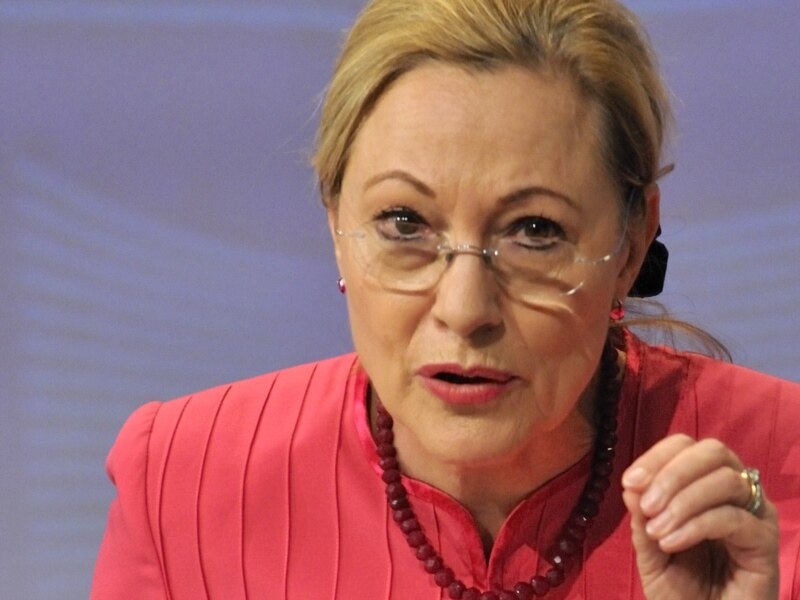
Benita Ferrero-Waldner is expected to tell EU foreign ministers that the bloc has no choice but to seek closer ties with its neighbors.
Keeping its eastern neighbors on the path to stability and prosperity has become a formidable test for EU foreign policy in recent months. As she unveiled an annual review of the bloc's European Neighborhood Policy, EU External Relations Commissioner Benita Ferrero Waldner told the 27 EU foreign ministers it has been a "difficult year" -- particularly in the east.
But Czech Foreign Minister Karel Schwarzenberg, who chaired the meeting, said the EU is resolved to push on with its Eastern Partnership initiative, which is designed to forge closer ties between the bloc and six eastern neighbors.
"We believe that sending a strong message to the six partnership countries -- Ukraine, Belarus, Moldova, Georgia, Armenia, and Azerbaijan -- is very important in the light of the recent developments in the region, and that we need to engage with our neighbors more closely in order to promote good governance, the rule of law, and transparency," he said.
Brutal Crackdown
One need look no further than this month's unrest in Moldova to know that this will not be easy.
That country is still recovering from a brutal crackdown on mass public protests in the capital, Chisinau, following a landslide win for the ruling Communists in parliamentary elections. In the wake of the violence, the country's increasingly Russian-leaning president, Vladimir Voronin, pointedly accused neighboring Romania -- an EU member -- of fomenting the unrest.
Moldova then expelled the ambassador to Romania and imposed a summary visa regime on Romanian visitors. And sources in Brussels say Voronin told Kalman Miszei, the EU special envoy, that Moldova has "friends elsewhere."
Now, at Romania's request, EU foreign ministers meeting in Luxembourg discussed Moldova during talks over lunch -- a setting usually reserved for issues of particular concern. The EU adopted a declaration saying it has "serious concerns" about developments in the country, and Czech Foreign Minister Schwarzenberg said Moldova "poses a challenge" for the EU.
"The current tensions in the country pose a challenge for the European Union. Our task is now to find a proper way to strengthen our policy of bringing Moldova closer to our standard," he said. "We expect Moldova to behave in a European way, not only vis-a-vis the European Union and its members, but first of all, of course, internally."
But, Schwarzenberg stressed, the Eastern Partnership initiative remains "no doubt the right tool" to bolster reforms in Moldova.
Cutting Some Slack
Czech Prime Minister Miroslav Topolanek, who was in Chisinau last week representing the EU Presidency, reported that neither the government nor the opposition appears to have the political will to meet the other side for talks -- a key EU wish.
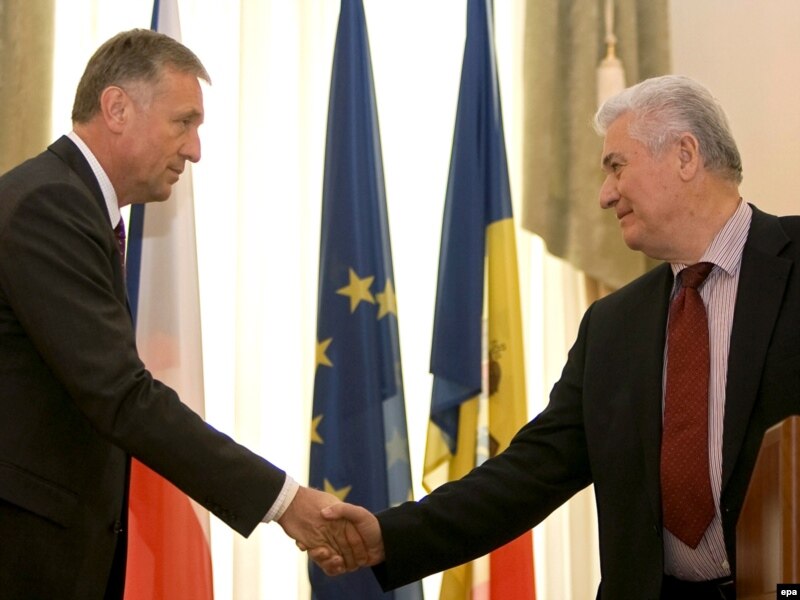
Moldovan President Vladimir Voronin (right) meets with Czech Prime Minister Mirek Topolanek in Chisinau on April 22.
The Netherlands is the lone advocate of a tougher EU stance on Moldova (and another problematic partnership member, Belarus). But Germany and Poland head the EU's mainstream in arguing that Moldova must not be isolated and needs greater EU support.
The country's economy is seen by many in the EU to be on the brink of collapse.
Moldova's decision to slap visas on Romanians is, however, likely to have repercussions. The European Commission has called the measure unacceptable in light of EU-Moldova visa facilitation talks and is likely to raise it at an EU-Moldova meeting in a few days. Moldova's partner on the EU lunch agenda was neighboring Ukraine, where there has been no public unrest but where mounting political and economic paralysis increasingly threatens the country's viability. Again, Germany and Poland appear to be closely coordinating policy, with the two countries' foreign ministers reported to have addressed a joint letter to the EU's Czech presidency last week expressing concern at the economic and political situation in Ukraine.
The two ministers are said to have floated the idea of an EU assistance mission to Ukraine to facilitate dialogue among all political leaders. However, it is generally feared that a resolution to the political crisis in Ukraine is improbable before the 2010 presidential elections.
The EU's foreign-policy chief, Javier Solana, said after the meeting that the EU would now study ways of stabilizing the country. "After the discussion today we will see how we can help prior to the elections and after the elections, the presidential elections, to see how we can arrange the economic situation and the political situation," he said. Is Lukashenka Coming?
The EU foreign ministers on April 27 will also discuss the agendas and guest lists of two important upcoming summits. On May 7, representatives of Belarus, Ukraine, Moldova, Georgia, Armenia, and Azerbaijan have been invited to attend a summit in Prague on its Eastern Partnership, which is meant to extend special benefits to the EU's eastern neighbors.
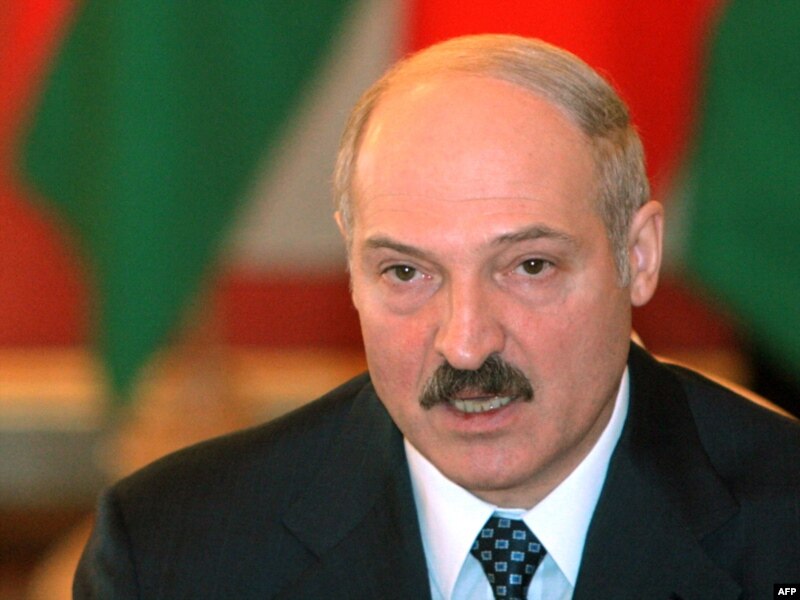
Much speculation is circulating over whether Belarus's authoritarian president, Alyaksandr Lukashenka, will attend. The invitations to the summit are not personal, giving every country's leader the choice of whether to turn up in Prague in person. Many EU nations expect Lukashenka to send a stand-in.
A joint declaration signed by the 27 EU member states and the six partner countries is planned for the summit. The text of the document is still being discussed with the partners and is expected to be finalized a week in advance of the summit. On May 8, the EU will hold another summit in Prague, dedicated to what has become known as the Southern Corridor of energy provision.
This meeting will be conducted under the auspices of the EU "troika" of Topolanek, Solana, and European Commission President Jose Manuel Barroso. The three will face officials representing Azerbaijan, Georgia, Turkey, Kazakhstan, and Turkmenistan. Six 'Observers'
Together, the five countries represent the EU's main hope of securing significant amounts of natural gas deliveries without resorting to Russian supplies or mediation. Six "observers" have also been invited -- Iraq, Egypt, and Uzbekistan as potential supplier countries; and Russia, Ukraine, and the United States as other major interested parties. The presence of the last three has been the subject of some controversy within the EU. Germany led a long-established group of countries -- including France, Italy, and Spain, among others -- which overcame resistance from others and secured an invitation for Russia. The Southern Corridor is explicitly defined by the EU as a direct link to energy resources in the Caspian Sea region bypassing Russia. A draft summit declaration, seen by RFE/RL, breaks new ground for the EU by saying the bloc intends to "give strong political support" to the construction of the Southern Corridor -- including the "trans-Caspian link."
This is a planned gas pipeline running from Turkmenistan to Azerbaijan which would link Central Asia directly with the Nabucco pipeline projected to run from Baku to Europe, circumventing Russia.
As the first cases of swine flu outside North America were confirmed Monday in Spain and Scotland, European health officials issued a series of contradictory public warnings and vacillated over whether it was safe to travel to the United States or Mexico.
In Luxembourg, Androulla Vassiliou, the European Union's health commissioner, told reporters she was "not worried at this stage" about a global pandemic spreading to Europe but nonetheless urged all travelers to avoid the United States and Mexico "unless it is very urgent for them."
The statement prompted a rebuke from U.S. health officials, who said there was no need to impose a ban on travel to the United States, where 40 cases of swine flu -- none of them fatal -- have been diagnosed. Richard E. Besser, acting director of the Centers for Disease Control and Prevention in Atlanta, called the E.U. travel warning "quite premature."
Vassiliou later backtracked and said she was simply advising Europeans to avoid "unnecessary travel" to areas in North America where there have been "serious outbreaks" of swine flu in humans.
"People should use their common sense," she told the BBC. "It's unreasonable to ban traveling, or to even advise travelers not to go to, let's say, Chicago or other places where there are no outbreaks. It's only that people should be more careful before they leave."
The European Union said it would hold an emergency meeting of health ministers from its 27 member countries to coordinate a response to the spread of swine flu. The meeting, however, is not scheduled to occur until Thursday.
Meanwhile, individual European countries have issued a melange of travel and health advisories, with some warning against travel to Mexico but others playing down the risk.
Robert Madelin, the European Union's director-general for health and consumer protection, said it was imperative for European countries to fashion a united response.
"If we do not coordinate, individual regions and countries take measures which are inconsistent and create huge economic and personal costs," he told reporters in Brussels.
In Germany, the foreign ministry issued an advisory Monday against nonessential travel to Mexico. It urged the public to monitor conditions in the United States but did not warn against travel there.
Two large German tourism companies, TUI and Thomas Cook, canceled flights to Mexico City until at least next week. They told customers it was still safe to travel directly to Mexican beach resorts, for the time being.
Officials at Frankfurt and Munich international airports, two of Europe's busiest, distributed swine-flu informational leaflets and instructed employees to watch for passengers who might be infected.
"I think we can assume that we will see the virus here soon," Michael Pfleiderer, a German government virologist, told Bavarian radio. "But that does not mean that we should paint the whole picture dark or even black." He said that normal hygiene measures were sufficient to guard against the virus and that local health agencies were well prepared.
In Spain, health officials confirmed that a 23-year-old university student who returned from Mexico last week had tested positive for the virus. The patient has been isolated in a hospital ward in the town of Almansa since Saturday, but his condition is not serious, said Trinidad Jimenez, the Spanish health minister.
Spanish officials said they were treating 20 other suspected but unconfirmed cases, all involving people who recently traveled to Mexico. Suspected cases were also reported in France, Sweden, Germany and Switzerland.
In Scotland, Health Secretary Nicola Sturgeon said late Monday that two people who returned Friday from Mexico had tested "conclusively" for swine flu. Officials said the two patients were being kept in isolation in a hospital in the town of Airdrie and were expected to recover.
Seven people who had been in contact with the travelers have displayed mild flu symptoms but are not being hospitalized, Sturgeon said. "We remain very encouraged by the fact that outside Mexico everyone who has contracted swine flu has experienced mild symptoms only," she said.
British officials said a Canadian tourist visiting Manchester also was suspected of having swine flu after a general test for influenza came back positive. Health officials are investigating 14 other cases involving people with flu-like symptoms who recently traveled to the United States or Mexico. None are hospitalized, however, as they undergo further tests.
British Health Secretary Alan Johnson told the House of Commons that the government had a stockpile of 33 million doses of flu vaccine, enough for about half the United Kingdom's population. He said the government had been building up stockpiles against a potential flu pandemic for the past five years.
Johnson said the government had stepped up health checks for passengers arriving in the United Kingdom. Passengers on planes from Mexico have been questioned by a doctor before being allowed to leave the aircraft.
Correspondent Kevin Sullivan in London contributed to this report.
U.S. presidential candidates run for office as if they would be free to act however they wish once elected. But upon election, they govern as they must. The freedom of the campaign trail contrasts sharply with the constraints of reality.
The test of a president is how effectively he bridges the gap between what he said he would do and what he finds he must do. Great presidents achieve this seamlessly, while mediocre presidents never recover from the transition. All presidents make the shift, including Obama, who spent his first hundred days on this task.
Obama won the presidency with a much smaller margin than his supporters seem to believe. Despite his wide margin in the Electoral College, more than 47 percent of voters cast ballots against him. Obama was acutely aware of this and focused on making certain not to create a massive split in the country from the outset of his term. He did this in foreign policy by keeping Robert Gates on as defense secretary, bringing in Hillary Clinton, Richard Holbrooke and George Mitchell in key roles and essentially extrapolating from the Bush foreign policy. So far, this has worked. Obama’s approval rating rests at 69 percent, which The Washington Post notes is average for presidents at the hundred-day mark.
Obama, of course, came into office in circumstances he did not anticipate when he began campaigning — namely, the financial and economic crisis that really began to bite in September 2008. Obama had no problem bridging the gap between campaign and governance with regard to this matter, as his campaign neither anticipated nor proposed strategies for the crisis — it just hit. The general pattern for dealing with the crisis was set during the Bush administration, when the Treasury Department and the Federal Reserve Board put in place a strategy of infusing money into failing institutions to prevent what they feared would be a calamitous economic chain reaction.
Obama continued the Bush policy, though he added a stimulus package. But such a package had been discussed in the Bush administration, and it is unlikely that Sen. John McCain would have avoided creating one had he been elected. Obviously, the particular projects funded and the particular interests favored would differ between McCain and Obama, but the essential principle would not. The financial crisis would have been handled the same way — just as everything from the Third World debt crisis to the Savings and Loan crisis would have been handled the same way no matter who was president. Under either man, the vast net worth of the United States (we estimate it at about $350 trillion) would have been tapped by printing money and raising taxes, and U.S. assets would have been used to underwrite bad investments, increase consumption and build political coalitions through pork. Obama had no plan for this. Instead, he expanded upon the Bush administration solution and followed tradition.
The Reality of International Affairs
The manner in which Obama was trapped by reality is most clear with regard to international affairs. At the heart of Obama’s campaign was the idea that one of the major failures of the Bush administration was alienating the European allies of the United States. Obama argued that a more forthcoming approach to the Europeans would yield a more forthcoming response. In fact, the Europeans were no more forthcoming with Obama than they were with Bush.
Obama’s latest trip to Europe focused on two American demands and one European — primarily German — demand. Obama wanted the Germans to increase their economic stimulus plan because Germany is the largest exporter in the world. With the United States stimulating its economy, the Germans could solve their economic problem simply by increasing exports into the United States. This would limit job creation in the United States, particularly because German exports involve automobiles as well as other things, and Obama has struggled to build domestic demand for U.S. autos. Thus, he wanted the Germans to build domestic demand and not just rely on the United States to pull Germany out of recession. But the Germans refused, arguing that they could not afford a major stimulus now (when in fact they have no reason to be flexible, because the U.S. stimulus is going to help them no matter what Germany does).
Germany’s and France’s unwillingness to provide substantially more support in Afghanistan gave Obama a second disappointment. Some European troops were sent, but their numbers were few and their mission was limited to a very short period. (In some cases, the European force contribution will focus on training indigenous police officers, which will take a year or more to really have an impact.) The French and Germans essentially were as unwilling to deal with Obama as they were with Bush on this matter.
The Europeans, on the other hand, wanted a major effort by the International Monetary Fund (IMF). The Central European banking system, largely owned by banks from more established European countries, has reached a crisis state because of aggressive lending policies. The Germans in particular don’t want to bail out these banks; they want the IMF to do so. Put differently, they want the United States, China and Japan to help underwrite the European banking system. Obama did agree to contribute to this effort, but not nearly on the scale the Europeans wanted.
On the whole, the Europeans gave two big nos, while the Americans gave a mild yes. In substantive terms, the U.S.-European relationship is no better than it was under Bush. In terms of perception, however, the Obama administration managed a brilliant coup, shifting the focus to the changed atmosphere that prevailed at the meeting. Indeed, all parties wanted to emphasize the atmospherics, and judging from media coverage, they succeeded. The trip accordingly was perceived as a triumph.
Campaign Promises and Public Perception
This is not a trivial achievement. There are campaign promises, there is reality and there is public perception. All presidents must move from campaigning to governing; extremely skilled presidents manage the shift without appearing duplicitous. At least in the European case, Obama has managed the shift without suffering political damage. His core supporters appear prepared to support him independent of results. And that is an important foundation for effective governance.
We can see the same continuity in his treatment of Russia. When he ran for president, Obama pledged to abandon the U.S. ballistic missile defense (BMD) deployment in Poland amid a great show made about resetting U.S. Russia policy. On taking office, however, he encountered the reality of the Russian position, which is that Russia wants to be the pre-eminent power in the former Soviet Union. The Bush administration took the position that the United States must be free to maintain bilateral relations with any country, to include the ability to extend NATO membership to interested countries. Obama has reaffirmed this core U.S. position.
The United States has asked for Russian help in two areas. First, Washington asked for a second supply line into Afghanistan. Moscow agreed so long as no military equipment was shipped in. Second, Washington offered to withdraw its BMD system from Poland in return for help from Moscow in blocking Iran’s development of nuclear weapons and missiles. The Russians refused, understanding that the offer on BMD was not worth removing a massive thorn (i.e., Iran) from the Americans’ side.
In other words, U.S.-Russian relations are about where they were in the Bush administration, and Obama’s substantive position is not materially different from the Bush administration’s position. The BMD deal remains in place, the United States is not depending on Russian help on logistics in Afghanistan, and Washington has not backed off on the principle of NATO expansion (even if expansion is most unlikely).
In Iraq, Obama has essentially followed the reality created under the Bush administration, shifting withdrawal dates somewhat but following the Petraeus strategy there and extending it — or trying to extend it — to Afghanistan. The Pakistani problem, of course, presents the greatest challenge (as it would have for any president), and Obama is coping with it to the extent possible.
Obama’s managing of perceptions as opposed to actually making policy changes shows up most clearly in regard to Iran. Obama tried to open the door to Tehran by indicating that he was prepared to talk to the Iranians without preconditions — that is, without any prior commitment on the part of the Iranians regarding nuclear development. The Iranians reacted by rejecting the opening, essentially saying Obama’s overture was merely a gesture, not a substantial shift in American policy. The Iranians are, of course, quite correct in this. Obama fully understands that he cannot shift policy on Iran without a host of regional complications. For example, the Saudis would be enormously upset by such an opening, while the Syrians would have to re-evaluate their entire position on openings to Israel and the United States. Changing U.S. Iranian policy is hard to do. There is a reason Washington has the policy it does, and that reason extends beyond presidents and policymakers.
When we look at Obama’s substantive foreign policy, we see continuity rather than changes. Certainly, the rhetoric has changed, and that is not insignificant; atmospherics do play a role in foreign affairs. Nevertheless, when we look across the globe, we see the same configuration of relationships, the same partners, the same enemies and the same ambiguity that dominates most global relations.
Turkey and the Substantial U.S. Shift
One substantial shift has taken place, however, and that one is with Turkey. The Obama administration has made major overtures to Turkey in multiple forms, from a presidential visit to putting U.S. anti-piracy vessels under Turkish command. These are not symbolic moves. The United States needs Turkey to counterbalance Iran, protect U.S. interests in the Caucasus, help stabilize Iraq, serve as a bridge to Syria and help in Afghanistan. Obama has clearly shifted strategy here in response to changing conditions in the region.
Intriguingly, the change in U.S.-Turkish relations never surfaced as even a minor issue during the U.S. presidential campaign. It emerged after the election because of changes in the configuration of the international system. Shifts in Russian policy, the U.S. withdrawal from Iraq and shifts within Turkey that allowed the country to begin its return to the international arena all came together to make this necessary, and Obama responded.
None of this is designed to denigrate Obama in the least. While many of his followers may be dismayed, and while many of his critics might be unwilling to notice, the fact is that a single concept dominated Obama’s first hundred days: continuity. In the face of the realities of his domestic political position and the U.S. strategic position, as well as the economic crisis, Obama did what he had to do, and what he had to do very much followed from what Bush did. It is fascinating that both Obama’s supporters and his critics think he has made far more changes than he really has.
Of course, this is only the first hundred days. Presidents look for room to maneuver after they do what they need to do in the short run. Some presidents use that room to pursue policies that weaken, and even destroy, their presidencies. Others find ways to enhance their position. But normally, the hardest thing a president faces is finding the space to do the things he wants to do rather than what he must do. Obama came through the first hundred days following the path laid out for him. It is only in Turkey where he made a move that he wasn’t compelled to make just now, but that had to happen at some point. It will be interesting to see how many more such moves he makes.
Three major meetings will take place in Europe over the next nine days: a meeting of the G-20, a NATO summit and a meeting of the European Union with U.S. President Barack Obama. The week will define the relationship between the United States and Europe and reveal some intra-European relationships. If not a defining moment, the week will certainly be a critical moment in dealing with economic, political and military questions. To be more precise, the meeting will be about U.S.-German relations. Not only is Germany the engine of continental Europe, its policies diverge the most sharply from those of the United States. In some ways, U.S.-German relations have been the core of the U.S.-European relationship, so this marathon of summits will focus on the United States and Germany.
Although the meetings deal with a range of issues — the economy and Afghanistan chief among them — the core question on the table will be the relationship between Europe and the United States following the departure of George W. Bush and the arrival of Barack Obama. This is not a trivial question. The European Union and the United States together account for more than half of global gross domestic product. How the two interact and cooperate is thus a matter of global significance. Of particular importance will be the U.S. relationship with Germany, since the German economy drives the Continental dynamic. This will be the first significant opportunity to measure the state of that relationship along the entire range of issues requiring cooperation.
Relations under Bush between the United States and the two major European countries, Germany and France, were unpleasant to say the least. There was tremendous enthusiasm throughout most of Europe surrounding Obama’s election. Obama ran a campaign partly based on the assertion that one of Bush’s greatest mistakes was his failure to align the United States more closely with its European allies, and he said he would change the dynamic of that relationship.
There is no question that Obama and the major European powers want to have a closer relationship. But there is a serious question about expectations. From the European point of view, the problem with Bush was that he did not consult them enough and demanded too much from them. They are looking forward to a relationship with Obama that contains more consultation and fewer demands. But while Obama wants more consultation with the Europeans, this does not mean he will demand less. In fact, one of his campaign themes was that with greater consultation with Europe, the Europeans would be prepared to provide more assistance to the United States. Europe and Obama loved each other, but for very different reasons. The Europeans thought that the United States under Obama would ask less, while Obama thought the Europeans would give more.
The G-20 and Divergent Economic Expectations
Begin with the G-20 summit of 20 of the world’s largest economies, which, along with the Americans and Europeans, include the Russians, Chinese and Japanese. The issue is, of course, the handling of the international financial crisis. In contrast to the G-20 meetings held in November 2008, the economic situation has clarified itself substantially — itself an improvement — and there are the first faint signs in the United States of what might be the beginning of recovery. There is still tremendous economic pain, but not nearly the panic seen in October.
There is, however, still discord. The most important disagreement is between the United States and United Kingdom on one side and France and Germany on the other. Both the United States and the United Kingdom have selected a strategy that calls for strong economic stimulus at home. The Anglo-American side wants Europe to match it (though the United Kingdom has begun tempering its demands). It fears that the heavily export-oriented Germans in particular will use the demand created by U.S. and British stimulus on their economies to surge German exports into these countries as demand rises. Germany and France would thus get the benefit of the stimulus without footing the bill, enjoying a free ride as the United States builds domestic debt. We must focus here on Germany and the United States because Germany is the center of gravity of the European economy just as the United States is of the Anglo-American bloc. Others are involved, but in the end this comes down to a U.S.-German showdown.
German Chancellor Angela Merkel argued that Germany could not afford the kind of stimulus promoted by the Anglo-Americans because German demographic problems are such that the proposed stimulus would impose long-term debt on a shrinking population, an untenable situation. Germany and France’s position makes perfect sense, whether it is viewed as Merkel has framed it, or more cynically, as Germany taking advantage of actions Obama already has taken. Either way, the fact remains that German and U.S. national interest are not at all the same. As Merkel put it in an interview with The New York Times, “International policy is, for all the friendship and commonality, always also about representing the interests of one’s own country.”
Paralleling this is the issue of how to deal with the Central European financial crisis. Toxic U.S. assets did not create this problem, internal European practices did. Western European banks took dominant positions in Eastern Europe in the past decade. They began to offer mortgages and other loans at low interest rates denominated in euros, Swiss francs and yen. This was an outstanding deal unless the Polish zloty and the Hungarian forint were to plunge in value, which they have over the past six months. Loan payments soared, massive defaults happened, and Italian, Austrian and Swedish banks were left holding the bag.
The United States viewed this as an internal EU matter, leaving it to European countries to save their own banks. Meanwhile, the Germans — who had somewhat less exposure than other countries — helped block a European bailout, arguing that the Central European countries should be dealt with through the International Monetary Fund (IMF), which was being configured to solve such problems in second-tier countries. From the German point of view, the IMF was simply going to be used for the purpose for which it was created. But Washington saw this as the Germans trying to secure U.S. (and Chinese and Japanese) money to deal with a European problem.
Add to this the complexity of Opel, a German carmaker owned by GM, which Germany wants the United States to bailout but which the United States wants nothing to do with, and the fundamental problem is clear: While both Germany and the United States have a common interest in moving past the crisis, Germany and the United States have very different approaches to the problem. Embedded in this is the hard fact that the United States is much larger than any other national economy, and it will be the U.S. recovery (when it comes) pulling the rest of the world — particularly the export-oriented economies — out of the ditch. Given that nothing can change this, the Germans see no reason to put themselves in a more difficult position than they are already in.
The Germans will not yield on the stimulus issue and Obama will not press, since this is not an issue that will resonate politically. But what could be perceived as a massive U.S. donation to the IMF would resonate politically in the United States. The American political system has become increasingly sensitive to the size of the debt being incurred by the Obama administration. A loan at this time to bail out other countries would not sit well, especially when critics would point out that some of the money will be going to bail out European banks in Central Europe.
But there is almost no chance of Germany or France sending more troops, as public opinion in those countries is set against it and they have vastly limited military resources. During the U.S. presidential debates, Obama emphasized that he would be looking to the Europeans to increase aid in Afghanistan (the “good” war) while Iraq (the “bad” war) ends. The Germans will make some symbolic gestures — aid to Pakistan, reconstruction workers — but they will not be sending troops.
This will put Obama in a difficult position. If he donates money to the IMF, some of it earmarked for Europe, while the Europeans not only refuse to join the United States in a stimulus package but refuse to send troops to Afghanistan, the entire foundation of Obama’s foreign policy will start becoming a public issue. Obama argued that he would be more effective in building cooperation with European allies than Bush was or U.S. Sen. John McCain would have been. If he comes home empty-handed, which is likely, the status of that claim becomes uncertain.
Which brings us to the third meeting: the Obama-EU summit. We have been speaking of Germany as if it were Europe. In one sense, it is, as its economic weight drives the system. But politically and militarily, Europe is highly fragmented. Indeed, one of the consequences of German nationalism in dealing with Europe’s economy is that Europe’s economy is fragmented as well. Many smaller EU members, which had great expectations of what EU membership would mean, are disappointed and alienated from Germany and even the European Union itself largely due to the lack of German willingness to help them in their time of need.
More Fertile Ground for Obama
These are the waters Obama can go fishing in. Clearly, NATO is no longer functioning as it was a generation ago. Reality has shifted, and so have national interests. The international economic crisis has heightened — not reduced — nationalism as each nation looks out for itself. The weaker nations, particularly in Central Europe, have been left to fend for themselves.
Obama’s strategy of coming closer to the Franco-German bloc appears to be ending in the same kind of train wreck in which Bush’s attempts ended. That is reasonable since these are not questions of atmospherics but of national interest on all sides. It therefore follows that the United States must consider new strategic relationships. The countries bordering Russia and Ukraine are certainly of interest to the United States, and share less interests with Germany and France than they thought they did. New bilateral relations — or even multilateral relations excluding some former partners like Germany — might be a topic to think about at the EU summit, even if it is too early to talk about it.
But let’s remember that Obama’s trip doesn’t end in Europe, it ends in Turkey. Turkey is a NATO member but has been effectively blocked from entry into the EU. It is doing relatively well in the economic crisis, and has a substantial military capability as well. The United States needs Turkey to extend its influence in Iraq to block Iranian ambitions, and north in the Caucasus to block Russian ambitions. Turkey is thus a prime candidate for an enhanced relationship with the United States. Excluded from Europe out of fears of Turkish immigration, economically able to stand on its own two feet, and able to use its military force in its own interest, it doesn’t take a contortionist to align U.S. and Turkish policies — they flow naturally.
However planned, Obama’s visit to Turkey will represent a warning to the Germans and others in its orbit that their relationship with the United States is based, as Merkel put it, on national interest, and that Germany’s interests and American interests are diverging somewhat. It also drives home that the United States has options in how to configure its alliance system, and that in many ways, Turkey is more important to the United States than Germany is.
Obama has made the case for multilateralism. Whatever that means, it does not have to mean continued alignment with all the traditional allies the United States had. There are potential new relationships and potential new arrangements. The inability of the Europeans to support key aspects of U.S. policy is understandable. But it will inevitably create a counter pressure on Obama to transfer the concept of multilateralism away from the post-World War II system of alliances toward a new system more appropriate to American national interests.
From our point of view, the talks in Europe are locked into place. A fine gloss will be put on the failure to collaborate. The talks in Turkey, on the other hand, have a very different sense about them.