Showing posts with label Republic of Moldova. Show all posts

Wednesday, August 8, 2012

Moldovan Journalist, arrested in Ukraine

While the negotiations on Transdniestr continue to be frozen, the relations between Moldova and Ukraine continue to register variations with more downs than ups. Even though at the first time it could be hard to understand the reason of the moves, very often the lecture should take into consideration an important contribution of the Russian strategies in the region. 

Transdniestr is one of the pieces of this game. When the Moldavian Parliament decided mid-July to ban the use of Communist symbols, the first victims were the communists from Tiraspol which are still using the hammer and sickle. The same Parliament decided the condemnation of the crimes commited under the Soviet regime, another arrow sent in the direction of Moscow.

The consequence: a couple of days ago, a journalist from Moldova, Semion Niculin, who worked for the Unified Control Commission in Kyiv, was arrested on suspicion of spionage. The information was confirmed by the Ministry of Interior and European Integration from Kishinev. Niculin was arrested in an apartment in Kyiv where, according to the rumors and news released by now, he was trying to obtain secret documents. At the first sight, Niculin - who risks from 8 to 15 years of prison if the accusations are proved true - might be a small fish. On the other hand, due to the fact that he was employed by the Unified Control Commission as press officer, might shed a bad light on the institution as such and on the entire negotiation process. 

Regardless of what will happen with Niculin, this is a short warning sent by Moscow to Moldova - EU and NATO candidate - via the loyal supporters from Ukraine. A new and more important episode of the dispute could occur at any time. 


Tuesday, October 6, 2009

Mediators and Observers meet on Transnistria conflict

VIENNA, 6 October- Ambassador Charalampos Christopoulos, Special Representative of the OSCE Chairperson-in-Office, released the following statement today on behalf of the Mediators and Observers in the Transnistria settlement process (the "3+2"):

"Representatives of the Mediators and Observers in the Transnistria Settlement Negotiations process - the Russian Federation, Ukraine, OSCE, U.S. and EU - the '3+2' - met in Vienna, Austria, on 6 October under the auspices of the OSCE Chairmanship. Ambassador Christopoulos, the Chairperson-in-Office's Special Representative, convened the meeting.

The Mediators and Observers reaffirmed their commitment to helping the Sides find a just and durable political settlement to the Transnistria conflict based on the sovereignty and territorial integrity of Moldova and an agreed status for Transnistria that upholds OSCE principles and commitments. They called on both Sides to renew serious negotiations towards that goal.

The Mediators and Observers discussed recent political events in Moldova and expressed their readiness to continue to work closely with both Sides.

The Mediators and Observers called on both Sides to renew the work of the Joint Experts' Working Groups on Confidence-Building Measures. The Mediators and Observers supported plans for an OSCE-sponsored seminar on Co-operation between the Law Enforcement Bodies of both Sides."

Sunday, October 4, 2009

New PM in Moldova

is Vlad Filat, the new - not fully, but more Western oriented than his precedessors, for sure.
What it is necessary, rapidly, is to offer to Moldova an incentive package, encouraging them to go closer to the EU. And some signs have been already sent.

Friday, July 31, 2009

Communist ousted from power in Moldova

The Telegraph - Moldovan Communist lost power

But it is rather the beginning: what will be the new Government, how the political establishment will find the proper dialogue with Moscow, how the relationship with Romania - seriously deteriorated in the last month - will evolve, what economic and human resources will be able to cope the deep crisis of the Moldavian society?

Tuesday, April 28, 2009

Mediators and Observers meet on Transnistria conflict

OSCE
Press Release
April 28


Ambassador Charalampos Christopoulos, Special Representative of the OSCE Chairperson-in-Office, released the following statement today on behalf of the Mediators and Observers in the Transnistria settlement process (the "3+2"):

"The Mediators and Observers in the Transnistria settlement process (the Russian Federation, Ukraine, OSCE, the United States and the European Union), meeting in Vienna on 28 April under the chairmanship of Ambassador Charalampos Christopoulos, Special Representative of the OSCE Chairperson-in-Office, noting the recent situation in Moldova, reiterated the relevant statements made previously by their respective authorities, and agreed on the necessity of the early renewal of political negotiations in the Permanent Conference on Political Issues in the Framework of the Transnistria Settlement Process (the "5+2").

The Mediators and Observers stressed the importance of further direct contacts between the Sides at all levels, including in the Joint Expert Working Groups on Confidence-building Measures, and called for the re-activation of the work of these groups. They supported a prospective seminar on Confidence- and Security-Building Measures in the Military Field to be organized by the OSCE Mission to Moldova and the Greek OSCE Chairmanship.

The Mediators and Observers looked forward to visiting the region and meeting with the leaderships of the Sides in the coming months."


For PDF attachments or links to sources of further information, please visit: http://www.osce.org/item/37390.html

For further information contact:

Martin Nesirky - Spokesperson
Press and Public Information Section
Wallnerstrasse 6
1010 Vienna
Austria
Tel.: +43 1 514 36 6150 (office) +43 664 859 08 26 (mobile)
Fax: +43 1 514 36 6105
E-mail: spokesperson@osce.org

EU Foreign Ministers Discuss Growing Eastern Instability


Ahto Lobjakas
Radio Free Europe/Radio Liberty
April 27


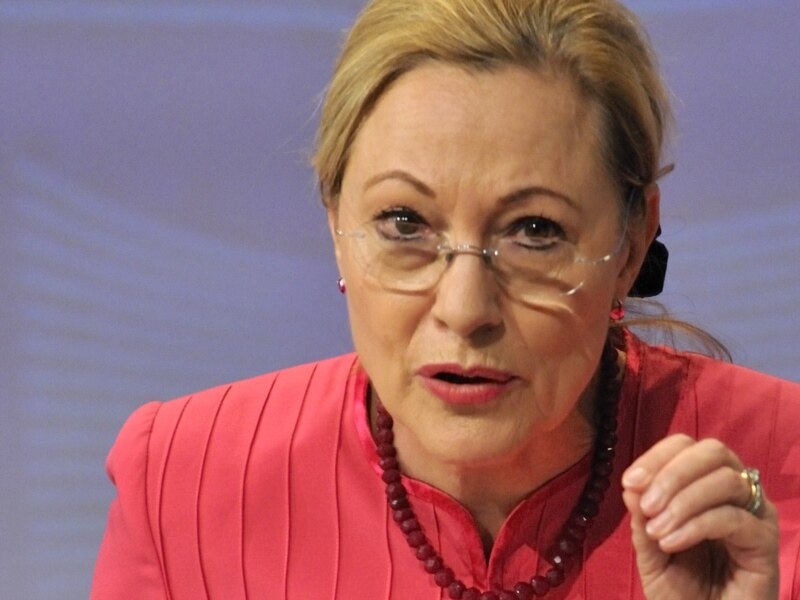
Benita Ferrero-Waldner is expected to tell EU foreign ministers that the bloc has no choice but to seek closer ties with its neighbors.


Keeping its eastern neighbors on the path to stability and prosperity has become a formidable test for EU foreign policy in recent months.

As she unveiled an annual review of the bloc's European Neighborhood Policy, EU External Relations Commissioner Benita Ferrero Waldner told the 27 EU foreign ministers it has been a "difficult year" -- particularly in the east.

But Czech Foreign Minister Karel Schwarzenberg, who chaired the meeting, said the EU is resolved to push on with its Eastern Partnership initiative, which is designed to forge closer ties between the bloc and six eastern neighbors.

"We believe that sending a strong message to the six partnership countries -- Ukraine, Belarus, Moldova, Georgia, Armenia, and Azerbaijan -- is very important in the light of the recent developments in the region, and that we need to engage with our neighbors more closely in order to promote good governance, the rule of law, and transparency," he said.

Brutal Crackdown

One need look no further than this month's unrest in Moldova to know that this will not be easy.

That country is still recovering from a brutal crackdown on mass public protests in the capital, Chisinau, following a landslide win for the ruling Communists in parliamentary elections. In the wake of the violence, the country's increasingly Russian-leaning president, Vladimir Voronin, pointedly accused neighboring Romania -- an EU member -- of fomenting the unrest.

Moldova then expelled the ambassador to Romania and imposed a summary visa regime on Romanian visitors. And sources in Brussels say Voronin told Kalman Miszei, the EU special envoy, that Moldova has "friends elsewhere."

Now, at Romania's request, EU foreign ministers meeting in Luxembourg discussed Moldova during talks over lunch -- a setting usually reserved for issues of particular concern.

The EU adopted a declaration saying it has "serious concerns" about developments in the country, and Czech Foreign Minister Schwarzenberg said Moldova "poses a challenge" for the EU.

"The current tensions in the country pose a challenge for the European Union. Our task is now to find a proper way to strengthen our policy of bringing Moldova closer to our standard," he said. "We expect Moldova to behave in a European way, not only vis-a-vis the European Union and its members, but first of all, of course, internally."

But, Schwarzenberg stressed, the Eastern Partnership initiative remains "no doubt the right tool" to bolster reforms in Moldova.

Cutting Some Slack

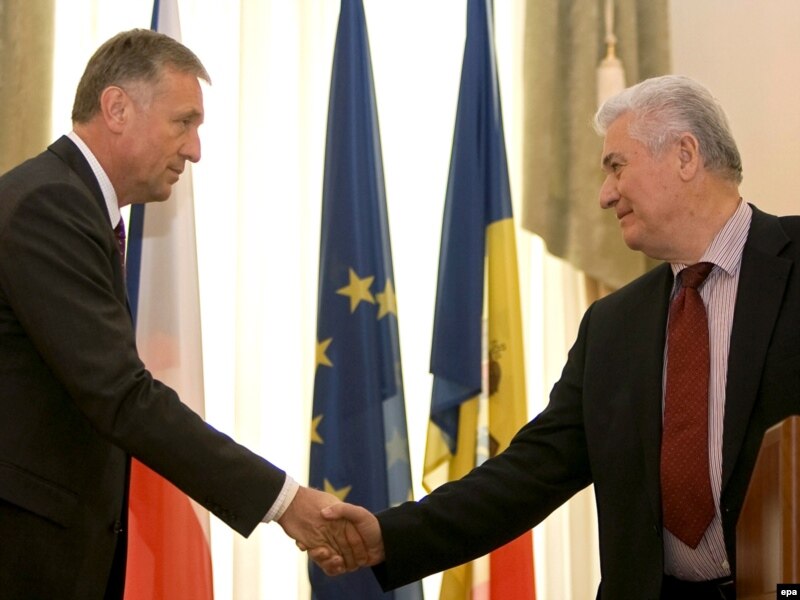
Czech Prime Minister Miroslav Topolanek, who was in Chisinau last week representing the EU Presidency, reported that neither the government nor the opposition appears to have the political will to meet the other side for talks -- a key EU wish.

Moldovan President Vladimir Voronin (right) meets with Czech Prime Minister Mirek Topolanek in Chisinau on April 22.

The Netherlands is the lone advocate of a tougher EU stance on Moldova (and another problematic partnership member, Belarus). But Germany and Poland head the EU's mainstream in arguing that Moldova must not be isolated and needs greater EU support.


The country's economy is seen by many in the EU to be on the brink of collapse.

Moldova's decision to slap visas on Romanians is, however, likely to have repercussions. The European Commission has called the measure unacceptable in light of EU-Moldova visa facilitation talks and is likely to raise it at an EU-Moldova meeting in a few days.

Moldova's partner on the EU lunch agenda was neighboring Ukraine, where there has been no public unrest but where mounting political and economic paralysis increasingly threatens the country's viability.

Again, Germany and Poland appear to be closely coordinating policy, with the two countries' foreign ministers reported to have addressed a joint letter to the EU's Czech presidency last week expressing concern at the economic and political situation in Ukraine.

The two ministers are said to have floated the idea of an EU assistance mission to Ukraine to facilitate dialogue among all political leaders. However, it is generally feared that a resolution to the political crisis in Ukraine is improbable before the 2010 presidential elections.

The EU's foreign-policy chief, Javier Solana, said after the meeting that the EU would now study ways of stabilizing the country. "After the discussion today we will see how we can help prior to the elections and after the elections, the presidential elections, to see how we can arrange the economic situation and the political situation," he said.

Is Lukashenka Coming?

The EU foreign ministers on April 27 will also discuss the agendas and guest lists of two important upcoming summits.

On May 7, representatives of Belarus, Ukraine, Moldova, Georgia, Armenia, and Azerbaijan have been invited to attend a summit in Prague on its Eastern Partnership, which is meant to extend special benefits to the EU's eastern neighbors.

Much speculation is circulating over whether Belarus's authoritarian president, Alyaksandr Lukashenka, will attend. The invitations to the summit are not personal, giving every country's leader the choice of whether to turn up in Prague in person. Many EU nations expect Lukashenka to send a stand-in.


A joint declaration signed by the 27 EU member states and the six partner countries is planned for the summit. The text of the document is still being discussed with the partners and is expected to be finalized a week in advance of the summit.

On May 8, the EU will hold another summit in Prague, dedicated to what has become known as the Southern Corridor of energy provision.

This meeting will be conducted under the auspices of the EU "troika" of Topolanek, Solana, and European Commission President Jose Manuel Barroso. The three will face officials representing Azerbaijan, Georgia, Turkey, Kazakhstan, and Turkmenistan.

Six 'Observers'

Together, the five countries represent the EU's main hope of securing significant amounts of natural gas deliveries without resorting to Russian supplies or mediation.

Six "observers" have also been invited -- Iraq, Egypt, and Uzbekistan as potential supplier countries; and Russia, Ukraine, and the United States as other major interested parties.

The presence of the last three has been the subject of some controversy within the EU. Germany led a long-established group of countries -- including France, Italy, and Spain, among others -- which overcame resistance from others and secured an invitation for Russia.

The Southern Corridor is explicitly defined by the EU as a direct link to energy resources in the Caspian Sea region bypassing Russia.

A draft summit declaration, seen by RFE/RL, breaks new ground for the EU by saying the bloc intends to "give strong political support" to the construction of the Southern Corridor -- including the "trans-Caspian link."

This is a planned gas pipeline running from Turkmenistan to Azerbaijan which would link Central Asia directly with the Nabucco pipeline projected to run from Baku to Europe, circumventing Russia.

Monday, April 27, 2009

Diplomatic confusion

From today's Washington Times, "Embassy Row" section:

Foreign Visitors in Washington this Week

Iulian Fota, national security adviser to President Traian Basescu of Moldova, who addresses the German Marshall Fund of the United States on "realities and repercussions of unrest in Moldova."

A couple of observations:
Traian Basescu is the president of Romania. The president of Moldova is Vladimir Voronin. According - at least -to the UN, Republic of Moldova and Romania are two different countries.

Saturday, April 25, 2009

Moldova's 'Twitter revolutionary' speaks out


BBC
April 25


The Moldovan capital, Chisinau, was rocked by protests earlier this month amid claims that an election which returned the Communist Party to power was rigged.

The BBC's Oana Lungescu spoke to Natalia Morar, the journalist accused of masterminding Moldova's "Twitter revolution" - so dubbed because many demonstrators were alerted to the protests by text and social networking tools.

Natalia Morar, 25, smiled broadly when I met her on Friday night in a park in central Chisinau.

"I never felt that just a walk in the park could be such a big happiness," she told me. "It feels great!"

Just hours before, she had been under house arrest. For the previous 10 days she had had no access to internet and was not allowed to talk on the phone.

"It was really terrible because I was absolutely cut off from all sources to find out what happened to my friends, who were with me in the street."

Officially charged with helping organise mass disturbances, she faces 15 years in prison, but strongly denies any involvement in the violence.


Spontaneous protest


The authorities, she says, have shown her no photos, videos or any other evidence to substantiate the charges against her.

It all started in a Chisinau cafe, when Ms Morar and a handful of friends decided to hold a peaceful protest against the Communist victory in what they thought was a rigged election.

"It just happened through Twitter, the blogosphere, the internet, SMS, websites and all this stuff. We just met, we brainstormed for 15 minutes, and decided to make a flash mob [internet-organised spontaneous public gathering]...

"In several hours, 15,000 people came out into the street."


Youth 'unhappy'


Although she was amazed by the size of the protests which started peacefully on 6 April, she thinks the reason was sheer frustration pent up in Europe's poorest country.

"None of us could imagine that such a thing could happen," Ms Morar told me, "but it shows there exists a very big protest inside society and within young people.

"Moldovan youth are not pleased with what is happening in Moldova. Liberty is a great thing for us and we don't want to live in a Soviet kind of society," she says vehemently.

The protests, which turned violent on 7 April, were dominated by young people who grew up after Moldova declared independence from the Soviet Union in 1991. Thousands have studied in neighbouring Romania, an EU member, and hundreds of thousands have had to seek work abroad.

Ms Morar dismisses allegations that either Romanian or Russian secret services were behind the protests.

Two years ago, she was expelled from Russia for writing about a money-laundering scandal allegedly involving the Kremlin and Russia's security service.

Now, she tells me, she plans to quit journalism and work full-time with a youth foundation called ThinkMoldova she helped set up last year to bring democratic change to her native country.

But does she consider herself a dangerous woman? The question makes her laugh.

"I'm just a young woman with an active [interest in my country], nothing else. I'm just a free person and I want to be free."


Breakthrough


Most of the 200 people arrested during the protests have now been freed.

Three died during the protests in suspicious circumstances.

In an apparent breakthrough, after two high-level EU visits to Chisinau this week, the EU foreign policy chief Javier Solana announced that the authorities had agreed to start a political dialogue with the opposition parties and include them, together with international experts, in a commission due to investigate the unrest.

After talks with Mr Solana, the veteran communist President Vladimir Voronin said Moldova had emerged from the political crisis. But a senior EU diplomat described it more cautiously as "a good start."

The EU envoy for Moldova, Kalman Mizsei, will work out the details in the next few days, together with officials from the Council of Europe.

EU foreign ministers will also discuss the situation in Moldova on Monday, in a flurry of diplomatic activity that shows Europe's troubled eastern border remains under close watch.

Friday, April 17, 2009

EU dismayed by Romania mass citizenship plan


Andrew Rettman

EU Observer

April 17


EU institutions are appalled at Romania's proposal to give citizenship to up to 1 million Moldovans - a project that could damage Romania's standing inside the union.

If the scheme goes ahead and Moldova retaliates by making dual citizenship illegal, the EU country would effectively annex one quarter of its neighbour's population in a scenario described by one EU official as "frightening" in terms of regional stability.

Passport control - Romania is to enter the Schengen zone in 2011 (Photo: mpd01605)

"This is just a proposal, an expression of will. I am not sure if it is not just a political statement," EU foreign relations spokeswoman Christina Gallach said.

But the Czech EU presidency publicly rebuked Bucharest after a meeting between Czech EU minister Alexandr Vondra and Romanian foreign minister Cristian Diaconescu, in a sign of rising tension within the bloc.

"I told my Romanian colleague about our serious concerns of the possible risks arising from adopting simplified procedures for Romanian citizenship," Mr Vondra said.

Bucharest on Wednesday night put forward a bill to extend the right to naturalisation for Moldovans whose grandparent or great-grandparent was a Romanian. Previously, only Moldovans with Romanian grandparents could apply.

The draft law - which still needs parliamentary approval - also cut the deadline for processing paperwork from six months to five months and dropped a Romanian language test.

The move is a tit-for-tat reaction to Moldova's decision to impose visa requirements on Romanian citizens after accusing Romania of trying to stage a coup following elections last week.

Under EU law, Romania is free to give citizenship to anybody it likes.

EU states in any case collectively naturalise over 730,000 people a year in what amounts to an annual mini-enlargement, bigger in scale than the individual populations of the smallest member states, Malta and Luxembourg.

In 2006 - the latest data available - the UK and France each gave citizenship to some 150,000 people, while Germany gave passports to 125,000 individuals. But mass-scale naturalisation on the Romania-Moldova model would be unprecedented.


The Spanish gambit


Spain in 2005 "normalised" 600,000 irregular migrants. The move stopped short of granting EU citizenship but did give permanent residency and right to work, with Madrid at the time facing strong criticism for failing to consult EU colleagues.

Poland at one point mooted offering citizenship to up to 1 million ethnic Poles left in Ukraine, Belarus, Russia and Kazakhstan following post-World War II changes to its borders and Stalinist relocations.

But Warsaw feared potential complications in its bid to join the EU's passport-free Schengen zone. The final deal in 2007 - the right for ethnic Poles to apply for a "Polish Card" - limited rights to a refund of visa costs, access to healthcare and a cheap bus pass.

"People still haven't quite forgiven Spain. You see that in the little obstacles put in their way during day-to-day talks on immigration matters," one EU diplomat said. "The EU institutions have a long memory."

Saturday, April 11, 2009

RSF: Moldovan authorities urged to stop violence against journalists


Reporters Without Borders
Press Release
April 10


Reporters Without Borders is very disturbed that the Moldovan authorities have been arresting journalists and even using violence against them amid angry protests and rioting about the results of last weekend’s parliamentary elections. Both Moldovan and Romanian journalists have been affected.

“We appeal to the authorities to act with care and restraint,” Reporters Without Borders said. “They have a duty to ensure that the detained journalists are released without delay and that media are able to work freely and safely. Moreover, the stigmatisation of Romania and Romanian journalists is a dangerous strategy. Both the Moldovan authorities and foreign governments must refrain from stirring up violence, especially ethnic violence.”

The press freedom organisation added : “We appeal to the Organisation for Security and Cooperation in Europe to take a firm position. The protection of journalists and civil rights is an essential part of the OSCE mandate.”

Oleg Brega, a journalist with the Internet TV station Jurnaltv.md and free speech activist involved in organising peaceful demonstrations, was attacked by five men, some wearing uniforms, while filming on 8 April in Chisinau. Brega and another journalist, Vasile Costiuc, were arrested yesterday. Costiuc was released but Brega is still being held. His apartment was searched today.

The editor of the Jurnal de Chisinau newspaper, Rodica Mahu, was arrested this morning by four men in plain clothes from the Department of Special Missions who claimed she was “gathering and evaluating information in order to attack a government building.” She was freed this afternoon. Cameraman Constantin Rogodantev of the ProTV Chisinau television station was attacked last night by masked policemen who smashed his camera.

Among the many Romanian journalists to be targeted was Doru Dendiu of the Romanian public television channel TvR, who was arrested today as he was about to introduce a report live for the 1pm news programme. A crew with the Romanian TV station Realitatae was detained for several hours last night.

Interior ministry officials threatened to jail or shoot Romanian journalists Evgenia Kironaki, Mihai Valentin Buzduga and Gabriel Colac. In the end, they were deported. Peru Terguta, a journalist who is the Romanian correspondent for Romania’s Antena 3 TV station and who also works for Moldova’s TV 7, was forced to leave the country under OSCE escort after receiving phone calls announcing his imminent arrest.


Meanwhile, the protests in the Republic of Moldova are continuing, as the harassment of journalists and the surrender of people suspected of being against the regime. A huge gathering of the opposition is scheduled for Sunday.


See also:

09.04.09/ Declaration of media NGOs from Moldova on the situation of the press, violations of the right to access to information and attacks on journalists.

Media NGOs are expressing serious concern about the recent deterioration of the media situation in Moldova, violations against the public right to access information and recent incidences of journalists' harassment by law enforcement officials.

Several reporters from the investigative newspaper "Ziarul de Garda," were harassed by police officers on the evening of April 8, 2009. The journalists' arms were physically assaulted and were told that their cameras would be destroyed. On the same day, while doing his job, Oleg Brega, a cameraman for the Internet news channel Jurnal TV, was beaten by several individuals wearing plain clothes who then seized two of his video cameras. Ziarul de Garda and Jurnal TV have gathered evidence from both incidents which could identify the perpetrators, and are willing to provide this evidence to law enforcement officials.

On Thursday, April 9, the social networking websites, Facebook.com and Odnoklassniki. ru were blocked for users in Moldova. The day before, administrators discovered that the server of the information portal Unimedia.md had been attacked several times. A number of online resources have been blocked for Moldovan users over the past 3 days. TV stations Realitatea TV and TVR 1 have been taken off the list of cable operators in Moldova. These stations disappeared on Tuesday night, at around 21.00. Cable operators have cited technical difficulties as the cause, but the rebroadcasting have yet to be restored. Consequently, Moldovans are being denied access to vital international sources of information.

The signatory organizations contributing to this statement vehemently protest the attacks made on working journalists by Moldovan law enforcement officials and demand an immediate end to these abusive and illegal practices. The victims' cases should be thoroughly investigated and those responsible for the attacks must be brought to justice.

In support of the constitutional right to access to information for all citizens through media, the signatory organizations call upon Moldovan authorities to ensure media freedom under the obligations incumbent to a member of the Council of Europe and to facilitate the public's access to information.


Independent Journalism Center

Association of Independent Press

Investigative Journalism Center

Young Journalist Center of Moldova

Union of Journalists of Moldova

Broadcast Media Association

"Acees-info" Center


Thursday, April 9, 2009

Russia asks EU to protect Moldova's sovereignty


Dmitry Solovyov and Sabina Zawadzki
Reuters
April 9

CHISINAU (Reuters) - Russia asked the European Union and Romania on Thursday to guarantee the sovereignty of its ally Moldova, where riots have swept the capital and prompted a crackdown on the pro-Western opposition.

Moldova's veteran Communist president, Vladimir Voronin, has accused neighboring Romania of stoking a coup attempt after demonstrators ransacked parliament during post-election protests two days ago and waved EU and Romanian flags from his offices.

The European Union urged Moldova to drop punitive measures it took against Romania and respect constitutional freedoms after at least 193 people were arrested in Tuesday's riots.

Moldova has imposed a visa regime on Romania, expelled its ambassador and denied entry to more than 19 Romanian journalists. It says the measures are needed because Romania is threatening its sovereignty, a charge Bucharest dismisses.

"In the past days, Chisinau has taken arbitrary and discriminatory measures against Romanian citizens," Romanian Foreign Minister Cristian Diaconescu told reporters, describing the visa imposition as "reckless."

Located on the European Union's border but within the former Soviet space that Moscow sees as its sphere of influence, Moldova has the potential to enflame EU-Russian relations, already upset by last August's Russia-Georgia war and disruption to Russian gas flows to Europe at the start of this year.

Wary of getting embroiled in a new dispute with Moscow, the EU's executive Commission said the bloc fully recognized Moldovan sovereignty.

"While understanding the complexity of the Moldovan-Romanian relations, we call on the government of Moldova to resume normal relations with Romania," the foreign ministers of France and the Czech Republic and Sweden said in a joint statement. The three countries are the EU's previous, current and next presidents.

In Moscow, Russian Foreign Minister Sergei Lavrov said he was "deeply disturbed" by the flags and slogans at Tuesday's riots because they showed that the demonstrators "were obsessed with the idea of destroying Moldovan statehood."

Most of present-day Moldova, Europe's poorest country, was part of Romania until Stalin annexed it to the Soviet Union in 1940. It won independence when the Soviet Union fell in 1991.

"We hope that the EU and the Romanian leadership, which publicly condemned the violence, will take action to ensure that Romanian flags and Romanian slogans are not used as the cover for undermining Moldovan statehood," Lavrov told the state-run RIA news agency.

Europe's only Communist ruler, Voronin says Romania wants to seize control of his mainly rural country of four million people where the average monthly salary is $250. Romania has rejected the accusations.


Protests dwindle


In power since 2001, Voronin faces a growing economic crisis as thousands of Moldovans working abroad lose their jobs in the global economic crisis and stop sending home the hard currency on which much of the local economy depends.

"People here simply don't have a future," said a woman walking in the capital who refused to give her name. "We also have children and we're hoping for a better life. We're simply tired of this dictatorship."

The streets of the capital Chisinau were quiet on Thursday morning as the opposition parties, shaken by the scale of Tuesday's violence, pondered their next move.

Opposition leaders have tried to distance themselves from the violence. They said people had been getting messages on their mobile phones and via the Internet about a new protest on Friday which they said they had nothing to do with.

The Liberal party, which won 12.75 percent of the vote in the disputed parliamentary election, called on the European Union to send a special mission to investigate the riots.

Some Moldovan opposition figures say the Communists were behind the violence as part of an attempt to distract the population from Moldova's economic woes. The Central Election Commission has rebuffed opposition demands for a recount of Sunday's vote, which the Communists won with 49.5 percent.


See also:

Moldova asks Ukraine to extradite businessman Stati


Kyiv Post

The Moldovan Prosecutor General's Office has asked Ukraine to extradite Moldovan businessman Gabriel Stati, who has been accused of funding the recent protests in Chisinau, Moldovan Prosecutor General Valeriu Gurbulea told the media on Thursday.

"The prosecutor's office has received confirmation of the arrest in Odesa of Gabriel Stati. Moldovan prosecutors appealed to their Ukrainian colleagues [to extradite Stati] on Wednesday," he said.

"His extradition is under consideration. We will investigate his possible involvement in the organization and funding of the protests," Gurbulea said.

Wednesday, April 8, 2009

Twitter Revolution in Republic of Moldova: the third day

- The border points between Romania and Republic of Moldova have been closed the last night. Many Romanian and foreign journalists were not allowed to cross the border.

- The Romanian ambassador in Kishinew was declared persona non grata. The same happened with the minister counselor of the Romanian embassy. Moldova announced the introduction of the visa system for Romanian citizens. The announcement was made by president Vladimir Voronin for the Russian press agency Ria Novosti. The same Voronin in another declaration for Ria Novosti accused again Romania of involvement in the protests from Kishinew. In addition, Voronin warned that the use of force against the protesters will be took into consideration. The Romanian MoFA considered those claims are unacceptable.

- Most part of the declarations and media reports are transmitted via the Russian media, mostly the declarations of Moldovian officials.

- Children from schools and highschools in Kishinew are forbidden to leave the school compounds.

- In the central square from Kishinew around 1.000 young people are continuing the protests. The number decreased in the afternoon to 00/

- The Russian minister of Foreign Affairs, Serghei Lavrov, stated the claims for reorganization of the parliamentary elections in the Republic of Moldova are "groundless".

- Russian media: Serghei Mocanu, leader of the opposition, is under arrest.


See also:

Following the violent protests in Moldova , Eastern Europe experts at the European Council on Foreign Relations have issued the following media statements (April 7):

Andrew Wilson, senior policy fellow, says:

" Moldova 's violent 'Twitter revolution' is totally different from the peaceful protest of Ukraine 's Orange Revolution. This time the crowd are not angry at a stolen election, but at the growing corruption of the ruling Communist Party, its recent turn towards Russia and an imminent economic crisis."

Nicu Popescu, policy fellow, says:

" Moldova may be small, but the survival of its democracy matters for the whole of Europe . Javier Solana must immediately travel to Chisinau to mediate between politicians and protestors before any further blood is shed."

Read more:

Andrew Wilson has published widely on the politics of the European neighbourhood, and on previous "coloured revolutions" .

Nicu Popescu is a Moldovan, and has written extensively on the politics of his country. He holds a doctorate in International Relations from the Central European University in Budapest , Hungary , and co-wrote the Moldova chapter of Nations in Transit 2006 (Freedom House).

Wilson and Popescu are the authors of a forthcoming ECFR policy report comparing the European and Russian Neighbourhood Policies.

For press enquiries:


Andrew Wilson : E: andrew.wilson@ecfr.eu; T: +44 7920 421 066

Nicu Popescu : E: nicu.popescu@ecfr.eu; T: +44 7795 312 467

For all other press queries please send an email to press@ecfr.eu

About ECFR:

Launched in October 2007, the European Council on Foreign Relations is a pan-European think tank and advocacy group, co-chaired by Martti Ahtisaari, Joschka Fischer and Mabel van Oranje. (www.ecfr.eu)

James Clasper
Media Advisor
European Council on Foreign Relations
5th Floor, Cambridge House
100 Cambridge Grove
London
W6 0LE

Tel: +44 (0)20 7031 1623
Mob: +44 (0)7951 936 556
E: press@ecfr.eu
W: www.ecfr.eu

OSCE Mission to Moldova condemns post-election violence and appeals to all sides for restraint

CHISINAU, 7 April 2009 - The Head of the OSCE's Mission to Moldova, Ambassador Philip Remler, condemned today's outbreak of violence in the Moldovan capital following Sunday's parliamentary elections and urged all political sides to do their utmost to de-escalate the situation.

"Violence is not compatible with democratic values. We strongly urge all to refrain from any violent actions, which we unreservedly condemn. We call on the authorities and all political forces to exercise restraint and to urge others to show restraint as well," he said.

Sunday's parliamentary elections were observed by a joint mission of the OSCE Office for Democratic Institutions and Human Rights (ODIHR), the OSCE Parliamentary Assembly, the Parliamentary Assembly of the Council of Europe and the European Parliament.

The joint mission's statement and preliminary findings can be found here: http://www.osce.org/documents/odihr/2009/04/37142_en.pdf

The OSCE Mission to Moldova will continue to monitor the protest in line with its mandate.

ODIHR is following the post-election situation according to its normal procedures.


Tuesday, April 7, 2009

Violent anti-communist protests after election in Moldova


Demonstrators hurl stones at the police during a protest against the outcome of Sunday's election in Chisinau

(Gleb Garanich/Reuters)

Demonstrators hurl stones at police during the protest in Chisinau. At least 30 people were hurt


The tiny republic of Moldova erupted in violence today as anti-communist demonstrators stormed the parliament in protest at what they said were rigged elections.

Angry crowds smashed windows and threw furniture and computers from the building after overwhelming riot police in the capital Chisinau. Up to 20,000 people were said to be on the streets, many chanting "Freedom, freedom" and "Down with the communists".

At least 30 protesters and police were reported hurt in clashes. Police fired tear gas and water cannon to try to regain control as the demonstrators, many of them students, lit fires and attacked a nearby presidential administration building.

The violence came after the Communists won some 50 per cent of the vote in parliamentary elections in the former Soviet republic, where they have been in power since 2001. Under Moldova's constitution, parliament will elect a new president to succeed the Communist leader Vladimir Voronin, who is due to step down after serving the maximum two terms.

Moldova is Europe's only communist state and one of its poorest, with an average monthly salary of only $350. Thousands of its people seek work abroad to support their families, sending back $1.6 billion in remittances last year - about the same amount as the state budget.

International observers had judged the election to be fair but the Mayor of Chisinau, Dorin Chirtoaca, alleged that turnout had been inflated to cover up ballot fraud and multiple voting. Mr Chirtoaca is also deputy leader of the opposition Liberal Party.

Moldova's three main opposition parties demanded fresh elections to defuse tensions as protesters burnt communist flags and chanted "We want to join Europe" and "We are Romanians". Many were waving Romanian and European Union flags.

Two-thirds of Moldova's 3.8 million people are descended from Romanians and retain strong ties with their neighbour in the EU. The former Bessarabia was part of Romania until Josef Stalin annexed it for the Soviet Union under the Molotov-Ribbentrop pact with Hitler's Germany in World War Two.

The EU's foreign policy chief Javier Solana called on all sides to "refrain from violence and provocation" amid fears of instability on the union's eastern border. Moldova is scheduled to join the EU's new Eastern Partnership aid programme next month with five other former Soviet republics.

Russia's deputy foreign minister, Grigory Karasin, expressed concern at the violence, which he said had been provoked. He noted that observers from the Organisation for Security and Co-operation in Europe and from former Soviet republics in the Commonwealth of Independent States had declared the election result to be fair.

The protest began yesterday with demonstrations organised by a protest group called I Am An Anti-Communist. Organisers said that they did not believe one in two Moldovans had voted for the Communists.

"The protests are justified because people did not vote for the Communists in such large numbers," Mr Chirtoaca told local television. "The elections were fraudulent, there was multiple voting...These are people who don't know what democracy is."

The only foreign leader to congratulate Moldova after Sunday's poll was Russia's President Dmitri Medvedev. He has recently sought to mediate a settlement to the "frozen conflict" between Moldova and its Russian-dominated region of Transdniestr, which declared independence in 1990.

Hundreds died in fighting between the two sides until Russian peacekeepers intervened. Transdniestr voted in a referendum in 2006 to seek to join Russia, but the international community refused to recognise the decision.

Moldova's Communist Party was strongly pro-Russian until 2005, when it abruptedly adopted a pro-European policy amid local anger at negotiations over Transdniestr that many feared would hand too much power to Moscow.

The party ran on a pledge to build a "European Moldova" in the elections, although the country remains heavily dependent on Russia for supplies of gas and other materials.


In a way, it is a similar scenario, played before in Serbia-Montenegro in the time of Milosevic, in Kucima's Ukraine, in Shevarnadze's Georgia. In all these cases you had suspicions over the organisation of the electoral process. Also, you had the same ruling parties with strong ties to organized crime and corruption, under the cover of (neo)communism. These "revolutions" made history. Part of history is as well the lack of proper elites and individuals prepared to take seriously the public duties. What will happened in the Republic of Moldova - is unknown, dued also to the trouble situation from Transdniestr. The lesson of Georgia from the last year should be revisited.


Moldova's Twitter Revolution


Evgeny Morosov

Foreign Policy

April 7


Cellphones and text messaging are widely believed to have played a crucial role in fostering the Orange Revolution in Ukraine (or at least, making the protests as widespread and successful as they were); the Berkman Center at Harvard published probably the most comprehensive study of the role that social media played in the Orange Revolution (even though I criticized some of its cyber-utopian assumptions in a recent essay for Boston Review).

Could it be that five years after the famous protests in Kiev's Maidan Square another technology - Twitter - will usher in another revolution in neighbouring Moldova? Will we remember the events that are now unfolding in Chisinau not by the color of the flags but by the social-networking technology used?

If you asked me about the prospects of a Twitter-driven revolution in a low-tech country like Moldova a week ago, my answer would probably be a qualified "no". Today, however, I am no longer as certain. If you bothered to check the most popular discussions on Twitter in the last 48 hours, you may have stumbled upon a weird threat of posts marked with a tag "#pman" (it's currently listed in Twitter's "Trending Topics" along with "Apple Store", Eminem, and Easter).

No, "pman" is not short for "pacman"; it stands for "Piata Marii Adunari Nationale", which is Romanian name for the biggest square in Chisinau, Moldova's capital. This is not the first time that a Twitter "tag" has been used to mobilize young people around a particular event; the most famous previous case has been that of "griots" - the tag used to report on the youth riogs in Greece, which later spread to Europe, arguably also with the help of Twitter (chech these two pieces I wrote on the subject of "networked protest" - one for The Economist and one for openDemocracy).

Ever since yesterday's announcement that Moldova's communists have won enough votes to form a government in Sunday's elections, Moldova's progressive youth took to the streets in angry protests. As behooves any political protest by young people today, they also turned to Facebook and Twitter to raise awareness about the planned protests and flashmobs. Led by youth NGOs like HydePark and ThinkMoldova, the protests began very peacefully - as a flashmob, where young people were simply supposed to hold lit candles in the vicinity of the square.

However, this morning things got out of hand - and, with or without Twitter's help, the crowd got much larger, reaching as many as 10,000 people, who first picketed Election Commission headquarters, the president’s residence (windows are reported to be broken - and there are also reports that this building has been stormed), and other government buildings before storming the building of the Moldovan Parliament, which happens to be just across the road.

Technology is playing an important role in facilitating these protests. In addition to huge mobilization eforts both on Twitter and Facebook, Moldova's angry youth - especially those who are currently abroad (roughly a quarter of Moldova's population are working abroad due to dire economic conditions back at home) - could follow the events on this livestream provided by a Romanian TV station - directly from the square.

I've just spoken to a Moldovan friend who is himself a big technology fan; according to him, there is little to none cellphone coverage in the square itself (turning off cellphone coverage in protest areas is a trick that was also used by the Belarusian authorities to diffuse 2006 protests in Minsk's central square), so protesters have to leave it to post updates to Twitter via GPRS technology on their mobiles.

The related posts on Twitter are being posted at a record-breaking rate - I've been watching the Twitter stream for the last 20 minutes - and I see almost 200 new Twitter messages marked with "pman" (virtually all of them in Romanian, with only one or two in English). In the last few hours there have also emerged several "smart" aggregators of posts on the subject, like this one - they have to contextualize what exactly is happening -- and this one for YouTube videos. Many blog posts are also being updated in real-time - minute by minute - check this one. There are also a plenty of videos on YouTube and photos, including those uploaded to Facebook.

There are also a few moving English-language Twitter posts like this - "in #pman a grenade thrown by the police has torn apart one of the protester's leg"- that would surely be perused by foreign journalists. It's hard to predict for how long this cornucopia of user-generated media would continue; my Moldovan contacts report that the authorities may have required some Moldovan ISPs to restrict Internet connection with the outside world, so the protesters might soon face difficulties in getting their reports out.

All in all, while it's probably too early to tell whether Moldova's Twitter revolution will be successful, it would certainly be wrong to disregard the role that Twitter and other social media have played in mobilize (and, even more so, reporting on) the protests. Of course, it helps that young Moldovans are sick and tired of the communist government (for a long time the only one in Europe) and there may be a few reasons to be concerned about voting irregularities but, overall, the Chisinau protests undoubtedly present an interesting case-study that I hope academic institutions like Harvard's Berkman Center and others would take on and examine in detail.

Photo: VADIM DENISOV/AFP/Getty Images

16.10 - The Internet was cut in Kishinew. The sites of the news agencies and othr media tools were not available two hours later.


See also:

Jamestown Foundation on the prospects of Moldova-Balkans pipeline

EU Presidency Statement on the developments in the Republic of Moldova


The Presidency expresses its serious concern at the developments in the Republic of Moldova, following the 5 April parliamentary elections.

The Presidency wishes to recall that the International Election Observation Mission noted in its preliminary findings that the elections met many international standards and commitments, but that further improvements were required to ensure an electoral process free from undue administrative interference, and to increase public confidence.

The Presidency condemns the use of violence and calls for restraint on all sides. It is crucial to respect the freedom of peaceful assembly.


Facts about ex-Soviet Republic of Moldova

(Reuters) - Moldova's opposition parties are calling for a fresh election in the former Soviet republic.

They made the demand after students protesting over Sunday's election victory by the ruling Communists broke into Moldova's Parliament building on Tuesday and hurled chairs, tables and papers into the street before setting them ablaze.

Following are facts about the country.

* Moldova is a former Soviet republic that declared independence on August 27, 1991.

* It has a population of about 4.5 million sandwiched between Ukraine and European Union member Romania, with whom it shares linguistic and historic heritage.

* Moldova's ruling Communists won a parliamentary election on Sunday. The Organisation for Security and Cooperation in Europe said the poll met many international standards, but several thousand people, mainly students and youths, took to the streets to protest against what they said were Communist violations. Some broke into the parliament building on Tuesday.

* President Vladimir Voronin is the only Communist leader in Europe and the former Soviet Union. In office since 2001, he has said he wants to stay close to power. He cannot serve a third consecutive term.

* Transdniestria, a sliver of land in the east and populated by mainly Russian speakers, broke away in 1990 and the two sides fought a brief war in 1992 after Moldova gained independence. Transdniestria, home to much of the country's industry, demands independence. Moldova is willing only to give it autonomy.

* Moldova is the poorest country in Europe. Its economy is driven by agricultural production -- its wines are famous in the region.

* Moldova is part of the EU's Eastern Partnership and European Neighbourhood Policy initiatives, but not a member of the NATO military alliance. It relies heavily on Russia for its energy resources.


An eye on Belarus:

EU Czech presidency: “Situation in Belarus hasn’t considerably changed”

charter97.com

April 7

The Czech Republic, holding the EU presidency, says the decision on inviting Alyaksandr Lukashenka to the Eastern Partnership summit will be made at the very last moment.

On April 6, Czech deputy prime minister for European affairs Alexandr Vondra said “it is important to motivate Minsk to positive steps,” Agence France-Presse reports.

“This European policy has so far produced partial results. However, we are far from saying that the situation has considerably improved," the Czech official said.

Alexandr Vondra stressed that none of the six countries is yet prepared for EU membership and that the program should "bridge the period" till membership begins.

The Czech Republic also confirmed the summit would be held in Prague on May 7. Earlier it was said that the summit might have been held in Brussels. The Eastern Partnership program is one of the primary aims of the Czech presidency, expiring on June 30.

Azerbaijan, Armenia, Belarus, Georgia, Moldova, and Ukraine are offered closer political ties and economic integration in the frames of the new project. It doesn’t suppose membership in the European Union but offers participation in bilateral and multilateral projects.

The EU foreign ministers confirmed in March a decision on nine-month visa ban reprieve for Belarusian high ranking officials, including Alyaksandr Lukashenka, who were banned to entry Europe.

In October 2008, the EU Council of Ministers decided to suspend visa bans for Belarusian officials, imposed in 2006 in response to Belarus’s actions against the opposition. The sanctions affected Lukashenka and 41 Belarusian officials.

Sanctions against the officials, suspected by the international community of killings of opposition leaders and a journalist, namely former interior minister Uladzimir Navumau, former secretary of the Security Council Viktar Sheiman, commander of special task squad of the internal troops Dzmitry Paulichenka, and former interior minister Yury Sivakou still remain in force. Lidziya Yarmoshyna, head of the Central Election Commission, is also banned to entry the EU for rigging the election results in Belarus.


UPDATES from Kishinew


17.00 The representatives of the opposition from Kishinew are negotiating with the prime minister Zinaida Greceanu and the leaders of the Communist Party the possibility to organize new elections. The discussions are taking place in the presence of the EU and US ambassadors in the Republic of Moldova.
This round ended at 18.10 without any clear results. The Communist Party accused Romania of implication in a plot aiming to topple the current leadership.
- In the speech held two hours earlier than scheduled, Vladimir Voronin talked about a "very well planned operation" and that "they" want a" bloodshed".
- In a declaration for the Russian agency Interfax, Aleksei Ostrovski, the chief of the State Duma Commission for relationships with the CIS, referred to implications of European intelligence services and certain forces from Romania.
- The Romanian Minister of Foreign Affairs outlined it is following the position of the EU regarding the last evolutions in Kishinew.


In the afternoon, in 10 big towns from Romania, including the capital-city Bucharest they were organized several public gatherings of solidarity with the opposition in the Republic of Moldova.

Thursday, April 2, 2009

EU Dreams in Communist Moldova


Uwe Klussmann in Moldova

Spiegel on-line

April 2

Europe's last Communist regime is looking increasingly shaky. The population in Moldova, which holds parliamentary elections this Sunday, wants reunification with Romania -- and the EU membership it would bring.

German reunification is an increasingly common topic of conversation these days in Moldova, the poorest part of Europe. In the run-up to parliamentary elections on April 5, opposition parties calling for closer links, or even a union, with EU member state Romania are enjoying massive support.

Moldova, a Romanian-speaking country on the south-western border of Ukraine, was part of Romania from 1918 to 1940, and approximately 800,000 of Moldova's current 3.4 million inhabitants have already applied for Romanian citizenship. "If Romanians and Moldovans decide in favor of a union, the EU will not oppose them," says one European diplomat confidently. After all, he says, the Germans had created a precedent with the reunification of East and West Germany in 1990.

Moldova, a former Soviet republic, is located in a region of geo-political tension between Moscow and the West. The country is neutral and belongs to the Commonwealth of Independent States (CIS), a regional organization of former Soviet republics. Russian troops have kept the peace in the country's breakaway region of Transnistria since a 1992 cease-fire ended a secessionist war. At the same time, they are cementing Russian influence in the region, which is home to around half a million people. The explosive situation is comparable to that in South Ossetia, which sparked a war between Georgia and Russia last August.


The party most keen to keep Moldova independent is the Communist Party, which has ruled the country for eight years. It draws strength from the fact that the poor region enjoyed a significant boom during the Soviet era. For years, Moldovan President Vladimir Voronin, who leads the Communist Party, spurred the electorate with hopes for a "rebirth of the socialist community." Now he's taking a more pro-Europe stance.

The graying party functionary still lays Soviet-style wreaths at Lenin monuments on holidays and the Communist Party program still invokes the "volcano of social creativity, born in the revolution." The Communist Party is popular with their German comrades in the far-left Left Party, whose delegations get driven through the country's sunny wine country in Russian Volga cars. The Left Party members rave about their "friendly" and "warm" Moldovan counterparts.


'We Have No Fear'


Those affable Communists, though, are becoming less and less popular among their own people. The only people who listen obediently to Voronin's monotonous speeches are pensioners in worn coats. Speaking in a cultural center in Ustia, a village in the east of the country, he promises that they will soon "be no worse off than the people in the cities."

A Communist election poster, glued to the door of a grocery store, shows a beautiful young woman with impeccable teeth and the slogan: "We are building a European Moldova together." But there is little sign of young beauties with perfect smiles in the village. The customers coming into the store are mainly long-term unemployed with missing teeth. "The young people have gone to Russia or Europe," says Mikhail, a villager in his late fifties. "They are building their futures there."

Among those who are left behind, there are frequent outbursts of rage at the corrupt Communist Party regime, which has helped the president's son Oleg become one of the richest "biznesmen" in the country. The average monthly wage is €175 ($232). "We have no fear" is the slogan at a rally of liberal and right-wing opposition parties in the capital Chisinau, attended by some 30,000 people.

The source of that fear is the country's Information and Security Service, which is headed by a presidential confidant. The intelligence agency is located in a stone building surrounded by rolls of barbed wire on the capital's August 31 Street. In private, its officers boast that they have opposition politicians "under control" -- in other words, blackmailed and bought. The Communist Party plans to enthrone a successor to Voronin, who is barred by the constitution from serving another term, after the election.

Anyone who wants to resist the regime needs to endure a lot -- like Serafim Urechean, leader of the largest opposition party, Our Moldova. Urechean, the ex-mayor of Chisinau and a former Communist Party functionary, sits in his office surrounded by nine icons. He has survived five criminal proceedings, mainly related to abuse of authority, launched by the public prosecutor, which does the government's bidding. Urechean, who has a certain godfather-style charm, sees himself as a savior of the fatherland and a future president. He wants to bring the country into the EU as part of an alliance with Romania.

Dorin Chirtoaca, for his part, dreams of a Greater Romania -- one that includes Moldova. Chirtoaca is the energetic current mayor of Chisinau, belongs to the Liberal Party and has studied in the Romanian capital Bucharest. But his dreamt-of reunification would almost certainly take place without the Russian-speaking region of Transnistria, which suffered so much under Nazi-allied Romania during World War II that full reunification seems unlikely.

The self-proclaimed president of Transnistria, Igor Smirnov, who is not recognized internationally, says his territory would not join Romania. "You should not confuse us with East Germany," he says. "We are not East Germany and Moldova is not West Germany."