Showing posts with label Vladimir Voronin. Show all posts
Showing posts with label Vladimir Voronin. Show all posts
Thursday, June 4, 2009

Tuesday, April 28, 2009
EU Foreign Ministers Discuss Growing Eastern Instability
Radio Free Europe/Radio Liberty
April 27
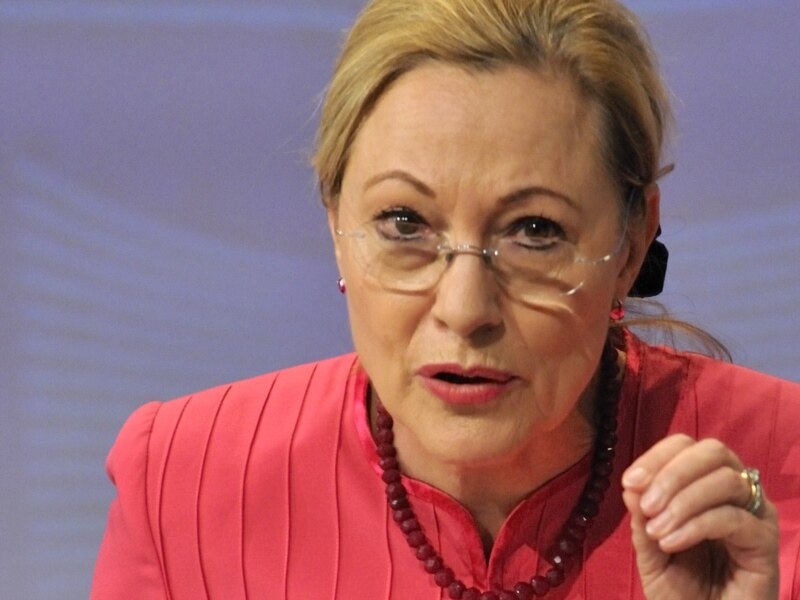
Benita Ferrero-Waldner is expected to tell EU foreign ministers that the bloc has no choice but to seek closer ties with its neighbors.
Keeping its eastern neighbors on the path to stability and prosperity has become a formidable test for EU foreign policy in recent months.
As she unveiled an annual review of the bloc's European Neighborhood Policy, EU External Relations Commissioner Benita Ferrero Waldner told the 27 EU foreign ministers it has been a "difficult year" -- particularly in the east.
But Czech Foreign Minister Karel Schwarzenberg, who chaired the meeting, said the EU is resolved to push on with its Eastern Partnership initiative, which is designed to forge closer ties between the bloc and six eastern neighbors.
"We believe that sending a strong message to the six partnership countries -- Ukraine, Belarus, Moldova, Georgia, Armenia, and Azerbaijan -- is very important in the light of the recent developments in the region, and that we need to engage with our neighbors more closely in order to promote good governance, the rule of law, and transparency," he said.
Brutal Crackdown
One need look no further than this month's unrest in Moldova to know that this will not be easy.
That country is still recovering from a brutal crackdown on mass public protests in the capital, Chisinau, following a landslide win for the ruling Communists in parliamentary elections. In the wake of the violence, the country's increasingly Russian-leaning president, Vladimir Voronin, pointedly accused neighboring Romania -- an EU member -- of fomenting the unrest.
Moldova then expelled the ambassador to Romania and imposed a summary visa regime on Romanian visitors. And sources in Brussels say Voronin told Kalman Miszei, the EU special envoy, that Moldova has "friends elsewhere."
Now, at Romania's request, EU foreign ministers meeting in Luxembourg discussed Moldova during talks over lunch -- a setting usually reserved for issues of particular concern.
The EU adopted a declaration saying it has "serious concerns" about developments in the country, and Czech Foreign Minister Schwarzenberg said Moldova "poses a challenge" for the EU.
"The current tensions in the country pose a challenge for the European Union. Our task is now to find a proper way to strengthen our policy of bringing Moldova closer to our standard," he said. "We expect Moldova to behave in a European way, not only vis-a-vis the European Union and its members, but first of all, of course, internally."
But, Schwarzenberg stressed, the Eastern Partnership initiative remains "no doubt the right tool" to bolster reforms in Moldova.
Cutting Some Slack
Czech Prime Minister Miroslav Topolanek, who was in Chisinau last week representing the EU Presidency, reported that neither the government nor the opposition appears to have the political will to meet the other side for talks -- a key EU wish.
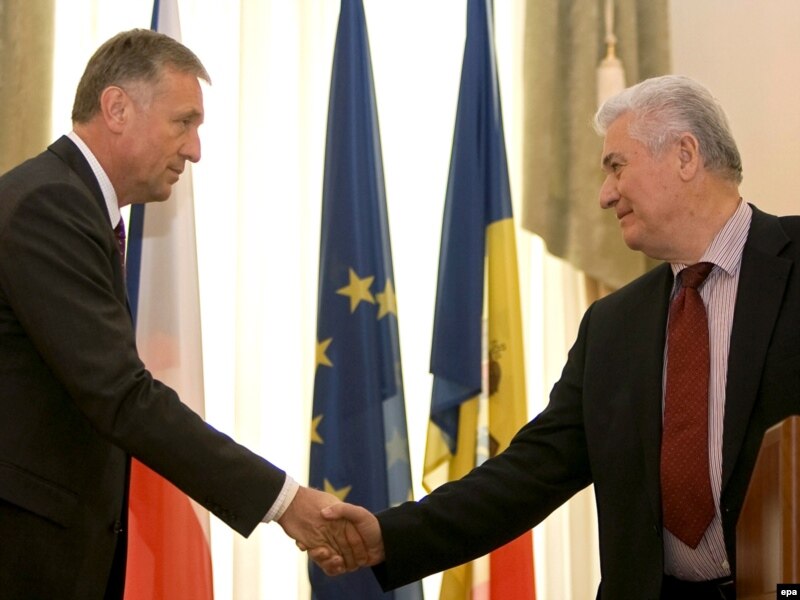
 Moldovan President Vladimir Voronin (right) meets with Czech Prime Minister Mirek Topolanek in Chisinau on April 22.
The Netherlands is the lone advocate of a tougher EU stance on Moldova (and another problematic partnership member, Belarus). But Germany and Poland head the EU's mainstream in arguing that Moldova must not be isolated and needs greater EU support.
The country's economy is seen by many in the EU to be on the brink of collapse.
Moldova's decision to slap visas on Romanians is, however, likely to have repercussions. The European Commission has called the measure unacceptable in light of EU-Moldova visa facilitation talks and is likely to raise it at an EU-Moldova meeting in a few days.
Moldova's partner on the EU lunch agenda was neighboring Ukraine, where there has been no public unrest but where mounting political and economic paralysis increasingly threatens the country's viability.
Again, Germany and Poland appear to be closely coordinating policy, with the two countries' foreign ministers reported to have addressed a joint letter to the EU's Czech presidency last week expressing concern at the economic and political situation in Ukraine.
The two ministers are said to have floated the idea of an EU assistance mission to Ukraine to facilitate dialogue among all political leaders. However, it is generally feared that a resolution to the political crisis in Ukraine is improbable before the 2010 presidential elections.
The EU's foreign-policy chief, Javier Solana, said after the meeting that the EU would now study ways of stabilizing the country. "After the discussion today we will see how we can help prior to the elections and after the elections, the presidential elections, to see how we can arrange the economic situation and the political situation," he said.
Is Lukashenka Coming?
The EU foreign ministers on April 27 will also discuss the agendas and guest lists of two important upcoming summits.
On May 7, representatives of Belarus, Ukraine, Moldova, Georgia, Armenia, and Azerbaijan have been invited to attend a summit in Prague on its Eastern Partnership, which is meant to extend special benefits to the EU's eastern neighbors.
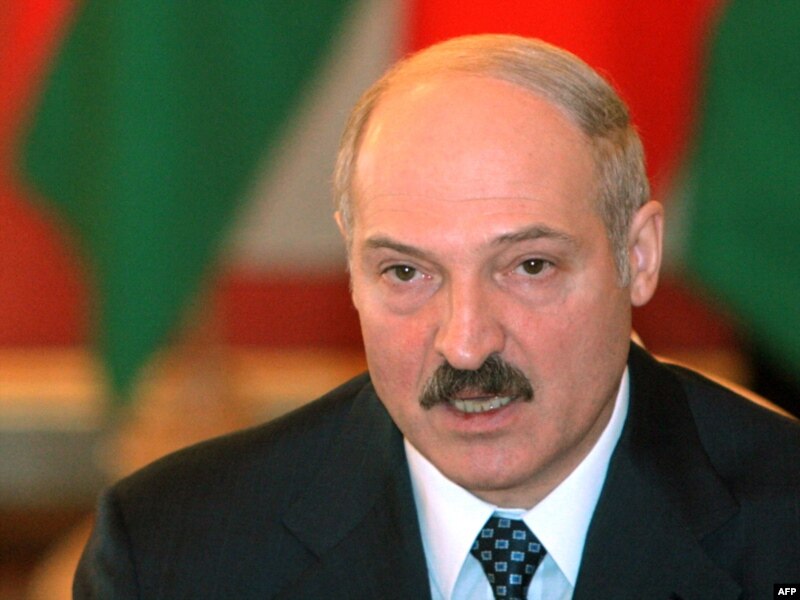
 Much speculation is circulating over whether Belarus's authoritarian president, Alyaksandr Lukashenka, will attend. The invitations to the summit are not personal, giving every country's leader the choice of whether to turn up in Prague in person. Many EU nations expect Lukashenka to send a stand-in.
A joint declaration signed by the 27 EU member states and the six partner countries is planned for the summit. The text of the document is still being discussed with the partners and is expected to be finalized a week in advance of the summit.
On May 8, the EU will hold another summit in Prague, dedicated to what has become known as the Southern Corridor of energy provision.
This meeting will be conducted under the auspices of the EU "troika" of Topolanek, Solana, and European Commission President Jose Manuel Barroso. The three will face officials representing Azerbaijan, Georgia, Turkey, Kazakhstan, and Turkmenistan.
Six 'Observers'
Together, the five countries represent the EU's main hope of securing significant amounts of natural gas deliveries without resorting to Russian supplies or mediation.
Six "observers" have also been invited -- Iraq, Egypt, and Uzbekistan as potential supplier countries; and Russia, Ukraine, and the United States as other major interested parties.
The presence of the last three has been the subject of some controversy within the EU. Germany led a long-established group of countries -- including France, Italy, and Spain, among others -- which overcame resistance from others and secured an invitation for Russia.
The Southern Corridor is explicitly defined by the EU as a direct link to energy resources in the Caspian Sea region bypassing Russia.
A draft summit declaration, seen by RFE/RL, breaks new ground for the EU by saying the bloc intends to "give strong political support" to the construction of the Southern Corridor -- including the "trans-Caspian link."
This is a planned gas pipeline running from Turkmenistan to Azerbaijan which would link Central Asia directly with the Nabucco pipeline projected to run from Baku to Europe, circumventing Russia.
As she unveiled an annual review of the bloc's European Neighborhood Policy, EU External Relations Commissioner Benita Ferrero Waldner told the 27 EU foreign ministers it has been a "difficult year" -- particularly in the east.
But Czech Foreign Minister Karel Schwarzenberg, who chaired the meeting, said the EU is resolved to push on with its Eastern Partnership initiative, which is designed to forge closer ties between the bloc and six eastern neighbors.
"We believe that sending a strong message to the six partnership countries -- Ukraine, Belarus, Moldova, Georgia, Armenia, and Azerbaijan -- is very important in the light of the recent developments in the region, and that we need to engage with our neighbors more closely in order to promote good governance, the rule of law, and transparency," he said.
Brutal Crackdown
One need look no further than this month's unrest in Moldova to know that this will not be easy.
That country is still recovering from a brutal crackdown on mass public protests in the capital, Chisinau, following a landslide win for the ruling Communists in parliamentary elections. In the wake of the violence, the country's increasingly Russian-leaning president, Vladimir Voronin, pointedly accused neighboring Romania -- an EU member -- of fomenting the unrest.
Moldova then expelled the ambassador to Romania and imposed a summary visa regime on Romanian visitors. And sources in Brussels say Voronin told Kalman Miszei, the EU special envoy, that Moldova has "friends elsewhere."
Now, at Romania's request, EU foreign ministers meeting in Luxembourg discussed Moldova during talks over lunch -- a setting usually reserved for issues of particular concern.
The EU adopted a declaration saying it has "serious concerns" about developments in the country, and Czech Foreign Minister Schwarzenberg said Moldova "poses a challenge" for the EU.
"The current tensions in the country pose a challenge for the European Union. Our task is now to find a proper way to strengthen our policy of bringing Moldova closer to our standard," he said. "We expect Moldova to behave in a European way, not only vis-a-vis the European Union and its members, but first of all, of course, internally."
But, Schwarzenberg stressed, the Eastern Partnership initiative remains "no doubt the right tool" to bolster reforms in Moldova.
Cutting Some Slack
Czech Prime Minister Miroslav Topolanek, who was in Chisinau last week representing the EU Presidency, reported that neither the government nor the opposition appears to have the political will to meet the other side for talks -- a key EU wish.
The Netherlands is the lone advocate of a tougher EU stance on Moldova (and another problematic partnership member, Belarus). But Germany and Poland head the EU's mainstream in arguing that Moldova must not be isolated and needs greater EU support.
The country's economy is seen by many in the EU to be on the brink of collapse.
Moldova's decision to slap visas on Romanians is, however, likely to have repercussions. The European Commission has called the measure unacceptable in light of EU-Moldova visa facilitation talks and is likely to raise it at an EU-Moldova meeting in a few days.
Moldova's partner on the EU lunch agenda was neighboring Ukraine, where there has been no public unrest but where mounting political and economic paralysis increasingly threatens the country's viability.
Again, Germany and Poland appear to be closely coordinating policy, with the two countries' foreign ministers reported to have addressed a joint letter to the EU's Czech presidency last week expressing concern at the economic and political situation in Ukraine.
The two ministers are said to have floated the idea of an EU assistance mission to Ukraine to facilitate dialogue among all political leaders. However, it is generally feared that a resolution to the political crisis in Ukraine is improbable before the 2010 presidential elections.
The EU's foreign-policy chief, Javier Solana, said after the meeting that the EU would now study ways of stabilizing the country. "After the discussion today we will see how we can help prior to the elections and after the elections, the presidential elections, to see how we can arrange the economic situation and the political situation," he said.
Is Lukashenka Coming?
The EU foreign ministers on April 27 will also discuss the agendas and guest lists of two important upcoming summits.
On May 7, representatives of Belarus, Ukraine, Moldova, Georgia, Armenia, and Azerbaijan have been invited to attend a summit in Prague on its Eastern Partnership, which is meant to extend special benefits to the EU's eastern neighbors.
A joint declaration signed by the 27 EU member states and the six partner countries is planned for the summit. The text of the document is still being discussed with the partners and is expected to be finalized a week in advance of the summit.
On May 8, the EU will hold another summit in Prague, dedicated to what has become known as the Southern Corridor of energy provision.
This meeting will be conducted under the auspices of the EU "troika" of Topolanek, Solana, and European Commission President Jose Manuel Barroso. The three will face officials representing Azerbaijan, Georgia, Turkey, Kazakhstan, and Turkmenistan.
Six 'Observers'
Together, the five countries represent the EU's main hope of securing significant amounts of natural gas deliveries without resorting to Russian supplies or mediation.
Six "observers" have also been invited -- Iraq, Egypt, and Uzbekistan as potential supplier countries; and Russia, Ukraine, and the United States as other major interested parties.
The presence of the last three has been the subject of some controversy within the EU. Germany led a long-established group of countries -- including France, Italy, and Spain, among others -- which overcame resistance from others and secured an invitation for Russia.
The Southern Corridor is explicitly defined by the EU as a direct link to energy resources in the Caspian Sea region bypassing Russia.
A draft summit declaration, seen by RFE/RL, breaks new ground for the EU by saying the bloc intends to "give strong political support" to the construction of the Southern Corridor -- including the "trans-Caspian link."
This is a planned gas pipeline running from Turkmenistan to Azerbaijan which would link Central Asia directly with the Nabucco pipeline projected to run from Baku to Europe, circumventing Russia.
Monday, April 27, 2009
Diplomatic confusion
From today's Washington Times, "Embassy Row" section:
Foreign Visitors in Washington this Week
• Iulian Fota, national security adviser to President Traian Basescu of Moldova, who addresses the German Marshall Fund of the United States on "realities and repercussions of unrest in Moldova."
A couple of observations:
Traian Basescu is the president of Romania. The president of Moldova is Vladimir Voronin. According - at least -to the UN, Republic of Moldova and Romania are two different countries.
Foreign Visitors in Washington this Week
• Iulian Fota, national security adviser to President Traian Basescu of Moldova, who addresses the German Marshall Fund of the United States on "realities and repercussions of unrest in Moldova."
A couple of observations:
Traian Basescu is the president of Romania. The president of Moldova is Vladimir Voronin. According - at least -to the UN, Republic of Moldova and Romania are two different countries.
Thursday, April 9, 2009
Russia asks EU to protect Moldova's sovereignty
CHISINAU (Reuters) - Russia asked the European Union and Romania on Thursday to guarantee the sovereignty of its ally Moldova, where riots have swept the capital and prompted a crackdown on the pro-Western opposition.
Moldova's veteran Communist president, Vladimir Voronin, has accused neighboring Romania of stoking a coup attempt after demonstrators ransacked parliament during post-election protests two days ago and waved EU and Romanian flags from his offices.
The European Union urged Moldova to drop punitive measures it took against Romania and respect constitutional freedoms after at least 193 people were arrested in Tuesday's riots.
Moldova has imposed a visa regime on Romania, expelled its ambassador and denied entry to more than 19 Romanian journalists. It says the measures are needed because Romania is threatening its sovereignty, a charge Bucharest dismisses.
"In the past days, Chisinau has taken arbitrary and discriminatory measures against Romanian citizens," Romanian Foreign Minister Cristian Diaconescu told reporters, describing the visa imposition as "reckless."
Located on the European Union's border but within the former Soviet space that Moscow sees as its sphere of influence, Moldova has the potential to enflame EU-Russian relations, already upset by last August's Russia-Georgia war and disruption to Russian gas flows to Europe at the start of this year.
Wary of getting embroiled in a new dispute with Moscow, the EU's executive Commission said the bloc fully recognized Moldovan sovereignty.
"While understanding the complexity of the Moldovan-Romanian relations, we call on the government of Moldova to resume normal relations with Romania," the foreign ministers of France and the Czech Republic and Sweden said in a joint statement. The three countries are the EU's previous, current and next presidents.
In Moscow, Russian Foreign Minister Sergei Lavrov said he was "deeply disturbed" by the flags and slogans at Tuesday's riots because they showed that the demonstrators "were obsessed with the idea of destroying Moldovan statehood."
Most of present-day Moldova, Europe's poorest country, was part of Romania until Stalin annexed it to the Soviet Union in 1940. It won independence when the Soviet Union fell in 1991.
"We hope that the EU and the Romanian leadership, which publicly condemned the violence, will take action to ensure that Romanian flags and Romanian slogans are not used as the cover for undermining Moldovan statehood," Lavrov told the state-run RIA news agency.
Europe's only Communist ruler, Voronin says Romania wants to seize control of his mainly rural country of four million people where the average monthly salary is $250. Romania has rejected the accusations.
Protests dwindle
In power since 2001, Voronin faces a growing economic crisis as thousands of Moldovans working abroad lose their jobs in the global economic crisis and stop sending home the hard currency on which much of the local economy depends.
"People here simply don't have a future," said a woman walking in the capital who refused to give her name. "We also have children and we're hoping for a better life. We're simply tired of this dictatorship."
The streets of the capital Chisinau were quiet on Thursday morning as the opposition parties, shaken by the scale of Tuesday's violence, pondered their next move.
Opposition leaders have tried to distance themselves from the violence. They said people had been getting messages on their mobile phones and via the Internet about a new protest on Friday which they said they had nothing to do with.
The Liberal party, which won 12.75 percent of the vote in the disputed parliamentary election, called on the European Union to send a special mission to investigate the riots.
Some Moldovan opposition figures say the Communists were behind the violence as part of an attempt to distract the population from Moldova's economic woes. The Central Election Commission has rebuffed opposition demands for a recount of Sunday's vote, which the Communists won with 49.5 percent.
See also:
Moldova asks Ukraine to extradite businessman Stati
Kyiv Post
The Moldovan Prosecutor General's Office has asked Ukraine to extradite Moldovan businessman Gabriel Stati, who has been accused of funding the recent protests in Chisinau, Moldovan Prosecutor General Valeriu Gurbulea told the media on Thursday.
"The prosecutor's office has received confirmation of the arrest in Odesa of Gabriel Stati. Moldovan prosecutors appealed to their Ukrainian colleagues [to extradite Stati] on Wednesday," he said.
"His extradition is under consideration. We will investigate his possible involvement in the organization and funding of the protests," Gurbulea said.
Wednesday, April 8, 2009
Twitter Revolution in Republic of Moldova: the third day
- The border points between Romania and Republic of Moldova have been closed the last night. Many Romanian and foreign journalists were not allowed to cross the border.
- The Romanian ambassador in Kishinew was declared persona non grata. The same happened with the minister counselor of the Romanian embassy. Moldova announced the introduction of the visa system for Romanian citizens. The announcement was made by president Vladimir Voronin for the Russian press agency Ria Novosti. The same Voronin in another declaration for Ria Novosti accused again Romania of involvement in the protests from Kishinew. In addition, Voronin warned that the use of force against the protesters will be took into consideration. The Romanian MoFA considered those claims are unacceptable.
- Most part of the declarations and media reports are transmitted via the Russian media, mostly the declarations of Moldovian officials.
- Children from schools and highschools in Kishinew are forbidden to leave the school compounds.
- In the central square from Kishinew around 1.000 young people are continuing the protests. The number decreased in the afternoon to 00/
- The Russian minister of Foreign Affairs, Serghei Lavrov, stated the claims for reorganization of the parliamentary elections in the Republic of Moldova are "groundless".
- Russian media: Serghei Mocanu, leader of the opposition, is under arrest.
See also:
Following the violent protests in Moldova , Eastern Europe experts at the European Council on Foreign Relations have issued the following media statements (April 7):
Andrew Wilson, senior policy fellow, says:
" Moldova 's violent 'Twitter revolution' is totally different from the peaceful protest of Ukraine 's Orange Revolution. This time the crowd are not angry at a stolen election, but at the growing corruption of the ruling Communist Party, its recent turn towards Russia and an imminent economic crisis."
Nicu Popescu, policy fellow, says:
" Moldova may be small, but the survival of its democracy matters for the whole of Europe . Javier Solana must immediately travel to Chisinau to mediate between politicians and protestors before any further blood is shed."
Read more:
Andrew Wilson has published widely on the politics of the European neighbourhood, and on previous "coloured revolutions" .
Nicu Popescu is a Moldovan, and has written extensively on the politics of his country. He holds a doctorate in International Relations from the Central European University in Budapest , Hungary , and co-wrote the Moldova chapter of Nations in Transit 2006 (Freedom House).
Wilson and Popescu are the authors of a forthcoming ECFR policy report comparing the European and Russian Neighbourhood Policies.
For press enquiries:
Andrew Wilson : E: andrew.wilson@ecfr.eu; T: +44 7920 421 066
Nicu Popescu : E: nicu.popescu@ecfr.eu; T: +44 7795 312 467
For all other press queries please send an email to press@ecfr.eu
About ECFR:
Launched in October 2007, the European Council on Foreign Relations is a pan-European think tank and advocacy group, co-chaired by Martti Ahtisaari, Joschka Fischer and Mabel van Oranje. (www.ecfr.eu)
James Clasper
Media Advisor
European Council on Foreign Relations
5th Floor, Cambridge House
100 Cambridge Grove
London
W6 0LE
Tel: +44 (0)20 7031 1623
Mob: +44 (0)7951 936 556
E: press@ecfr.eu
W: www.ecfr.eu
OSCE Mission to Moldova condemns post-election violence and appeals to all sides for restraint
CHISINAU, 7 April 2009 - The Head of the OSCE's Mission to Moldova, Ambassador Philip Remler, condemned today's outbreak of violence in the Moldovan capital following Sunday's parliamentary elections and urged all political sides to do their utmost to de-escalate the situation.
"Violence is not compatible with democratic values. We strongly urge all to refrain from any violent actions, which we unreservedly condemn. We call on the authorities and all political forces to exercise restraint and to urge others to show restraint as well," he said.
Sunday's parliamentary elections were observed by a joint mission of the OSCE Office for Democratic Institutions and Human Rights (ODIHR), the OSCE Parliamentary Assembly, the Parliamentary Assembly of the Council of Europe and the European Parliament.
The joint mission's statement and preliminary findings can be found here: http://www.osce.org/documents/odihr/2009/04/37142_en.pdf
The OSCE Mission to Moldova will continue to monitor the protest in line with its mandate.
ODIHR is following the post-election situation according to its normal procedures.
Thursday, April 2, 2009
EU Dreams in Communist Moldova
Uwe Klussmann in Moldova
April 2Europe's last Communist regime is looking increasingly shaky. The population in Moldova, which holds parliamentary elections this Sunday, wants reunification with Romania -- and the EU membership it would bring.
German reunification is an increasingly common topic of conversation these days in Moldova, the poorest part of Europe. In the run-up to parliamentary elections on April 5, opposition parties calling for closer links, or even a union, with EU member state Romania are enjoying massive support.
Moldova, a Romanian-speaking country on the south-western border of Ukraine, was part of Romania from 1918 to 1940, and approximately 800,000 of Moldova's current 3.4 million inhabitants have already applied for Romanian citizenship. "If Romanians and Moldovans decide in favor of a union, the EU will not oppose them," says one European diplomat confidently. After all, he says, the Germans had created a precedent with the reunification of East and West Germany in 1990.
Moldova, a former Soviet republic, is located in a region of geo-political tension between Moscow and the West. The country is neutral and belongs to the Commonwealth of Independent States (CIS), a regional organization of former Soviet republics. Russian troops have kept the peace in the country's breakaway region of Transnistria since a 1992 cease-fire ended a secessionist war. At the same time, they are cementing Russian influence in the region, which is home to around half a million people. The explosive situation is comparable to that in South Ossetia, which sparked a war between Georgia and Russia last August.
The party most keen to keep Moldova independent is the Communist Party, which has ruled the country for eight years. It draws strength from the fact that the poor region enjoyed a significant boom during the Soviet era. For years, Moldovan President Vladimir Voronin, who leads the Communist Party, spurred the electorate with hopes for a "rebirth of the socialist community." Now he's taking a more pro-Europe stance.
The graying party functionary still lays Soviet-style wreaths at Lenin monuments on holidays and the Communist Party program still invokes the "volcano of social creativity, born in the revolution." The Communist Party is popular with their German comrades in the far-left Left Party, whose delegations get driven through the country's sunny wine country in Russian Volga cars. The Left Party members rave about their "friendly" and "warm" Moldovan counterparts.
'We Have No Fear'
Those affable Communists, though, are becoming less and less popular among their own people. The only people who listen obediently to Voronin's monotonous speeches are pensioners in worn coats. Speaking in a cultural center in Ustia, a village in the east of the country, he promises that they will soon "be no worse off than the people in the cities."
A Communist election poster, glued to the door of a grocery store, shows a beautiful young woman with impeccable teeth and the slogan: "We are building a European Moldova together." But there is little sign of young beauties with perfect smiles in the village. The customers coming into the store are mainly long-term unemployed with missing teeth. "The young people have gone to Russia or Europe," says Mikhail, a villager in his late fifties. "They are building their futures there."
Among those who are left behind, there are frequent outbursts of rage at the corrupt Communist Party regime, which has helped the president's son Oleg become one of the richest "biznesmen" in the country. The average monthly wage is €175 ($232). "We have no fear" is the slogan at a rally of liberal and right-wing opposition parties in the capital Chisinau, attended by some 30,000 people.
The source of that fear is the country's Information and Security Service, which is headed by a presidential confidant. The intelligence agency is located in a stone building surrounded by rolls of barbed wire on the capital's August 31 Street. In private, its officers boast that they have opposition politicians "under control" -- in other words, blackmailed and bought. The Communist Party plans to enthrone a successor to Voronin, who is barred by the constitution from serving another term, after the election.
Anyone who wants to resist the regime needs to endure a lot -- like Serafim Urechean, leader of the largest opposition party, Our Moldova. Urechean, the ex-mayor of Chisinau and a former Communist Party functionary, sits in his office surrounded by nine icons. He has survived five criminal proceedings, mainly related to abuse of authority, launched by the public prosecutor, which does the government's bidding. Urechean, who has a certain godfather-style charm, sees himself as a savior of the fatherland and a future president. He wants to bring the country into the EU as part of an alliance with Romania.
Dorin Chirtoaca, for his part, dreams of a Greater Romania -- one that includes Moldova. Chirtoaca is the energetic current mayor of Chisinau, belongs to the Liberal Party and has studied in the Romanian capital Bucharest. But his dreamt-of reunification would almost certainly take place without the Russian-speaking region of Transnistria, which suffered so much under Nazi-allied Romania during World War II that full reunification seems unlikely.
The self-proclaimed president of Transnistria, Igor Smirnov, who is not recognized internationally, says his territory would not join Romania. "You should not confuse us with East Germany," he says. "We are not East Germany and Moldova is not West Germany."
Backroom Deals Can't Solve Transdniester Dispute
RFE/RL
March 20
Russian President Dmitry Medvedev met in Moscow this week with Moldovan President Vladimir Voronin and the head of the unrecognized breakaway region of Transdniester, Igor Smirnov. The final statement of the tripartite talks contains no legal commitments, but the meeting itself could have negative political implications for Moldova.
The joint statement praised the Russian-commanded peacekeeping troops -- the same forces that Moldovan Foreign Minister Andrei Stratan told an OSCE Ministerial Council meeting in December 2004 were stationed on Moldovan territory "against the political will of the Moldovan constitutional authorities in defiance of unanimously recognized international norms and principles."
The statement, however, does express a joint desire by the three leaders that the peacekeeping force be placed under a mandate from the Organization for Security and Cooperation in Europe (OSCE).
The joint statement praised the Russian-commanded peacekeeping troops -- the same forces that Moldovan Foreign Minister Andrei Stratan told an OSCE Ministerial Council meeting in December 2004 were stationed on Moldovan territory "against the political will of the Moldovan constitutional authorities in defiance of unanimously recognized international norms and principles."
The statement, however, does express a joint desire by the three leaders that the peacekeeping force be placed under a mandate from the Organization for Security and Cooperation in Europe (OSCE).
Three Agendas
Each of the three men went into the March 18 meeting with his own agenda. Voronin, who wanted the meeting most, was eager for a photo-op with Medvedev, who is the second-most-popular politician in Moldova after Russian Prime Minister Vladimir Putin, ahead of Moldova's April 5 parliamentary elections. Voronin's Communist Party counts heavily on the votes of ethnic Russians and on those of ethnic Moldovans whose jobs depend on Russia.
Medvedev, for his part, was seeking to rehabilitate Russia's reputation in the wake of August's war with Georgia, to show the world that Moscow can play a mediating role as a good neighbor. But in doing so, Russia has downplayed the 5+2 negotiating format (which includes the European Union, the United States, the OSCE, Russia, and Ukraine, in addition to Moldova and Transdniester) and pushed Moldova toward direct talks with Tiraspol under the Kremlin's auspices.
As for Smirnov, he is always ready to participate in whatever meetings in whatever format Moscow dictates. He is a Russian citizen who was sent to Moldova in 1987 in order to foment and lead a separatist movement to counterbalance the nationalist movement that was emerging in Chisinau. And he accomplished this task brilliantly.
The separatist protest on the eastern side of the Nistru River culminated in an armed uprising that turned into a bloody conflict in the summer of 1992. Moldova's central leadership and armed forces were weak and soon yielded to Russian-backed troops and security forces. The Moldavian Trans-Nistrian Republic (MTR), also called Transnistria or Transdniester, was born.
Participant Or 'Guarantor'?
When a cease-fire agreement was signed on July 7, 1992, by Russian President Boris Yeltsin and Moldovan President Mircea Snegur, it seemed clear that Russia and Moldova were the two parties to this conflict. This interpretation was reinforced by a 2004 ruling of the European Court of Human Rights and by a 2006 study of the conflict by the New York City Bar Association titled "Thawing a Frozen Conflict: Legal Aspects of the Separatist Crisis in Moldova."
Nevertheless, Moscow has insisted that its pawn, the Tiraspol government, not Russia, was a party to the conflict. As in the cases of Georgia's breakaway regions of Abkhazia and South Ossetia, Russia declared itself a "mediator" in Moldova, later elevating itself to the status of "guarantor of the peace." Russia has used all its available political and economic levers to compel Moldova to accept these terms.
Every time Moldova made concessions in the dispute, Russia consolidated its position. In 1994, Moldova accepted a Russian proposal on "synchronization" that would have made a Russian troop withdrawal contingent on a status agreement for the secessionist region. In 1997, the so-called Primakov memorandum (named after its promoter, Russian Foreign Minister Yevgeny Primakov) introduced the concept of a "common state," which was ultimately interpreted differently by all parties and led to no solutions.
The so-called Kyiv document of 2002, proposed by Moscow, stipulated the federalization of Moldova, a concept that was renewed in 2003 with the infamous Kozak memorandum (named for Dmitry Kozak, an aide to then Russian President Putin). That proposal was rejected by Voronin at the last minute under the pressure of street protests in Chisinau and on advice from the EU and the United States.
Moldova In 3-D
In 2004, nongovernmental Moldovan experts, working with Western analysts, offered an alternative plan for a federated Moldova. Called the "3-D strategy" (decriminalization, demilitarization, and democratization), this document has gained broad support in Moldova.
The plan called for strengthening the then-existing five-party negotiating format (Russia, Ukraine, and the OSCE, plus Moldova and Transdniester) with a 3+1+3 format (Russia, Ukraine, and Romania plus Molodova plus the EU, the United States, and the OSCE), thereby including the West and excluding Transdniester.
It also called for a border-monitoring mission along the Ukrainian-Moldovan border, a supervising authority, and an international civil provisional administration that would implement postconflict recovery plans.
The 3-D strategy was used by the Moldovan parliament to formulate three resolutions on the conflict that were adopted in June 2005 and the law on the basic principles of the special status of the localities on the eastern bank of the Nistru, which was adopted in July 2005. That year, Ukraine became actively involved in the negotiating process, putting forward its own plans and initiatives.
These, however, largely focused on democratization (through elections in Transdniester), which was counterproductive since the processes of decriminalization and demilitarization were stalled. As a result, any elections held could hardly be considered democratic.
Since 2005, both the United States and the EU have also stepped up their involvement, notably with the opening of the EU Border Assistance Mission (EUBAM) in December 2005.Medvedev, for his part, was seeking to rehabilitate Russia's reputation in the wake of August's war with Georgia, to show the world that Moscow can play a mediating role as a good neighbor. But in doing so, Russia has downplayed the 5+2 negotiating format (which includes the European Union, the United States, the OSCE, Russia, and Ukraine, in addition to Moldova and Transdniester) and pushed Moldova toward direct talks with Tiraspol under the Kremlin's auspices.
As for Smirnov, he is always ready to participate in whatever meetings in whatever format Moscow dictates. He is a Russian citizen who was sent to Moldova in 1987 in order to foment and lead a separatist movement to counterbalance the nationalist movement that was emerging in Chisinau. And he accomplished this task brilliantly.
The separatist protest on the eastern side of the Nistru River culminated in an armed uprising that turned into a bloody conflict in the summer of 1992. Moldova's central leadership and armed forces were weak and soon yielded to Russian-backed troops and security forces. The Moldavian Trans-Nistrian Republic (MTR), also called Transnistria or Transdniester, was born.
Participant Or 'Guarantor'?
When a cease-fire agreement was signed on July 7, 1992, by Russian President Boris Yeltsin and Moldovan President Mircea Snegur, it seemed clear that Russia and Moldova were the two parties to this conflict. This interpretation was reinforced by a 2004 ruling of the European Court of Human Rights and by a 2006 study of the conflict by the New York City Bar Association titled "Thawing a Frozen Conflict: Legal Aspects of the Separatist Crisis in Moldova."
Nevertheless, Moscow has insisted that its pawn, the Tiraspol government, not Russia, was a party to the conflict. As in the cases of Georgia's breakaway regions of Abkhazia and South Ossetia, Russia declared itself a "mediator" in Moldova, later elevating itself to the status of "guarantor of the peace." Russia has used all its available political and economic levers to compel Moldova to accept these terms.
Every time Moldova made concessions in the dispute, Russia consolidated its position. In 1994, Moldova accepted a Russian proposal on "synchronization" that would have made a Russian troop withdrawal contingent on a status agreement for the secessionist region. In 1997, the so-called Primakov memorandum (named after its promoter, Russian Foreign Minister Yevgeny Primakov) introduced the concept of a "common state," which was ultimately interpreted differently by all parties and led to no solutions.
The so-called Kyiv document of 2002, proposed by Moscow, stipulated the federalization of Moldova, a concept that was renewed in 2003 with the infamous Kozak memorandum (named for Dmitry Kozak, an aide to then Russian President Putin). That proposal was rejected by Voronin at the last minute under the pressure of street protests in Chisinau and on advice from the EU and the United States.
Moldova In 3-D
In 2004, nongovernmental Moldovan experts, working with Western analysts, offered an alternative plan for a federated Moldova. Called the "3-D strategy" (decriminalization, demilitarization, and democratization), this document has gained broad support in Moldova.
The plan called for strengthening the then-existing five-party negotiating format (Russia, Ukraine, and the OSCE, plus Moldova and Transdniester) with a 3+1+3 format (Russia, Ukraine, and Romania plus Molodova plus the EU, the United States, and the OSCE), thereby including the West and excluding Transdniester.
It also called for a border-monitoring mission along the Ukrainian-Moldovan border, a supervising authority, and an international civil provisional administration that would implement postconflict recovery plans.
The 3-D strategy was used by the Moldovan parliament to formulate three resolutions on the conflict that were adopted in June 2005 and the law on the basic principles of the special status of the localities on the eastern bank of the Nistru, which was adopted in July 2005. That year, Ukraine became actively involved in the negotiating process, putting forward its own plans and initiatives.
These, however, largely focused on democratization (through elections in Transdniester), which was counterproductive since the processes of decriminalization and demilitarization were stalled. As a result, any elections held could hardly be considered democratic.
Western Interest
Russia reluctantly accepted the West at the negotiating table, a reluctance driven by Moscow's view that the former Soviet republics form a special sphere of interest for Russia. Moscow also was unwilling to concede that after Romania joined NATO and the EU, Moldova had more in common with the West than with Russia, with which it does not have a common border.
When Moldova and Ukraine began implementing customs regulations in accordance with international norms in 2006, Russia responded by applying economic sanctions against Moldova. Moscow imposed an embargo on the importation of Moldovan wines and agricultural goods, an action that not only harmed Moldova, but also was a setback for Russia's bid to join the World Trade Organization (WTO).
No matter what government takes power after the April 5 elections in Moldova or who the new parliament selects as president, Moldova clearly needs to, as they say these days, push the reset button in relations with Russia.
Chisinau will have to stick solidly to the principles of international norms and agreements and push for Moscow to fulfill the commitments it has made within the framework of international organizations. It must reject a negotiating format that has no transparency for Moldova's Western partners.
The meeting in Moscow yesterday was a mistake -- it was wrong for Moldova to leave the room where its friends and neighbors were seated in order to deal with Russia behind the scenes. And most importantly, the 3-D strategy must remain Moldova's overarching framework for resolving the Transdniester dispute.
Vlad Spanu is the president of the Moldova Foundation in Washington. He served as a senior Moldovan diplomat between 1992 and 2001 and co-authored, with Andrei Brezianu, "The Historical Dictionary of Moldova." The views expressed in this commentary are the author's own and do not necessarily reflect those of RFE/RL
When Moldova and Ukraine began implementing customs regulations in accordance with international norms in 2006, Russia responded by applying economic sanctions against Moldova. Moscow imposed an embargo on the importation of Moldovan wines and agricultural goods, an action that not only harmed Moldova, but also was a setback for Russia's bid to join the World Trade Organization (WTO).
No matter what government takes power after the April 5 elections in Moldova or who the new parliament selects as president, Moldova clearly needs to, as they say these days, push the reset button in relations with Russia.
Chisinau will have to stick solidly to the principles of international norms and agreements and push for Moscow to fulfill the commitments it has made within the framework of international organizations. It must reject a negotiating format that has no transparency for Moldova's Western partners.
The meeting in Moscow yesterday was a mistake -- it was wrong for Moldova to leave the room where its friends and neighbors were seated in order to deal with Russia behind the scenes. And most importantly, the 3-D strategy must remain Moldova's overarching framework for resolving the Transdniester dispute.
Vlad Spanu is the president of the Moldova Foundation in Washington. He served as a senior Moldovan diplomat between 1992 and 2001 and co-authored, with Andrei Brezianu, "The Historical Dictionary of Moldova." The views expressed in this commentary are the author's own and do not necessarily reflect those of RFE/RL
Subscribe to:
Posts (Atom)