Showing posts with label going beyond divisions. Show all posts
Showing posts with label going beyond divisions. Show all posts
Saturday, October 10, 2009

Saturday, September 5, 2009
OSCE Chairperson welcomes progress in talks between Turkey and Armenia as contribution to regional stability
ATHENS, 1 September 2009 - The OSCE Chairperson-in-Office, Greek Foreign Minister Dora Bakoyannis, today welcomed Turkey and Armenia's joint statement announcing that they plan to start talks aiming to normalize bilateral relations, saying such a development would contribute to regional stability. "The establishment of diplomatic ties between Turkey and Armenia would be a positive step not just for the South Caucasus region, but also beyond," Bakoyannis said. "I warmly welcome this positive step toward normalization of ties between two OSCE participating States."Bakoyannis called on both sides to build on the positive momentum achieved in the Swiss-led talks.
For PDF attachments or links to sources of further information, please visit: http://www.osce.org/item/39343.html
Friday, June 5, 2009
The hedgehog and the fox
or how difficult is, on the ground to overcome the scars of the past. A December 2008 article of Bret Stephens, for the WSJ. The big problem is how to go beyond a past - of misunderstanding, of hate, of killings, of building and fighting an enemy. Obama itself recognized it is not easy. But, in some respects, it is tremendously complicate. And any faith will be able to restore this past, but very physical and individual beings, with projects and initiatives and good wills and full desire to build up a decent and conflict free - past free life for themselves, their children and their community.
Some quotes from the one year ago intervention
"I have long understood Israel's quest for peace and need for security. But never more so than during my travels there two years ago. Flying in an IDF helicopter, I saw a narrow and beautiful strip of land nestled against the Mediterranean. On the ground, I met a family who saw their house destroyed by a Katyusha Rocket. I spoke to Israeli troops who faced daily threats as they maintained security near the blue line. I talked to people who wanted nothing more simple, or elusive, than a secure future for their children".
"Our alliance is based on shared interests and shared values. Those who threaten Israel threaten us. Israel has always faced these threats on the front lines. And I will bring to the White House an unshakeable commitment to Israel's security.
That starts with ensuring Israel's qualitative military advantage. I will ensure that Israel can defend itself from any threat - from Gaza to Tehran. Defense cooperation between the United States and Israel is a model of success, and must be deepened. As President, I will implement a Memorandum of Understanding that provides $30 billion in assistance to Israel over the next decade - investments to Israel's security that will not be tied to any other nation. First, we must approve the foreign aid request for 2009. Going forward, we can enhance our cooperation on missile defense. We should export military equipment to our ally Israel under the same guidelines as NATO. And I will always stand up for Israel's right to defend itself in the United Nations and around the world".
That starts with ensuring Israel's qualitative military advantage. I will ensure that Israel can defend itself from any threat - from Gaza to Tehran. Defense cooperation between the United States and Israel is a model of success, and must be deepened. As President, I will implement a Memorandum of Understanding that provides $30 billion in assistance to Israel over the next decade - investments to Israel's security that will not be tied to any other nation. First, we must approve the foreign aid request for 2009. Going forward, we can enhance our cooperation on missile defense. We should export military equipment to our ally Israel under the same guidelines as NATO. And I will always stand up for Israel's right to defend itself in the United Nations and around the world".
"The long road to peace requires Palestinian partners committed to making the journey. We must isolate Hamas unless and until they renounce terrorism, recognize Israel's right to exist, and abide by past agreements. There is no room at the negotiating table for terrorist organizations. That is why I opposed holding elections in 2006 with Hamas on the ballot. The Israelis and the Palestinian Authority warned us at the time against holding these elections. But this Administration pressed ahead, and the result is a Gaza controlled by Hamas, with rockets raining down on Israel".
Let me be clear. Israel's security is sacrosanct. It is non-negotiable. The Palestinians need a state that is contiguous and cohesive, and that allows them to prosper - but any agreement with the Palestinian people must preserve Israel's identity as a Jewish state, with secure, recognized and defensible borders. Jerusalem will remain the capital of Israel, and it must remain undivided".
"Finally, let there be no doubt: I will always keep the threat of military action on the table to defend our security and our ally Israel. Sometimes there are no alternatives to confrontation. But that only makes diplomacy more important. If we must use military force, we are more likely to succeed, and will have far greater support at home and abroad, if we have exhausted our diplomatic efforts".
Thursday, May 7, 2009
Israel discussing withdrawal from Lebanese village
May 7
Israel's deputy foreign minister indicated Thursday that his government is considering withdrawing from part of a contentious village under Israeli control though a U.N. border puts part of it in Lebanon.
A border drawn by the U.N. after Israel withdrew its army from southern Lebanon in 2000 split the village of Ghajar between Lebanon and the Israeli-controlled Golan Heights. In keeping with pledges made in 2000 and 2006, Israel has pulled its forces behind the border, except in Ghajar.
Lebanon has demanded that Israel pull out of the Lebanese part of Ghajar.
On Thursday, Israel's deputy foreign minister, Danny Ayalon, met with Alain LeRoy, the U.N. official in charge of peacekeeping operations. The U.N. has a force in southern Lebanon.
Ayalon said they discussed the issue of Ghajar. "We are looking into all the issues involved and will announce the decision as soon as it is made," Ayalon said in a statement. A Security Cabinet discussion of the issue set for Wednesday was canceled without explanation.
On Wednesday the U.N. said Israeli officials discussed a U.N. withdrawal plan, and an Israeli defense official confirmed that Israel was looking for a way to pull out without endangering its security.
The 1,800 Ghajar villagers are Alawite Muslims, like the ruling sect in Syria. After Israel captured the Golan Heights from Syria in the 1967 war, they took Israeli citizenship, a rare move among the Arabs in the territory.
Ghajar residents built a new neighborhood north of the village after Israel took control. That is the part that lies across the boundary drawn by the U.N.
Residents say they oppose division of the village. They say they eventually want to return to Syrian control, though maps show that some of their land is clearly in Lebanon.
After a bloody 34-day war against Lebanese Hezbollah guerrillas in 2006, Israel agreed to pull its troops behind the border, but gave no time frame for withdrawing from the northern part of Ghajar.
Israel is concerned that turning over part of the village to Lebanon could facilitate Hezbollah attacks as well as arms and drug smuggling.
Thursday, February 12, 2009
Two Anniversaries, Two Legacies -- Which Will Bosnia Choose?
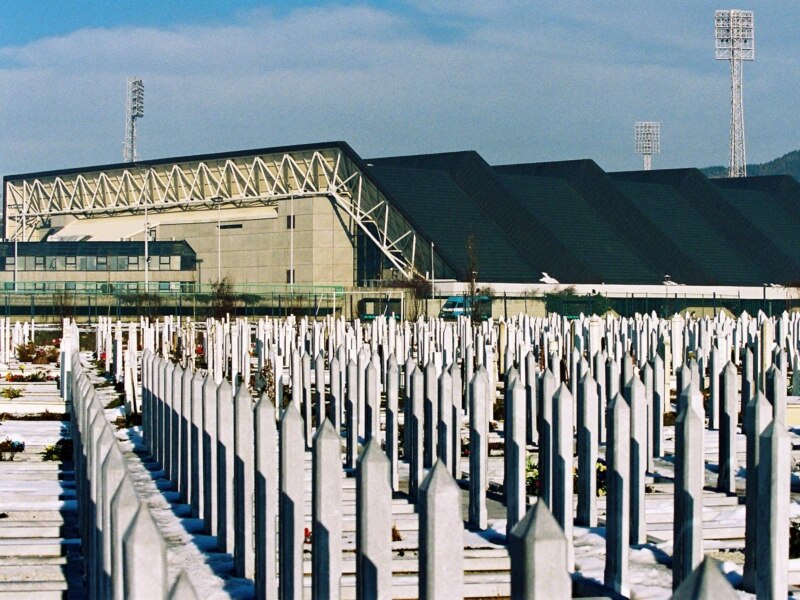
A cemetery for those who died in the siege of Sarajevo, built on a football pitch in front of the Zetra Olympic hall in Sarajevo (file photo)
Gordana Knezevic
Radio Free Europe/Radio Liberty
February 11
In Sarajevo, February is not the shortest month. At least it doesn't seem that way. There are simply too many anniversaries to honor, mourn, or celebrate.
It's been 25 years since the 1984 Winter Olympics, when for a fleeting moment the entire city was transformed into the world's sports capital. That February, every citizen of Sarajevo seemingly believed he or she had personally contributed to each medal won in the giant slalom, bobsled, or ski jump, or simply felt immeasurable pride at being a perfect host.
Eight years later, Sarajevo was back in the world's headlines when it was attacked by Serbian artillery forces. One of the worst massacres of the war that ensued took place on February 5, 1994, when a single shell killed more than 60 people and severely wounded 200 more in what came to be known as the Markale market massacre. February 5 was declared a day of remembrance for victims of the war, including 12,000 Sarajevans, many of whom are buried at former Olympic sites hastily converted to graveyards during the conflict.
The defense of Sarajevo was heroic. People of different ethnic backgrounds fought side by side to protect their right to live together -- only to see their country divided, once the war was over, into an ethnically identified Serb Republic (Republika Srpska) and a Muslim-Croat Federation.
Undoing Dayton?
The U.S.-brokered Dayton peace agreement in 1995 was praised for forcing all sides to the table to end nearly 3 1/2 years of fighting. But it was a shotgun wedding that failed to deliver the constitutional framework needed for Bosnia's future.
 A Sarajevan family mourns a victim of the city's February 1994 marketplace massacre. The shelling, which killed 68 people, did not discriminate between Bosniaks, Serbs, and Croats.
One of Dayton's legacies is the Office of the High Representative, an international post established to supervise the postwar normalization. Since December 1995, the world has sent six of its most prominent diplomats to babysit the fragile Bosnian peace. The post came with almost unlimited powers. But each time, the high representative left Bosnia frustrated at his inability to move the country forward, toward real stability.
The latest such case is High Representative Miroslav Lajcak, who is leaving in favor of a post as Slovak foreign minister. Lajcak signaled his intention to leave in late January; his successor has yet to be named. Local political leaders, reasoning that Lajcak is unlikely to use his final weeks in office to play disciplinarian, have seized on this window of opportunity, using the current power vacuum to propose that Bosnia be divided into four separate regions.
Despite the locals' protestations that the plan would create "sustainable economic units," this is hardly regionalism as it is understood in Europe. Rather, it is a throwback to the early 1990s, when Bosnian Serb leader Radovan Karadzic presented a scheme to divide Bosnia into four cantons -- one Serb, one Croat, and one Muslim, with Sarajevo thrown in as a separate entity to convince the international community the division was truly administrative in nature, and not a split along ethnic lines.
In the months leading up to the war, the leaders of Bosnia's three national parties secretly drew and redrew the maps in an attempt to formalize Karadzic's proposal. Many of those maps ended up in the dustbin; but psychologically they laid the groundwork for the ethnic cleansing that followed.
Old Goals
Once again, the maps are being privately redrawn. History does not repeat itself, and the current four-unit proposal does not mean Bosnia is once again teetering on the brink of war. If anything, the leaders of the three major national parties believe the time has come to achieve their wartime goals -- albeit through peaceful means.
Even Dayton, the treaty that brought peace to Bosnia, has become a weapon in the mounting tensions. It has been nearly 14 years since the ink dried in Paris, but Bosnia's national leaders have yet to comply with one of its basic demands -- that they sit together and produce an official constitution. Without that step, Bosnia cannot move ahead on European integration or NATO membership.
But attempts to introduce a new constitution have failed repeatedly. When a preliminary document was finally cobbled together in 2007, Haris Silajdzic, the Bosniak member of the country's tripartite presidency, blocked the deal, saying it didn't go far enough. In truth, he has called for the dissolution of Republika Srpska, and has no inherent interest in carrying out Dayton to the letter. (Silajdzic was one of the key Bosniak negotiators in the Dayton talks but is now its chief critic inside the Muslim-Croat Federation.)
Similarly, Milorad Dodik, the prime minister of Republika Srpska, have no personal stake in seeing a constitution approved. Officials in Banja Luka, the capital of Republika Srpska, are pushing for secession from the Muslim-Croat Federation, and have traditionally refused to countenance the three-party negotiations prescribed by Dayton.
Dodik has hired an American law firm to advise his government on any further negotiations with the international community and on other legal issues. As Russia's money and Belgrade's influence in the region grow, Dodik is increasingly flexing his muscles. He is ready to use any legal loophole or marketing trick to block constitutional changes.
In Dodik's view, the future of Republika Srpska is safe -- it is Bosnia that will not last. His arrogance is not simply poor manners. It is an intentional jibe meant to annoy his political partners and force Muslim and Croat leaders to ask for an ethnic "divorce" -- a division of the country along ethnic lines.
New Element
To add to the turmoil, the religious head of Bosnia's Islamic community, Mustafa Ceric, last week defended the country's Wahabbist movement during Friday prayers. He rejected any division between "old" and "new" Muslims, invoking specters of "Islamophobia" and "genocide" that haunt all of Bosnia's Muslims.
The appearance of religion in an already tumultuous ethnic debate is a bad sign. And as long as politicians hold the people of Bosnia hostage to their ethnic or religious identities, no one will be asking the questions that really matter: Why are more than 40 percent of Bosnians unemployed? What is the average salary still below $600? What has happened to the millions of dollars and foreign aid that has poured into the country since the end of the war? Why have reforms aimed at European integration not been introduced?
What has been completely lost in Bosnia is a sense of reality. Each ethnic group clings to its own narrative of the recent past. Most Muslims consider Republika Srpska an entity created through genocide. Many inhabitants of Republika Srpska, meanwhile, deny that events like the Markale massacre ever happened.
Nationalism in Bosnia is a strong drug that keeps the country deeply divided.
Independent voices are not being heard.
Where is the global city of Sarajevo that hosted the Olympic Games?
Gordana Knezevic is director of RFE/RL's South Slavic and Albanian Languages Services. The views expressed in this commentary are the author's own and do not necessarily reflect those of RFE/RL.
It's been 25 years since the 1984 Winter Olympics, when for a fleeting moment the entire city was transformed into the world's sports capital. That February, every citizen of Sarajevo seemingly believed he or she had personally contributed to each medal won in the giant slalom, bobsled, or ski jump, or simply felt immeasurable pride at being a perfect host.
Eight years later, Sarajevo was back in the world's headlines when it was attacked by Serbian artillery forces. One of the worst massacres of the war that ensued took place on February 5, 1994, when a single shell killed more than 60 people and severely wounded 200 more in what came to be known as the Markale market massacre. February 5 was declared a day of remembrance for victims of the war, including 12,000 Sarajevans, many of whom are buried at former Olympic sites hastily converted to graveyards during the conflict.
The defense of Sarajevo was heroic. People of different ethnic backgrounds fought side by side to protect their right to live together -- only to see their country divided, once the war was over, into an ethnically identified Serb Republic (Republika Srpska) and a Muslim-Croat Federation.
Undoing Dayton?
The U.S.-brokered Dayton peace agreement in 1995 was praised for forcing all sides to the table to end nearly 3 1/2 years of fighting. But it was a shotgun wedding that failed to deliver the constitutional framework needed for Bosnia's future.

The latest such case is High Representative Miroslav Lajcak, who is leaving in favor of a post as Slovak foreign minister. Lajcak signaled his intention to leave in late January; his successor has yet to be named. Local political leaders, reasoning that Lajcak is unlikely to use his final weeks in office to play disciplinarian, have seized on this window of opportunity, using the current power vacuum to propose that Bosnia be divided into four separate regions.
Despite the locals' protestations that the plan would create "sustainable economic units," this is hardly regionalism as it is understood in Europe. Rather, it is a throwback to the early 1990s, when Bosnian Serb leader Radovan Karadzic presented a scheme to divide Bosnia into four cantons -- one Serb, one Croat, and one Muslim, with Sarajevo thrown in as a separate entity to convince the international community the division was truly administrative in nature, and not a split along ethnic lines.
In the months leading up to the war, the leaders of Bosnia's three national parties secretly drew and redrew the maps in an attempt to formalize Karadzic's proposal. Many of those maps ended up in the dustbin; but psychologically they laid the groundwork for the ethnic cleansing that followed.
Old Goals
Once again, the maps are being privately redrawn. History does not repeat itself, and the current four-unit proposal does not mean Bosnia is once again teetering on the brink of war. If anything, the leaders of the three major national parties believe the time has come to achieve their wartime goals -- albeit through peaceful means.
Even Dayton, the treaty that brought peace to Bosnia, has become a weapon in the mounting tensions. It has been nearly 14 years since the ink dried in Paris, but Bosnia's national leaders have yet to comply with one of its basic demands -- that they sit together and produce an official constitution. Without that step, Bosnia cannot move ahead on European integration or NATO membership.
But attempts to introduce a new constitution have failed repeatedly. When a preliminary document was finally cobbled together in 2007, Haris Silajdzic, the Bosniak member of the country's tripartite presidency, blocked the deal, saying it didn't go far enough. In truth, he has called for the dissolution of Republika Srpska, and has no inherent interest in carrying out Dayton to the letter. (Silajdzic was one of the key Bosniak negotiators in the Dayton talks but is now its chief critic inside the Muslim-Croat Federation.)
What has been completely lost in Bosnia is a sense of reality. Each ethnic group clings to its own narrative of the recent past.
Dodik has hired an American law firm to advise his government on any further negotiations with the international community and on other legal issues. As Russia's money and Belgrade's influence in the region grow, Dodik is increasingly flexing his muscles. He is ready to use any legal loophole or marketing trick to block constitutional changes.
In Dodik's view, the future of Republika Srpska is safe -- it is Bosnia that will not last. His arrogance is not simply poor manners. It is an intentional jibe meant to annoy his political partners and force Muslim and Croat leaders to ask for an ethnic "divorce" -- a division of the country along ethnic lines.
New Element
To add to the turmoil, the religious head of Bosnia's Islamic community, Mustafa Ceric, last week defended the country's Wahabbist movement during Friday prayers. He rejected any division between "old" and "new" Muslims, invoking specters of "Islamophobia" and "genocide" that haunt all of Bosnia's Muslims.
The appearance of religion in an already tumultuous ethnic debate is a bad sign. And as long as politicians hold the people of Bosnia hostage to their ethnic or religious identities, no one will be asking the questions that really matter: Why are more than 40 percent of Bosnians unemployed? What is the average salary still below $600? What has happened to the millions of dollars and foreign aid that has poured into the country since the end of the war? Why have reforms aimed at European integration not been introduced?
What has been completely lost in Bosnia is a sense of reality. Each ethnic group clings to its own narrative of the recent past. Most Muslims consider Republika Srpska an entity created through genocide. Many inhabitants of Republika Srpska, meanwhile, deny that events like the Markale massacre ever happened.
Nationalism in Bosnia is a strong drug that keeps the country deeply divided.
Independent voices are not being heard.
Where is the global city of Sarajevo that hosted the Olympic Games?
Gordana Knezevic is director of RFE/RL's South Slavic and Albanian Languages Services. The views expressed in this commentary are the author's own and do not necessarily reflect those of RFE/RL.
India welcomes Mumbai admission
India welcomes Pakistan's action
India has described the admission by Pakistan that last year's Mumbai terror attacks were partly planned on its soil as a "positive development".
A foreign ministry statement said India also expected Pakistan to take steps to dismantle the "infrastructure of terrorism" on its territory.
Pakistan's interior minister said suspects arrested could be prosecuted.
The admission was condemned by militant groups in Kashmir, who accused the government of bowing to US pressure.
This is the first sign of an easing in tension between the countries over the attacks, a BBC correspondent says.
 The attacks on Mumbai had overshadowed relations for weeks |
Many in Delhi are genuinely surprised at what some see as a major turn-around by the Pakistani authorities, Sanjoy Majumder reports from the Indian capital.
Relations had deteriorated considerably after the attacks by 10 gunmen which claimed 170 lives.
Pakistan denied any responsibility in the immediate aftermath of the attacks but later admitted that the sole gunman captured alive was one of its citizens.
Top Indian officials are now meeting to examine the information that has been handed over before determining their next move.
'By boat from Karachi'
"It remains India's goal to bring the perpetrators of the terrorist attacks on Mumbai to book and to follow this process through to the end," the Indian foreign ministry statement said.
Mr Malik conceded that a foreign terror plot was hatched in Pakistan
"We would also expect that the government of Pakistan take credible steps to dismantle the infrastructure of terrorism in Pakistan."
Earlier, Pakistani Interior Minister Rehman Malik said eight suspects from the banned Lashkar-e-Taiba militant group could face prosecution.
"Some part of the conspiracy has taken place in Pakistan," he told a news conference in the Pakistani capital Islamabad.
He said six of the suspects were in custody while two others remained at large.
"The attackers left from Karachi on a boat hired from Balochistan [Province]," Mr Malik said.
"An e-mail claiming responsibility for the attack was sent by Zarrar Shah of the Lashkar-e-Taiba."
Mr Shah was arrested at a Lashkar camp in December in Pakistani-administered Kashmir by security forces.
Another man arrested at the time was Zaki-ur-Rehman Lakhvi, described as Lashkar's chief of operations.
Mr Malik named Hamad Amin, a Karachi resident currently in Pakistani custody, as the mastermind behind the attacks.
Militant anger
The main alliance of militant groups in Kashmir, the United Jihad Council (UJC), condemned the Pakistani government for admitting to Lashkar-e-Taiba's involvement.
A UJC spokesman, Syed Sadaqat Hussain, said the government had done an about-turn after US envoy Richard Holbrooke's visit.
"Pakistan has succumbed to American pressure and fallen victim to an Indo-US conspiracy," he said.
Separatist leader Syed Ali Shah Geelani said that Pakistan did "not have an independent foreign policy" and had "bowed before the US".
It took more than one month for Islamabad's authorities to recognized their part in the Mumbai attacks. Maybe the visit in South Asia of US Special Envoy for Pakistan and Afghanistan, Richard Hoolbroke, is having its share in this. As long as it happens, the reasons are less important. It would be interesting to see what practical steps will follow in fighting terrorism and/by finding a solution for the Kashmir dispute.
See also:
Voice of America - Hoolbroke's mission to South Asia
Former Yugoslav Republic of Macedonia name talks resume at UN

Personal Envoy Matthew Nimetz
UN News Center
11 February 2009 – Representatives of Greece and the former Yugoslav Republic of Macedonia held talks today on the name of the latter country in what a United Nations envoy called a “good, solid discussion.”
Ambassador Adamantios Vassilakis of Greece and Ambassador Zoran Jolevski of the former Yugoslav Republic of Macedonia met at the initiative of Secretary-General Ban Ki-moon’s Personal Envoy Matthew Nimetz.
Today’s encounter was considered an exploratory meeting as it was the first with the former Yugoslav Republic of Macedonia’s new negotiator. The parties spoke about major issues and how progress could be made. Mr. Nimetz stressed the need to create a positive atmosphere and to avoid creating irritations between the parties. The two sides decided to meet again on a date yet to be agreed. No new proposals were aired during today’s meeting.
The meeting was the first since the former Yugoslav Republic of Macedonia instituted proceedings against Greece in November at the International Court of Justice (ICJ) in The Hague, alleging that Greece blocked its application to join the North Atlantic Treaty Organization (NATO) in violation of an agreement between the two countries.
When their representatives last met in New York in October, Mr. Nimetz presented a new set of ideas to both sides for their consideration. In the past, the Special Envoy has proposed several compromise names but the two sides remain far apart on what they consider to be a satisfactory name for the former Yugoslav Republic of Macedonia.
The Interim Accord of 13 September 1995, which was brokered by the UN, details the difference between the two countries on the issue. It also obliges the two sides to continue negotiations under the auspices of the UN Secretary-General to try to reach agreement.
Name Deal Depends on Greece Too- Macedonia
Balkan Insight
February 10

President Branko Crvenkovski
Macedonia is ready to look for a solution to the “name” row with Greece, but cannot accept Athens calling all the shots and not compromising, Macedonia’s President Branko Crvenkovski said on Tuesday.
Crvenkovski spoke during a visit to the Bulgarian capital Sofia, a day before a fresh round of UN sponsored talks between the two countries is due to take place in New York after several months on hiatus.
"The name dispute is the sole obstacle to Macedonia's accession into NATO and the EU. If Macedonia wants to become a member of the Euro-Atlantic community, it's logical that it has to find a compromise with Greece”, Crvenkovski said. “It's up to Greece as well, because it takes two to make a compromise”, he said as quoted by the Makfax news agency.
Dnevnik daily cited unnamed Macedonian diplomats as saying they expected nothing new from the talks except a technical meeting to determine the future course of negotiations. They expect both sides to stick to their previous positions at least until fall, due to the local and presidential polls in Macedonia slated for March and the European Parliament elections in Greece set for June.
Skopje is expected to continue insisting on the so called double name formula including one name for international use and another for bilateral relations with Athens. Greece on the other hand wants Macedonia to change its name and use the new name everywhere, arguing that the use of 'Macedonia' implies territorial claims over its own northern province that is called the same.
Relations between the two neighbours reached a low recently since last April, when Athens blocked Skopje’s NATO accession pending a solution to the row, then threatened to do the same in the EU, while in November Macedonia took Greece to the International Court of Justice in Hague over the NATO blockade. Observers feared this could practically freeze if not completely end the UN talks since the focus will be shifted on the suit instead.
Meanwhile Greek daily Kathimerini in a comment piece yesterday saying that the fresh round of talks marks a new era in the dispute. With George. W. Bush’s presidency over, Macedonia lost its biggest supporter on the international scene, the daily added.
Wednesday, February 4, 2009
Bangladesh Militants Involved in Mumbai Attacks, Dawn Reports
Jay Shankar
Bloomberg
February 5
Bloomberg
February 5
Pakistani investigators probing the terrorist attacks on India’s financial hub of Mumbai have evidence a banned militant group in Bangladesh was involved, the Dawn newspaper reported, citing officials it didn’t identify.
Investigators have determined that the Harkat-nl-Jihad-al Islami organization planned the Nov. 26-29 assault and trained the terrorists who took part, according to the report. The attack killed 164 people.
The Bangladesh connection will be included in a report to be submitted by Pakistan’s Federal Investigation Agency to the government and will be shared with India, according to the newspaper. The report may indicate the Mumbai attack was carried out by an “international network of Muslim fundamentalists,” Dawn said.
India blames Pakistan-based militant group Lashkar-e-Taiba for the attack. It presented Pakistani Prime Minister Yousuf Raza Gilani’s government with a dossier last month that it said proved the involvement of Pakistani nationals. Gilani said on Feb. 1 his government has investigated information provided by India on the attacks and will respond.
To contact the reporter on this story: Jay Shankar in Bangalore at jshankar1@bloomberg.net
See also:
Reuters-US' Holbrooke to visit India
Reuters - Pakistan must cooperate with India on Mumbai
Saturday, January 24, 2009
Pakistani peace mission in India
Sanjoy Majumder
BBC News, Delhi
| |
A Pakistani peace delegation made up of politicians, activists and journalists has travelled to India - the first such visit since the Mumbai attacks.
During three days in Delhi they will meet politicians and other Indians in an effort to reduce tensions between the two nuclear-armed neighbours.
India blames the Mumbai (Bombay) attacks on Pakistan-based groups and wants Islamabad to crack down on them.
The group will have only limited access to the Indian government.
They are meeting politicians and parliamentarians from both the governing Congress Party as well as left-wing parties, but no member of the cabinet or senior official.
'Challenging terrorism'
Despite the peace mission's limited mandate, the group of 24 Pakistani activists who crossed the land border into India and are now meeting their counterparts in Delhi feel it is worth the effort.
"We decided to come to meet not just our counterparts but also people in the government and outside and to see what is the way forward," says Asma Jahangir, delegation leader and chairperson of the Human Rights Commission of Pakistan.
"Certainly war is not the way forward."
India has handed over a dossier to Pakistan that it says contains evidence linking the Mumbai attacks to elements in that country.
But while there is sympathy for Delhi's position, Ms Jahangir believes that India is missing the point.
"The major issue is how do the governments of the region get together to challenge terrorism, which is not only spreading in Pakistan but throughout the region," she said.
In the past, interactions of this nature have had some success in pushing both governments to do business with each other.
But some believe that the mood in India has changed post-Mumbai, making efforts such as this one that much more challenging.
Friday, December 19, 2008
Egyptian intellectuals pay price for curiosity
LA Times
Rapprochement with Israel is a fraught issue. Most want to wait until Palestinians have a state, others support limited peace, and those who have done the unthinkable and visited Israel face ostracism
Rapprochement with Israel is a fraught issue. Most want to wait until Palestinians have a state, others support limited peace, and those who have done the unthinkable and visited Israel face ostracism
Reporting from Cairo -- It has been a tough peace for Ali Salem. His plays don't have a stage. Intellectuals shun him; the writers union refuses to pay his pension. He sits in a cafe window, typing on his laptop and defending his choice long ago to cross the border into Israel and make friends.
Egypt and Israel made peace in 1979, but that treaty remains as agitating to Egyptian artists and intellectuals as a sliver of glass beneath the skin. Most of them don't accept it, and those who do are often vilified, their artistic voices muffled by condemnation.
Egypt and Israel made peace in 1979, but that treaty remains as agitating to Egyptian artists and intellectuals as a sliver of glass beneath the skin. Most of them don't accept it, and those who do are often vilified, their artistic voices muffled by condemnation.
"Producers are afraid to come near me," said Salem, who in 1994 drove his car across Israel and wrote what critics considered a sympathetic book about the journey. "I anticipated there would be a strong reaction, but I didn't expect it would be so mean. It's hard and this is the wound."
Salem, a columnist for Al Hayat newspaper and a co-founder of the Cairo Peace Movement, added: "Peace is the right idea. But Egyptian intellectuals are afraid and can't get rid of their ancient fears. They still think Israel and the U.S. will inflict something bad upon us."
There are degrees of resistance among intellectuals toward rapprochement. Many oppose improving relations until Palestinians have their own state; others support limited peace but are guarded when discussing the passions around the Arab-Israeli conflict; a few have visited Israel to interact with their Jewish counterparts.
Salem, a columnist for Al Hayat newspaper and a co-founder of the Cairo Peace Movement, added: "Peace is the right idea. But Egyptian intellectuals are afraid and can't get rid of their ancient fears. They still think Israel and the U.S. will inflict something bad upon us."
There are degrees of resistance among intellectuals toward rapprochement. Many oppose improving relations until Palestinians have their own state; others support limited peace but are guarded when discussing the passions around the Arab-Israeli conflict; a few have visited Israel to interact with their Jewish counterparts.
And, occasionally, an artist unwittingly becomes the target of screeds and opinion page vitriol. Filmmaker Nadia Kamel’s recent documentary about her mother's Jewish roots was attacked as a call to "normalize" relations with Israel. Opera singer Gaber Beltagui had his membership in the musicians union suspended in 2007 when he sang at the 100th anniversary of a Cairo synagogue.
"How can he go sing at a synagogue while they [Israelis] are killing our sons?" Mounir Wasseemy, the head of the Musical Artists' Syndicate, said, denouncing Beltagui. "What glory was he seeking?"
The Cairo synagogue is "officially recorded as an Egyptian monument," said Beltagui, who has filed suit against the union. "I did not expect this reaction. I did nothing wrong. I had even asked permission from the state security services before I sang."
Similar furor has engulfed Mohammed Sayed Tantawi, the grand sheik of Cairo's Al Azhar Mosque, the leading Sunni institution in the Islamic world. Writers and newspapers have called for Tantawi’s resignation after he was photographed shaking hands with Israeli President Shimon Peres at a recent international conference on religious understanding sponsored by the United Nations.
The sheik said he had not recognized Peres, and has called his detractors "lunatics."
Gamal Ghitani is one of Egypt's best novelists. He covered the 1973 war as a correspondent and is curious to see the land of his enemy. That is not likely to happen soon; Ghitani's refusal to travel to Israel has not wavered in more than three decades.
"Cultural exchange can't be fruitful unless Israel achieves peace on the ground," he said. "How can I be at peace with this peace if Israel relies on its military superiority, builds fences and settlements and keeps kicking Palestinians out? Politics can follow the path it wants, but we as intellectuals must follow our conscience."
A chat with him on a recent morning rolled through history and present-day dangers. Ghitani, a polished man in a blue blazer, equates radical Zionists with Palestinian mujahedin, and he draws a distinction between individual Jews and the actions of a Jewish state. His conversation was laced with nuance and shifting politics; he said he opposed the criticism directed at opera singer Beltagui as "a form of extremism."
Yet he promised not to budge on making his own peace with Israel.
"This will take time," said Ghitani, editor of the literary journal Akhbar Al-Adab. "We can't go to Israel while they are killing Palestinians."
Salem was as rumpled as Ghitani was meticulous. Sitting in a cafe in a flannel shirt, Salem, a big man with rounded shoulders, leaned forward, his voice rattling like the growl of a loose muffler.
He was an established playwright when Cairo was ostracized by the Arab world after President Anwar Sadat traveled to Washington to sign the Camp David peace accords with Israel's Menachem Begin.
His open support of that peace, and his befriending of Jewish intellectuals, has cost him. The Egyptian Writers' Union stopped paying his pension in 2001 and he hasn't had a play produced here in years. So he has turned his newspaper column into a kind of one-man theatrical show. It's not the same as a production, but it allows him to vent.
"Peace will not come to you; you have to make it, you have to sculpt it," he said. "The intellectuals here always pull Israel from the bottom of the drawer and set it on the table. They can't move beyond it.
"But you know, business deals lead to peace, not 'enlightenment' from writers and intellectuals. . . . If you ask any Egyptian businessman, he will tell you there is peace with Israel. There's real cooperation on security, commerce and politics."
In November, Salem was awarded the $50,000 Civil Courage Prize from the Train Foundation, a New York-based trust that promotes tolerance and resistance to extremism, which recognized his commitment to peace with Israel and opposition to Islamic radicalism. When Salem discussed the prize, there was a shine in his eyes, the kind a man has when he gets one over on his critics.
He made his 1994 trip to Israel -- his first -- after the Oslo accords. His book about the journey, "My Drive to Israel," reportedly sold 60,000 copies and angered Egyptian intellectuals, as did his honorary doctorate from Israel's Ben-Gurion University of the Negev.
"When I went to Israel, I just wanted to see who are these people and what are they doing," he said. "The writers union still wants me to repent. But they will never forgive me if I retreat. That's when the real attacks would come, because deep down they know I speak the truth."
Fleishman is a Times staff writer.
jeffrey.fleishman@latimes.com
Noha El-Hennawy of The Times' Cairo Bureau contributed to this report.
"How can he go sing at a synagogue while they [Israelis] are killing our sons?" Mounir Wasseemy, the head of the Musical Artists' Syndicate, said, denouncing Beltagui. "What glory was he seeking?"
The Cairo synagogue is "officially recorded as an Egyptian monument," said Beltagui, who has filed suit against the union. "I did not expect this reaction. I did nothing wrong. I had even asked permission from the state security services before I sang."
Similar furor has engulfed Mohammed Sayed Tantawi, the grand sheik of Cairo's Al Azhar Mosque, the leading Sunni institution in the Islamic world. Writers and newspapers have called for Tantawi’s resignation after he was photographed shaking hands with Israeli President Shimon Peres at a recent international conference on religious understanding sponsored by the United Nations.
The sheik said he had not recognized Peres, and has called his detractors "lunatics."
Gamal Ghitani is one of Egypt's best novelists. He covered the 1973 war as a correspondent and is curious to see the land of his enemy. That is not likely to happen soon; Ghitani's refusal to travel to Israel has not wavered in more than three decades.
"Cultural exchange can't be fruitful unless Israel achieves peace on the ground," he said. "How can I be at peace with this peace if Israel relies on its military superiority, builds fences and settlements and keeps kicking Palestinians out? Politics can follow the path it wants, but we as intellectuals must follow our conscience."
A chat with him on a recent morning rolled through history and present-day dangers. Ghitani, a polished man in a blue blazer, equates radical Zionists with Palestinian mujahedin, and he draws a distinction between individual Jews and the actions of a Jewish state. His conversation was laced with nuance and shifting politics; he said he opposed the criticism directed at opera singer Beltagui as "a form of extremism."
Yet he promised not to budge on making his own peace with Israel.
"This will take time," said Ghitani, editor of the literary journal Akhbar Al-Adab. "We can't go to Israel while they are killing Palestinians."
Salem was as rumpled as Ghitani was meticulous. Sitting in a cafe in a flannel shirt, Salem, a big man with rounded shoulders, leaned forward, his voice rattling like the growl of a loose muffler.
He was an established playwright when Cairo was ostracized by the Arab world after President Anwar Sadat traveled to Washington to sign the Camp David peace accords with Israel's Menachem Begin.
His open support of that peace, and his befriending of Jewish intellectuals, has cost him. The Egyptian Writers' Union stopped paying his pension in 2001 and he hasn't had a play produced here in years. So he has turned his newspaper column into a kind of one-man theatrical show. It's not the same as a production, but it allows him to vent.
"Peace will not come to you; you have to make it, you have to sculpt it," he said. "The intellectuals here always pull Israel from the bottom of the drawer and set it on the table. They can't move beyond it.
"But you know, business deals lead to peace, not 'enlightenment' from writers and intellectuals. . . . If you ask any Egyptian businessman, he will tell you there is peace with Israel. There's real cooperation on security, commerce and politics."
In November, Salem was awarded the $50,000 Civil Courage Prize from the Train Foundation, a New York-based trust that promotes tolerance and resistance to extremism, which recognized his commitment to peace with Israel and opposition to Islamic radicalism. When Salem discussed the prize, there was a shine in his eyes, the kind a man has when he gets one over on his critics.
He made his 1994 trip to Israel -- his first -- after the Oslo accords. His book about the journey, "My Drive to Israel," reportedly sold 60,000 copies and angered Egyptian intellectuals, as did his honorary doctorate from Israel's Ben-Gurion University of the Negev.
"When I went to Israel, I just wanted to see who are these people and what are they doing," he said. "The writers union still wants me to repent. But they will never forgive me if I retreat. That's when the real attacks would come, because deep down they know I speak the truth."
Fleishman is a Times staff writer.
jeffrey.fleishman@latimes.com
Noha El-Hennawy of The Times' Cairo Bureau contributed to this report.
Monday, December 15, 2008
Public apology of Turkish intellectuals for mass killing of Armenians
A first step, indeed, after 100 years of dissent. Turkish intellectuals who raised this question were killed or sued or threatened. Turkish diplomats were assassinated in various corners of the world by Armenian patriots. The public campaign to be launched by intellectuals could open the door to a process of getting the history out of the present, not by ignoring it, but by assuming the past.
ANKARA (Reuters) -- A group of Turkish intellectuals and academics are planning to issue a public apology on the Internet for the mass killings of ethnic Armenians in World War I.
The campaign, which has drawn the ire of nationalists who regard it as an act of national betrayal, coincides with a diplomatic rapprochement between Turkey and Armenia to end almost 100 years of hostility.
Turks, including Nobel Literature Laureate Orhan Pamuk, have been prosecuted in the European Union candidate country for affirming that the mass killings of Armenians in 1915 amount to genocide.
Cengiz Aktar, a professor at Istanbul's Bahcesehir University and one of the campaign's organizers, said the group plans to issue the apology on December 15 along with a non-binding Internet petition to gather signatures.
It will read: "My conscience does not accept the insensitivity showed to, and the denial of, the Great Catastrophe that the Ottoman Armenians were subjected to in 1915. I reject this injustice and for my share, I empathies with the feelings and pain of my Armenian brothers. I apologies to them."
Turkey accepts that many Armenians were killed during the waning years of the Ottoman Empire, but strongly denies Armenian claims it was genocide, saying that Muslim Turks also died in inter-ethnic conflicts. Western historians have backed Armenian claims that the killings amounted to genocide.
The apology, which has been leaked to the media, threatens to reignite a controversy that challenges one of the ideological foundations of modern Turkey. It also comes at a time of heightened nationalism in Turkey.
Aktar said the initiative was meant to allow Turks to offer a personal apology and to end an official silence. "We are not targeting anyone. It's an apology of individual nature. We want to tell our Armenian brothers and sisters we apologies for not being able to discuss this issue for almost 100 years," he said.
He said the group included 200 writers, intellectuals, and academics. The European Union has repeatedly criticized Turkey for restrictions on free speech, in particular over punishments writers have received for comments on the Armenian issue.
President Abdullah Gul became the first Turkish leader to visit Armenia in September as Turkey has sought to improve ties. Several meetings between Turkish and Armenian officials have followed and the two countries have expressed hopes of restoring full diplomatic relations soon.
UPDATE:
Cengiz Aktar, a professor at Istanbul's Bahcesehir University and one of the campaign's organizers, said the group plans to issue the apology on December 15 along with a non-binding Internet petition to gather signatures.
It will read: "My conscience does not accept the insensitivity showed to, and the denial of, the Great Catastrophe that the Ottoman Armenians were subjected to in 1915. I reject this injustice and for my share, I empathies with the feelings and pain of my Armenian brothers. I apologies to them."
Turkey accepts that many Armenians were killed during the waning years of the Ottoman Empire, but strongly denies Armenian claims it was genocide, saying that Muslim Turks also died in inter-ethnic conflicts. Western historians have backed Armenian claims that the killings amounted to genocide.
The apology, which has been leaked to the media, threatens to reignite a controversy that challenges one of the ideological foundations of modern Turkey. It also comes at a time of heightened nationalism in Turkey.
Aktar said the initiative was meant to allow Turks to offer a personal apology and to end an official silence. "We are not targeting anyone. It's an apology of individual nature. We want to tell our Armenian brothers and sisters we apologies for not being able to discuss this issue for almost 100 years," he said.
He said the group included 200 writers, intellectuals, and academics. The European Union has repeatedly criticized Turkey for restrictions on free speech, in particular over punishments writers have received for comments on the Armenian issue.
President Abdullah Gul became the first Turkish leader to visit Armenia in September as Turkey has sought to improve ties. Several meetings between Turkish and Armenian officials have followed and the two countries have expressed hopes of restoring full diplomatic relations soon.
UPDATE:
AP:
Turkish nationalists have criticized the online apology and on Monday a group of some 60 retired Turkish diplomats described the move "as unfair, wrong and unfavorable to national interests."
"Such an incorrect and one-sided attempt would mean disrespecting our history," the diplomats said. Devlet Bahceli, the leader of the Nationalist Action Party said: "No one has the right to insult our ancestors, to present them as criminals and to ask for an apology."
By late Monday, there were no public threats of legal action over the petition.
Sunday, December 14, 2008
Steps to peace
Dec. 13, 2008
Liat Collins , THE JERUSALEM POST
Liat Collins , THE JERUSALEM POST
I didn't waltz while I was in Vienna a week ago. The toes I stepped on were metaphorical. They say it takes two to tango. Or to do a waltz. They also say it takes two to make peace. They (whoever they are) have never attended a peace conference.
Some 200 people sat in a splendid conference room at Vienna's Hofburg Congress Center, the former imperial palace, for the 16th International Media Seminar on Peace in the Middle East, organized by the UN's Department of Public Information and the Federal Ministry for European and International Affairs in Austria on December 2 and 3.
The city, smothered with Christmas decorations, seemed to be gift wrapped to welcome the participants. Since the theme of the conference was "The role of the international community," it is hardly surprising that the seminar was attended by more than just those directly affected by the Israeli-Palestinian situation. An Obama-supporting Native American by the name of Silverbird, for example, handed out business cards listing him as "ambassador, historian, entrepreneur."
Seeing as it was a media conference, I unapologetically spent time interviewing other journalists. Indeed, it was the discussions during coffee breaks or while seeking the nightlife in a city that goes to bed early which proved most interesting. A journalist from Jerusalem doesn't often get the chance to talk to a colleague from Algeria, even off the record.
A chat with the Cairo bureau chief of Al Arabiya News Channel, Randa Abul-Azm, was also illuminating. When I mentioned the Sunni-Shi'ite split, she countered: "That's an American invention. It didn't exist before the Iraqi invasion." I suggested that Egypt take some responsibility for Gaza, eliciting the response: "You can't expect Egypt to absorb the refugees. We're overcrowded as it is."
Fritz Froehlich, coordinator for "UNRWA at 60," pointed out that the problems have only just begun. In his assessment, the issue isn't the number of residents currently in Gaza, but the exponentially growing number in the future.
Many participants expressed concern about the Hamas hold on Gaza, cutting it off from the West Bank more effectively than any Israeli-imposed sanctions ever could.
Clearly we have a long way to go to reach solutions. The opening panel demonstrated just how far.
UN UNDER-SECRETARY General for Communications and Public Information Kiyo Akasaka stressed that "the process under way has kindled new hopes that peace can be attained" and read a message from Secretary General Ban Ki-Moon urging: "If people are to have faith in the political process, there is a need for tangible improvements in living conditions and security."
Throughout, the UN struggled to preserve an image of impartiality. But the feeling of hope and goodwill dissipated as the PA's deputy foreign minister, Almutawakel Taha, took to the floor with a speech that strung together every cliché in the book, starting with: "The crucifixion continues in Palestine, not only of human beings but of birds, children, trees and houses..."
I wondered if the "so on and so forth" I heard through my headphones was the literal translation of Taha's speech or a sign the simultaneous interpreter couldn't keep up. This wasn't a peace dialogue; it was a Palestinian narrative. A very distorted version of the truth.
I sat there, far from home, wondering about the ramifications of walking out of the conference in its first session. I decided to stick around, if only to counter some of the arguments in my own speech in the afternoon panel. Fortunately, I didn't have to wait that long.
ELI DAYAN, a former deputy foreign minister in Israel, who spoke immediately after Taha, put aside his planned address and responded directly to Taha's attack. The Moroccan-born Dayan, kippa on head, recalled good neighborly relations with Arabs. He also noted that when he served as mayor of Ashkelon, the city where he still lives - under almost daily rocket fire - his first step was to create a working relationship with the mayor of Gaza. Such speeches don't help promote peace in any way, Dayan berated Taha.
Dayan said there is a consensus in Israel for the two-state solution and much of the Arab world is no longer taking the stance of non-recognition of Israel. "We should be looking ahead," Dayan said. He also took the co-hosts to task, stating: "The UN should lay off its ritual annual decisions condemning Israel, which have no effect."
His sentiments were echoed by two other Ashkelon residents: Benny Vaknin, who has just been reelected mayor after a period out of office, and a Mekorot water company official, Sion Cohen.
Vaknin, Cohen and others were in Vienna to discuss the Israel-Palestinian Civil Society Initiative, chaired by Prof. Ilan Juran. The initiative, which got off the ground following the Moscow seminar two years ago, furthers peacemaking through inter-community cooperation at a local level. Juran noted the joint wastewater program between Hadera and Beit Sahur. Hadera Mayor Haim Avitan explained the triple advantage: saving water, preventing pollution and building trust. Beit Sahur Mayor Hani al-Hayek also urged the use of joint projects for peace.
WHEN IT was my turn to speak, I felt like a party pooper. A string of panelists had warned Israel and the Palestinians that "time is running out." But how can you make real peace while holding a stopwatch? Peace is more than a signed document and photo opportunity. The aim should be to stop people from suffering or being killed. It seems more important to use the coming year to develop environmental, health and educational projects than to chase an elusive agreement, especially when the world's ability to fund even these projects is limited. Sitting comfortably in the old imperial palace, it was as if participants were deliberately avoiding the topic of the Iranian threat and evidence of global jihad.
I was also ignoring Austria's own past, although a German participant suggested I visit Vienna's Jewish Museum, and I wondered if I could find the building where my late aunt used to live - and, perhaps, a clue to the exact fate of her parents in the Holocaust.
One issue I was not prepared to overlook at a conference addressing human rights: captive IDF soldier Gilad Schalit and the several MIAs. A member of Women in Black heckled me about the Palestinian prisoners, but, I pointed out, she knew exactly where they are, how they spend their time, and when they can have visitors.
WHILE WE were away, Kassams continued to fall and terrorists were arrested on their way to carry out an attack in Tel Aviv. As I returned, Israeli police evacuated Hebron's House of Peace, and hotheads attacked local Palestinians. I was pleased I didn't have to face questions on that, inexcusable, behavior.
At Ben-Gurion Airport, I overheard a discussion about Hanukka presents. I collected my suitcase, put aside emotional baggage, and headed for home in Jerusalem, far from Vienna's Christmas lights.
We might not have made peace, or even danced together, but perhaps we had taken a step - or two - in the right direction.
Saturday, December 13, 2008
The economic crisis - opportunities for cooperation
The current economic crisis is opening the doors for cooperation and dialog, going beyond divisions at the political level. China, Japan and South Korea summit could be an example of how the international agenda will look like in the next year, at least. In the same time, by not discussing the problems with a tensioned potential doesn't mean these problems disappeared or will be solved by themselves.
Joint Statement of the Summit
Joint Statement of the Summit
Subscribe to:
Posts (Atom)