Showing posts with label Bosnia Herzegovina. Show all posts

Thursday, October 14, 2010

About civil resistance in Bosnia


I attended recently a web discussion about civil resistance and civil movement in Bosnia Herzegovina. The full content can be find here, so no need to rephrase ideas and points of view already expressed.

I would like to have only a couple of remarks, on various aspects.
Foto right: Victims of the massacre from Srebenica

First of all, I am happy to remark again how interesting is to live in this 2010, and to enjoy living in a free country, including benefiting of free Internet access allowing me to listen and be part of great conversations about topics I am interested in, independently of my current geographical location.

Second, I was very happy to be part of a discussion about an area I always was very interested in. For various reasons, my interests switched recently on other areas, but I will still keep an eye to my dear South-Eastern Europe.

What this live webinar reminded me is that Bosnia and Herzegovina changed a lot in the last years, not only as a consequence of the steps forward on the road to the EU integration, but thanks to the civil society networks created shortly after the end of the Balkan wars. The initiatives started from the communities not involved directly in the public life, as it is the case of the women, and, more specifically, the relatives of victims, as was in the case of Mothers of Srebenica.

The past is complicate and you cannot simply delete the terrible memories from the time of the wars. The situation of war criminals is far of being solved - thanks to various political arrangements as well - and democracy is advancing shyly. But the determination of some organisations is vital and changing the society they used to live by now. Dosta was able to mobilize enough people - also via the 2.0 - for permanently pressing the authorities to fight corruption. And, as a consequence, a prime-minister resigned in 2009.

I would like to have more time to follow closely the complex transformations the new countries from the former Yugoslavia are going to. What I can remark is that it is under way a new form of civic involvement and a new type of civil society that we, in the West, preferred to limit to cultural action and social-environmental militantism. A new trend for a new type of society.

Friday, March 5, 2010

The criminal's smile

After watching a couple of fragments from the latest trial session of Radovan Karadzic I had an extremely unpleasant sensation: I was looking not only at the perfect liar, but the cold blooded criminal. The political motivated criminal. With large gestures, very relaxed, he was trying to explain how in fact, the images of the media crew were the creation of the journalists who enclosed their space with barbed wire. And that the emaciated people from the images were watching the journalists. And how the genocide was a Muslim-Bosnian "creation", a "myth". No regrets, no second thoughts.
Caught while in Belgrade, after a 13-year hunt, he faces 11 counts of genocide, war crimes, crimes against humanity and other atrocities in the Bosnian war of the 1990s. He do not recognize none of them and refused to be represented legally, considering, as Milosevic, he is strong enough to prove his "innocence". Another important fugitive, Ratko Mladic, is still hiding - or being hidden.
Hidding behind what the former UN Prosecutor Carla Del Ponte called in this book "The Hunt" - muro di gomma/wall of rubber (p.3): "I had encountered, and would encounter, the muro di gomma, during meetings with many powerful people, from mafia financiers to Swiss bankers and politicians, from heads of state like George W. Bush and prime ministers like Silvio Berlusconi to bureaucrats in government offices and the various departments of the UN and, late in my tenure, European foreign ministers who seemed to be prepared to welcome Serbia into the EU's embrace even as Serbia's political leaders, police and army were harboring men responsible for killing thousand of prisoners in cold blood before the eyes of the world". In her account of the time spent investigating Balkan and Rwandan crimes, I always found very interesting the hide-and-seek political game, the diplomatic dance against the blind impulse to deliver justice. In many aspects, the two roads do not meet never.
The ICTY was the first war crimes court created by the UN and the first international war crimes tribunal since the Nuremberg and Tokyo tribunals. It was established by the Security Council in accordance with Chapter VII of the UN Charter. The difference with the two other war tribunals is that frequently lacked the necessary public and international support in order to deliver justice.


Thursday, February 12, 2009

Two Anniversaries, Two Legacies -- Which Will Bosnia Choose?

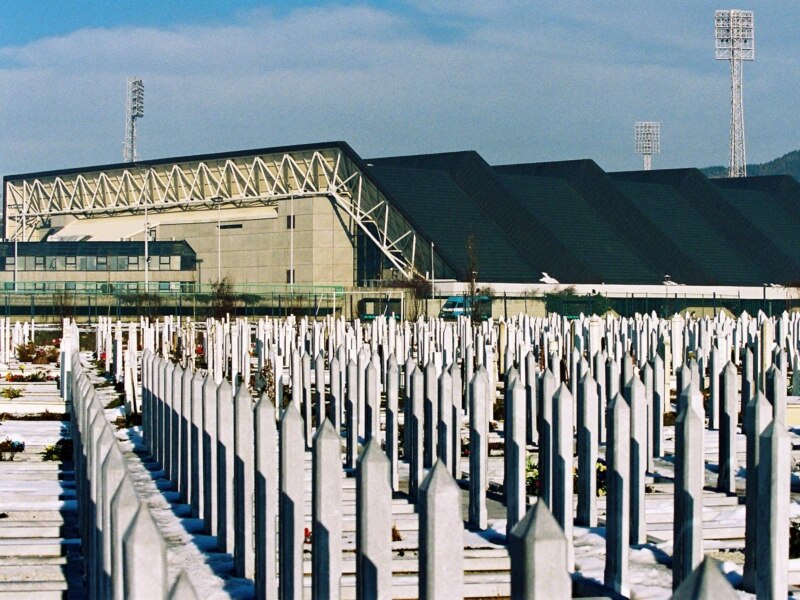
A cemetery for those who died in the siege of Sarajevo, built on a football pitch in front of the Zetra Olympic hall in Sarajevo (file photo)


Gordana Knezevic
Radio Free Europe/Radio Liberty
February 11

In Sarajevo, February is not the shortest month. At least it doesn't seem that way. There are simply too many anniversaries to honor, mourn, or celebrate.

It's been 25 years since the 1984 Winter Olympics, when for a fleeting moment the entire city was transformed into the world's sports capital. That February, every citizen of Sarajevo seemingly believed he or she had personally contributed to each medal won in the giant slalom, bobsled, or ski jump, or simply felt immeasurable pride at being a perfect host.

Eight years later, Sarajevo was back in the world's headlines when it was attacked by Serbian artillery forces. One of the worst massacres of the war that ensued took place on February 5, 1994, when a single shell killed more than 60 people and severely wounded 200 more in what came to be known as the Markale market massacre. February 5 was declared a day of remembrance for victims of the war, including 12,000 Sarajevans, many of whom are buried at former Olympic sites hastily converted to graveyards during the conflict.

The defense of Sarajevo was heroic. People of different ethnic backgrounds fought side by side to protect their right to live together -- only to see their country divided, once the war was over, into an ethnically identified Serb Republic (Republika Srpska) and a Muslim-Croat Federation.


Undoing Dayton?


The U.S.-brokered Dayton peace agreement in 1995 was praised for forcing all sides to the table to end nearly 3 1/2 years of fighting. But it was a shotgun wedding that failed to deliver the constitutional framework needed for Bosnia's future.


A Sarajevan family mourns a victim of the city's February 1994 marketplace massacre. The shelling, which killed 68 people, did not discriminate between Bosniaks, Serbs, and Croats.

One of Dayton's legacies is the Office of the High Representative, an international post established to supervise the postwar normalization. Since December 1995, the world has sent six of its most prominent diplomats to babysit the fragile Bosnian peace. The post came with almost unlimited powers. But each time, the high representative left Bosnia frustrated at his inability to move the country forward, toward real stability.


The latest such case is High Representative Miroslav Lajcak, who is leaving in favor of a post as Slovak foreign minister. Lajcak signaled his intention to leave in late January; his successor has yet to be named. Local political leaders, reasoning that Lajcak is unlikely to use his final weeks in office to play disciplinarian, have seized on this window of opportunity, using the current power vacuum to propose that Bosnia be divided into four separate regions.

Despite the locals' protestations that the plan would create "sustainable economic units," this is hardly regionalism as it is understood in Europe. Rather, it is a throwback to the early 1990s, when Bosnian Serb leader Radovan Karadzic presented a scheme to divide Bosnia into four cantons -- one Serb, one Croat, and one Muslim, with Sarajevo thrown in as a separate entity to convince the international community the division was truly administrative in nature, and not a split along ethnic lines.

In the months leading up to the war, the leaders of Bosnia's three national parties secretly drew and redrew the maps in an attempt to formalize Karadzic's proposal. Many of those maps ended up in the dustbin; but psychologically they laid the groundwork for the ethnic cleansing that followed.


Old Goals


Once again, the maps are being privately redrawn. History does not repeat itself, and the current four-unit proposal does not mean Bosnia is once again teetering on the brink of war. If anything, the leaders of the three major national parties believe the time has come to achieve their wartime goals -- albeit through peaceful means.


Even Dayton, the treaty that brought peace to Bosnia, has become a weapon in the mounting tensions. It has been nearly 14 years since the ink dried in Paris, but Bosnia's national leaders have yet to comply with one of its basic demands -- that they sit together and produce an official constitution. Without that step, Bosnia cannot move ahead on European integration or NATO membership.

But attempts to introduce a new constitution have failed repeatedly. When a preliminary document was finally cobbled together in 2007, Haris Silajdzic, the Bosniak member of the country's tripartite presidency, blocked the deal, saying it didn't go far enough. In truth, he has called for the dissolution of Republika Srpska, and has no inherent interest in carrying out Dayton to the letter. (Silajdzic was one of the key Bosniak negotiators in the Dayton talks but is now its chief critic inside the Muslim-Croat Federation.)

What has been completely lost in Bosnia is a sense of reality. Each ethnic group clings to its own narrative of the recent past.
Similarly, Milorad Dodik, the prime minister of Republika Srpska, have no personal stake in seeing a constitution approved. Officials in Banja Luka, the capital of Republika Srpska, are pushing for secession from the Muslim-Croat Federation, and have traditionally refused to countenance the three-party negotiations prescribed by Dayton.


Dodik has hired an American law firm to advise his government on any further negotiations with the international community and on other legal issues. As Russia's money and Belgrade's influence in the region grow, Dodik is increasingly flexing his muscles. He is ready to use any legal loophole or marketing trick to block constitutional changes.

In Dodik's view, the future of Republika Srpska is safe -- it is Bosnia that will not last. His arrogance is not simply poor manners. It is an intentional jibe meant to annoy his political partners and force Muslim and Croat leaders to ask for an ethnic "divorce" -- a division of the country along ethnic lines.


New Element


To add to the turmoil, the religious head of Bosnia's Islamic community, Mustafa Ceric, last week defended the country's Wahabbist movement during Friday prayers. He rejected any division between "old" and "new" Muslims, invoking specters of "Islamophobia" and "genocide" that haunt all of Bosnia's Muslims.


The appearance of religion in an already tumultuous ethnic debate is a bad sign. And as long as politicians hold the people of Bosnia hostage to their ethnic or religious identities, no one will be asking the questions that really matter: Why are more than 40 percent of Bosnians unemployed? What is the average salary still below $600? What has happened to the millions of dollars and foreign aid that has poured into the country since the end of the war? Why have reforms aimed at European integration not been introduced?

What has been completely lost in Bosnia is a sense of reality. Each ethnic group clings to its own narrative of the recent past. Most Muslims consider Republika Srpska an entity created through genocide. Many inhabitants of Republika Srpska, meanwhile, deny that events like the Markale massacre ever happened.

Nationalism in Bosnia is a strong drug that keeps the country deeply divided.

Independent voices are not being heard.

Where is the global city of Sarajevo that hosted the Olympic Games?


Gordana Knezevic is director of RFE/RL's South Slavic and Albanian Languages Services. The views expressed in this commentary are the author's own and do not necessarily reflect those of RFE/RL.

Friday, January 23, 2009

Wars in the Balkans, the sport version

Violence at Australian Open during match between Novak Djokovic and Amer Delic

Insults, punches and then chairs were thrown at Melbourne Park on Friday during fighting between Serbian and Bosnian spectators after the third-round match of the Australian Open between Serbian Novak Djokovic, the defending champion, and Amer Delic, a Bosnian-born American.

Mark Hodgkinson, Melbourne


The Telegraph

January 23


Two men were arrested and 30 spectators thrown out of the grounds after the fighting, which saw one woman knocked out after being struck by a flying chair.

It is the third year in succession that there has been crowd unrest at the Australian Open, following the running battles between Croatian and Serbian supporters during the 2007 tournament and last year's incident when police used pepper-spray on some Greek fans.

The police had hoped that they had the security measures in place for this year's Australian Open to prevent a repeat of the crowd violence.

The French Open is known for being oh so terribly chic, Wimbledon is famed for its strawberry-and-cream traditions, and the US Open prides itself on being the loudest party in the sport, but now the Australian Open has developed a reputation for being the Fight Club of the tennis world, for being the place where age-old Balkan enmities come alive in the garden area.

Earlier this week, two fans were ejected from Melbourne Park after scuffles that followed Croatian Marin Cilic's second-round victory over Janko Tipsarevic, of Serbia.

Before the match against Djokovic, Delic had posted a message on his website asking his supporters not to cause any unrest. "As we all know, Bosnians and Serbs have had some differences in the past," said Delic.

"However, this is not the time to settle these differences. Novak and I are tennis players in one of the greatest settings in the world of tennis. I am hoping for a fair fight that all the fans will enjoy, with the key word being 'enjoy'. That's what we are all here for, to enjoy moments like these."

Inside the Rod Laver Arena, the Bosnian and Serbian spectators were generally well behaved. But outside, around the garden square area of Melbourne Park, it was a different story.


About the Serbian tennis, see also International Herald Tribune